Four Shia Bakers killed In Logar Province

Local sources in Logar said that four members of a Shia family were killed at their bakery shop by unidentified armed men in Pul Alam, the city center of Logar province on Wednesday night.

Local sources in Logar said that four members of a Shia family were killed at their bakery shop by unidentified armed men in Pul Alam, the city center of Logar province on Wednesday night.
A local shopkeeper told Afghanistan International that the dead included three brothers and another relative.
The shopkeeper added that the killed people were residents of Khushi district and were members of the Shiite community. It is said that these people had no personal enmity.
So far, no group or individual has taken responsibility for this killing, and Taliban officials have not commented on the murder.
Earlier, Islamic State-Khorasan (IS-K) had taken responsibility for attacks against Afghanistan’s Shia community members in various provinces, including the capital Kabul.
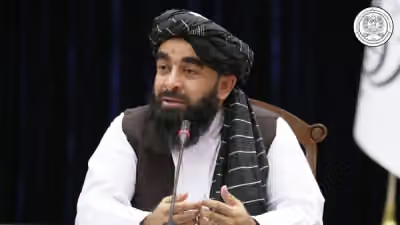

Several Afghan activists in an open letter urged leaders around the world to exert diplomatic pressure on Taliban officials to reopen secondary school for girls in Afghanistan.
The letter sought world leaders, regional allies, and international organizations to take coordinated and bold action to uphold their commitments to support the rights of Afghan girls.
They said, "What we are asking for is more than a declaration of solidarity or a moment of silence to condemn the Taliban." The group has demanded immediate financial support for the educational system in Afghanistan, funding for human rights and civil society organizations, and the development of alternative mechanisms for the education of girls in Afghanistan.
After the takeover of Afghanistan on August 15, 2021, the Taliban stopped secondary education for girls in Afghanistan. It has been 300 days since secondary school for girls stopped operations across the country.
Despite the international community's pressures on the Taliban, the group has not responded positively to the reopening of girls' schools yet.

Sardar Wali Saqib, one of the Salafist clerics and an instructor at the Narinj Bagh seminary in Jalalabad city, was killed in Kabul on Wednesday. The Taliban's Ministry of Interior confirmed the murder and said that Saqib was killed by unidentified men in district 5 of Kabul.
So far, no person or group has taken responsibility for the murder of Saqib. However, Salafist clerics, who are said to have similar religious views as that of Islamic State of Iraq and Syria (ISIS), have been mysteriously killed in the eastern provinces, especially Nangarhar.
Earlier, the Taliban had been blamed for being involved in the killing of Salafi clerics. However, Saqib had pledged allegiance to the Taliban leadership. Taliban officials in Nangarhar say that Saqib was killed by circles that want to create rifts between the Taliban and Salafi clerics.
Sardar Wali Saqib had gained fame as a religious scholar in the eastern provinces of Afghanistan.

The International Committee of the Red Cross Afghanistan (ICRC) has announced that the price of wheat flour in Afghanistan has increased by 68 percent. According to ICRC, drought and restrictions on the export of wheat from Kazakhstan are the main causes of the price hike.
Kazakhstan, the main exporter of wheat to Afghanistan, has imposed restrictions on its exports due to the war in Ukraine.
According to the ICRC Afghanistan, hundreds of thousands of Afghan citizens are unemployed due to food insecurity and inflation in the country. Reports show that drought has also affected the production of wheat inside Afghanistan.
The increase in the price of basic food items due to the low production of agricultural products, such as wheat, has limited people's access to food.
The war in Ukraine has also affected prices of food items in the Afghan market.
According to the statistics of ICRC, since June 2021, the price of wheat flour has increased by 68%, edible oil by 55%, fertilizer by 107%, and fuel such as diesel by 93% inside Afghanistan.

At least 39 people, including nine children, have been killed since July 5, across five provinces, due to flash flooding in Afghanistan, as per the UN Office for the Coordination of Humanitarian Affairs (OCHA).
Incidences of flash flooding increased in the past week with in the east, south, south-east, and central regions of the country. The heavy rains have damaged or destroyed around 2,900 houses, a tenfold increase since the last reporting period, and also disrupted livelihoods.
OCHA said that the affected families need emergency shelter, non-food items, food and water, sanitation, and hygiene support.
Critical civilian infrastructure such as roads and bridges have also been impacted. The rains have caused land to slide, exposing unexploded ordnance from four decades of war and conflict, which are transported into several villages of Paktia. This risk will increase as heavy rains continue, OCHA said. Reportedly, the controlled explosions of the mines helped prevent further casualties, OCHA said.
Twenty people have been reported dead in Uruzgan; six in Ghazni; seven in Nuristan; three in Paktia and three in Zabul.

Nasser Kanaani, the Iranian Foreign Ministry’s spokesperson, said on Wednesday that Tehran expects Kabul to ensure security of borders inside Afghanistan.
During a press conference, Kanaani said that they had asked the Taliban to provide a positive response to Iran’s efforts of holding joint meetings in order to provide security at the borders between the two countries.
He added that currently talks with the Taliban regarding border security is in progress. Without divulging details, Kanaani also announced that presently both the countries are discussing an agreement of cooperation.
He emphasized that the border areas should have an atmosphere of peace and friendship, based on the interests of both the countries.
Recently, Taliban members have been involved in clashes with Iranian border guards several times over the past few months. Earlier, an Iranian border guard had been killed too during such a clash. The Iranian government had announced that their border guard was killed by armed rebels, but credible sources had said that he lost his life in a clash with Taliban forces.