Taliban Claims Arrest of IS-K Suicide Bomber in Kabul

Taliban’s General Directorate of intelligence (GDI) said that an Islamic State-Khurasan (IS-K) member who intended to commit a suicide attack on a Shia mosque in Kabul, has been arrested.

Taliban’s General Directorate of intelligence (GDI) said that an Islamic State-Khurasan (IS-K) member who intended to commit a suicide attack on a Shia mosque in Kabul, has been arrested.
The GDI, published a video of the IS-K member depicting that he was advertising for IS-K on social media under the alias Abu Khalid.
The IS-K member introduced himself as Ziaullah from Paghman district of Kabul province in the video. He confessed that he was arrested by the Taliban intelligence agency before conducting an attack on a Shia Mosque.
Zaiullah said that he was recruited by IS-K through Telegram communication app.
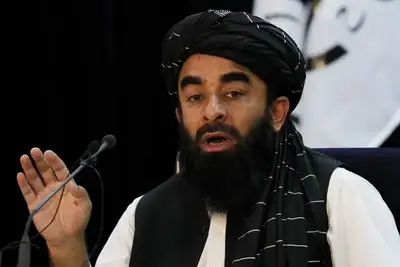

United Nations Assistance Mission in Afghanistan (UNAMA) stated that human rights violations must be investigated especially with respect to two of the Taliban’s bodies – Ministry of Propagation of Virtue and Prevention of Vice and General Directorate of Intelligence (GDI).
Detailing the findings, UNAMA’s scathing report on Wednesday stated that many of the directives issued by these two bodies limit the human rights and freedoms of Afghans, in particular women and girls.
The report also stated that officials of the GDI have been involved in perpetrating human rights violations against individuals in their custody, including extrajudicial killings, torture, and ill-treatment, as well as arbitrary arrests and detentions. The report recounted 217 instances of cruel, inhuman and degrading punishments carried out by the Taliban since 15 August 2021 and 118 instances of excessive use of force by the group between 15 August 2021 and 15 June 2022.
UNAMA stated that the Taliban must investigate these violations, perpetrators held accountable, and ultimately, incidents should be prevented from reoccurring in the future. “It is beyond time for all Afghans to be able to live in peace and rebuild their lives after 20 years of armed conflict. Our monitoring reveals that despite the improved security situation since 15 August, the people of Afghanistan, in particular women and girls, are deprived of the full enjoyment of their human rights,” said Markus Potzel, Acting Secretary-General’s Special Representative for Afghanistan.
The report also detailed extrajudicial killings of individuals accused of affiliation with armed groups, as well as cruel, inhuman, and degrading punishments and extrajudicial killings of individuals accused of “moral” crimes and the excessive use of force by Taliban officials. At least 160 extrajudicial killings, 178 arbitrary arrests and detentions of former ANDSF and government have been reported despite the announcement of a general amnesty by the Taliban.
At least 18 extrajudicial killings, 54 instances of torture and ill-treatment and 113 instances of arbitrary arrest and detention have been reported of individuals accused of affiliation with self-identified “National Resistance Front”, stated UNAMA.
The report added that the erosion of women’s rights has been one of the most notable aspects of the Taliban to date. Since 15 August, women and girls have progressively had their rights to fully participate in education, the workplace and other aspects of public and daily life restricted and in many cases completely taken away.
“The education and participation of women and girls in public life is fundamental to any modern society. The relegation of women and girls to the home denies Afghanistan the benefit of the significant contributions they have to offer. Education for all is not only a basic human right, it is the key to progress and development of a nation,” said the UN envoy.
On the issues of freedom of speech, the report said that in the 10 months since the Taliban took control of Afghanistan, the group has limited dissent by cracking down on protests and curbing media freedoms, including the arbitrary arrest of journalists, protestors and civil society activists and the issuing of restrictions on media outlets. Human rights violations also affected 173 journalists and media workers, 163 of which were attributed to the Taliban, stated the UNAMA report.
The report also said that despite an overall, significant reduction in armed violence, between mid-August 2021 and mid-June 2022, UNAMA recorded 2106 civilian casualties (700 killed, 1406 wounded). The majority of civilian casualties were attributed to targeted attacks by the armed group self-identified “Islamic State in Iraq and the Levant – Khorasan Province” against ethnic and religious minority communities in places where they go to school, worship and go about their daily lives.
UNAMA stated that the human rights situation has been exacerbated by a nationwide economic, financial and humanitarian crisis of unprecedented scale. It called on the international community to continue its support for the people of Afghanistan by ensuring that urgent humanitarian and basic needs are met. Further, it stated that the international community has an obligation to ensure that sanctions, while they remain in place, do not have a negative impact on human rights.

The United Nations High Commissioner for Refugees (UNHCR) stated in a report that 65 per cent of all Afghan refugees who had recently entered Iran have been deported by the Iranian government.
UNHCR in its latest report on Afghan refugees in Iran, called on Tehran to restart the Census process for the Afghans who have been left out of this programme. The organization added that they had advised Iran not to deport Afghans who have fled the war, but it continues to do so.
The Iranian government had started distributing temporary residence documents to Afghan refugees in April. This process was completed on June 30th and the interior ministry of Iran had announced that the programme will not be extended further.
UNHCR quoted the Iranian government as saying that between 500,000 to 1,000,000 Afghan refugees have entered Iran in 2021. This organization said that the social and economic conditions in Afghanistan has caused Afghans to continue to immigrate to Iran in 2022.
The UNHCR estimates that 274,000 Afghans who recently entered Iran, including those who went to the country in 2021, will remain in Iran till the end of 2022.
UNHCR added that till the end of June, the return of 173 Afghan refugees had been facilitated. “This shows a 75 percent decrease as compared to 706 returnees during the same period in 2021,” said UNHCR.
The organization added that instability and the fragile security situation in Afghanistan have reduced the interest of Afghans to return to their country.

Local sources report that Taliban fighters killed a young man named Mozamel Ayar Nikzad in Nijrab district of Kapisa province on Monday night, July 18. Residents said that Nikzad, who left home to go to his farm around 10:00pm, was shot at by the Taliban.
It has been reported that he was a member of the Afghanistan National Army in the previous government.
According to human rights organizations, despite the Taliban’s general amnesty announcement after their takeover on August 15, 2021, there have been many arbitrary killings in Panjshir and other northern provinces of Afghanistan.

The International Committee of the Red Cross (ICRC) announced on Tuesday that 19.6 million people in Afghanistan face acute food insecurity. In a tweet, ICRC also confirmed the dramatic soaring of prices in the country.
According to the organization, the price of wheat flour has increased by 68 percent, cooking oil by 55 percent, diesel fuel by 93 percent, and fertilizer by 107 percent.
After the fall of the republic government in Afghanistan, a severe economic crisis has plagued Afghan citizens.
The spike in food prices along with the increase in poverty and unemployment has made life difficult for most Afghans across the country.
According to a United Nations survey, about 97% of Afghan people are struggling with poverty and hunger in Afghanistan.

A group of women protestors sought justice for the woman who is said to have been arbitrarily killed by the Taliban on Sunday, July 17.
Protestors called for the end of civilian killings in Panjshir. The protestors had gathered at an undisclosed location in order to maintain their security and stated that women and girls in Panjshir have no protection.
According to their statement, the Taliban has not fulfilled its promise to provide security and members of this group are acting arbitrarily in Panjshir and other provinces.
The statement added that “people aren’t raising their voice as they fear they might lose their lives”.
Protestors called “these crimes” shameful and said that supporting Taliban is a crime against humanity.