25 Afghan Military Officers Return to Kabul from India, Says Taliban MoD

The Taliban Ministry of Defense (MoD) announced on Friday that 25 military officers of the former government who got military training in India have returned to Kabul.

The Taliban Ministry of Defense (MoD) announced on Friday that 25 military officers of the former government who got military training in India have returned to Kabul.
According to the Taliban MoD, these military officers have completed an 18-month training course at the Indian Military Academy.
Taliban officials welcomed these officers at Kabul airport.
Earlier, Farid Mamundzay, Afghanistan's ambassador to New Delhi, said that 43 Afghan military officers had graduated from the Indian Military Academy, Dehradun in India.
The Ministry of Defense of the Taliban said that they had encouraged these military officers to return to Afghanistan.
The return of military officers comes at a time when watchdog groups and the United Nations, confirmed that the Taliban has killed dozens of military personnel of the former government in cold-blood and detained and tortured dozens of others.
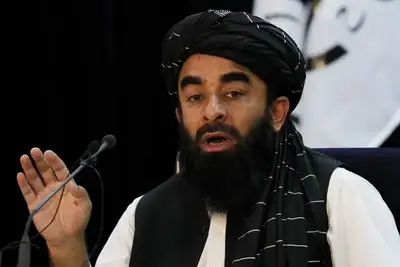

Three persons were injured after Taliban forces opened fire at houses of civilians in Abedak village of Salang district in Parwan province, local sources told Afghanistan International.
The firing started at around 8:00pm on July 28 and as a result, a 30-year-old woman, a 17-year-old girl, and a 17-year-old boy were injured. They were transferred to the Emergency hospital in Kabul.
Local sources told Afghanistan International that a Taliban unit, called “Laghmani Unit” came to Dara Orti of Salang district and warned people not to leave their houses.
“Later, forces of this unit went to the mountains and opened fire at every window from where lights could be seen switched on or if anyone was spotted moving around," sources said.
Taliban has not yet commented on this matter.

Shanghai Cooperation Organization (SCO) foreign ministers’ meeting began on Friday, in Tashkent, Uzbekistan. The meeting will last for two days and the participants include foreign ministers of China, India, Pakistan, Kazakhstan, Russia, Kyrgyzstan, Tajikistan, and Uzbekistan.
It is expected that SCO foreign ministers will discuss important regional and international issues and approve the decisions that are to be presented at the summit of the heads of state of the Shanghai Cooperation Organization in September.
There will be one-on-one meetings of the foreign ministers of the SCO on the sidelines of the event.
Amir Khan Muttaqi, the Acting Minister of Foreign Affairs of the Taliban, who went to Uzbekistan last week to participate in the international meeting in Tashkent, has not returned to Kabul.
Muttaqi met with the foreign ministers of Pakistan and China in the past few days.

With the promise of a place in the power structures of Afghanistan, Zamir Kabulov, Russian President’s Special Envoy for Afghanistan, offers Ahmad Massoud, leader of National Resistance Front (NRF), a chance to hold talks with the Taliban.
Kabulov, during a press conference on Thursday, said that if Massoud is ready, he can probably play a role in the power structure. He, however, added that to reach an agreement, the resistance must be stopped.
According to Kommersant Newspaper, Kabulov stressed that any attempt to support the armed opposition means the resumption of civil war on an ethnic-political basis. He said that Russia does not support such approaches.
These statements were made while there were reports that Ahmad Massoud and the Taliban held meetings in Moscow.
Increase in IS-K fighters in Afghanistan
Kabulov also said that the number of Islamic State-Khurasan (IS-K) fighters in Afghanistan has increased.
He said that since the Taliban took over power in August 2021, the number of ISIS fighters in Afghanistan has tripled. Kabulov added that in the past year, this number has reached 6,000.
Kabulov stated that the rise of ISIS fighters is "the most negative aspect of the current situation in Afghanistan”.
He said that this situation poses a threat not only to Afghanistan, but also to the national interests of Russia's partners such as Iran, Pakistan, and China.
According to Kabulov, as a result of the sanctions, the Taliban does not have enough financial resources to increase the ability of its forces to fight against terrorists.

Iranian President Ebrahim Raisi ordered the Ministers of Foreign Affairs and Energy of Iran on Wednesday to follow up on Iran's water rights of the Helmand river.
Raisi emphasized during the meeting of the Council of Ministers of Iran that the Islamic Republic will not fail in any way in pursuing the "rights of the nation".
The office of the Iranian President said in a statement that Raisi instructed the relevant ministries to seriously pursue alternate ways of supplying drinking and agricultural water to the people of Sistan and Balochistan province.
Officials of the Islamic Republic of Iran insist on the country's water rights from the Helmand river, while the Taliban have continuously said that according to the agreement between Afghanistan and Iran, Iran's annual water rights have been given.
Earlier, Ali Akbar Mehrabian, Minister of Energy of Iran, said that the Taliban has only verbally promised to fulfil the country's water rights.
Mehrabian told reporters that he will personally start negotiations with Taliban to fulfil Iran's water rights when he comes to Afghanistan.
Iran's Crisis Management Organisation had previously said that the country is vulnerable in the water sector and there is no safe water in Iran, except the sea.
Iran's water rights have always been a source of tension between Tehran and Kabul. Under the Taliban’s reign in the past year, the two countries have even witnessed armed clashes over water issues.

Qari Fasihuddin Fitrat, Taliban’s Chief of Staff of Army, headed a military delegation to Balkhab district of Sar-e-Pul province. The Ministry of Defense of Taliban said that the delegation visit has been scheduled for assessment of the security situation of Balkhab district.
The Ministry of Defense of the Taliban reported that Mawlawi Muzamal and Mawlawi Najibullah, the deputy of the Ministry of Interior and the General Directorate of Intelligence of the Taliban, were also part of the military delegation.
In late July, the Taliban sent thousands of military forces to suppress Mawlawi Mahdi, the only Hazara commander of the group, to Balkhab district of Sar-e-Pul province. Three days after the fierce fighting in Balkhab, the pro-Mahdi forces fled from the district.
The United Nations Office for the Coordination of Humanitarian Aid for Afghanistan (OCHA) announced that at least 27,000 people have been displaced as a result of the three-day war in Balkhab.
Human Rights organizations reported that the Taliban have shot civilians, set people's houses on fire, and killed prisoners in Balkhab district.