
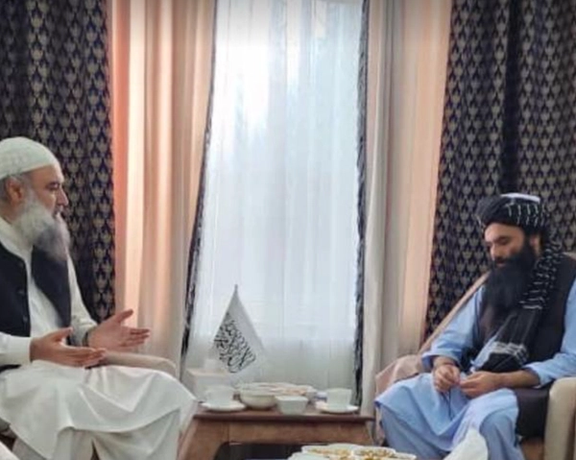
Mutasim Agha Jan, a disgruntled Taliban leader, has met with Sirajuddin Haqqani, the group’s interior minister. The Taliban has not released details of the meeting and it is not clear what the leaders of the group have discussed.
Agha Jan returned to Kabul along with Mullah Yaqoob, the Taliban's defense minister on December 8.
He was the head of the Taliban's political committee and was the target of a failed assassination attempt in Pakistan in 2011 as a result of differences among the Taliban.
Since then he has lived in Turkey and United Arab Emirates (UAE).
It is not clear as to why Agha Jan has returned to Kabul.
After the Taliban’s takeover of Afghanistan in 2021, there have been many reports about the group’s internal differences between the Haqqanis and the Kandahari Taliban.
The Taliban have continuously tried to keep the details of these differences from leaking outside the group’s inner circles. But in the latest case, hundreds of Kandahari Taliban have left Helmand and returned to Kandahar due to group differences and dissatisfaction.
Some observers believe that Agha Jan has returned to Kabul to resolve these internal differences.
Sources told Afghanistan International that Iran has replaced Bahadur Aminian, the country’s ambassador to Kabul. The change in Tehran’s ambassador in Kabul comes weeks after Aminian’s controversial speech about the Taliban and Afghanistan had been leaked.
After Afghanistan International published his speech, Aminian has not been seen in Kabul and Iran’s deputy ambassador in Afghanistan has been in charge of the embassy’s operations.
Last month, a hacker group got access to an internal Fars News Agency bulletin and published the full text of its findings on a Telegram channel.
A part of these files was the transcript of the speech of Bahadur Aminian, the ambassador of the Islamic Republic of Afghanistan, in a small gathering in Tehran. Aminian had said that if his conversations would get published in the media and reached the Taliban, he would not be able to return to Kabul.
In that speech, the ambassador of the Islamic Republic of Iran had described the Taliban as a disaster that is unacceptable, embarrassing, and subversive, but at the same time, he had emphasised that the Islamic Republic has no choice but to work with them and support them.
He compared the Taliban, which, according to reports, came to power in Afghanistan with the extensive financial and military support of Iran, with the Mongol army, and suggested that the Islamic Republic must treat them like the Mongols so that they become civilised.
The text of Aminian’s speech had been published by Afghanistan International.
The Embassy of the Islamic Republic of Iran in Kabul reacted immediately and confirmed the main source of the news publication, but called publishing the news as biased.
The last time Aminian had been seen in Kabul was in a meeting with Hamid Karzai, three days before the news of his speech was published. Hasan Mortazavi, the deputy ambassador of the Islamic Republic, has been running the affairs of the embassy and has been meeting with the Taliban officials over the last two weeks.
During the past week, it has been reported that Hassan Kazemi Qomi, Iran’s special envoy for Afghanistan, has replaced Aminian as the new Ambassador of Tehran in Kabul. However, the Ministry of Foreign Affairs of Iran reacted to these rumors and announced that Qomi will continue to work as the special envoy in Afghanistan affairs.
Russian foreign ministry in a statement strongly condemned the recent ISIS attack on Chinese citizens in Kabul. In this statement, Moscow urged the Taliban to guarantee the safety of foreign citizens and take decisive measures in the fight against ISIS.
Russia said that according to their information, at least five people had been killed and 30 others, including five Chinese citizens, had been injured in the attack.
The Ministry of Foreign Affairs of Russia stressed that joint and coordinated action of the international community is necessary to eradicate terrorist threats from Afghanistan.
Earlier, the Russian embassy had been attacked in Kabul which killed two senior diplomats of the country too. ISIS had claimed responsibility for the attack.
ISIS had previously said that the Taliban is not capable of providing security for embassies in Afghanistan.
The group also attacked the Charge d'Affaires of the Pakistani embassy in Kabul. He was not harmed in the attack, but his bodyguard was seriously injured.
As the ISIS attacks increased on foreign targets in Afghanistan, Russia suspended its consular services in Afghanistan, Pakistan pulled out its ambassador, and China has asked its citizens to leave Afghanistan.
Pakistan's Foreign Minister, Bilawal Bhutto Zardari, said on Thursday in New York that the recent border skirmish between the Taliban and Pakistani forces will not change Islamabad's policy towards the group. He said that sanctions on the Taliban will not be effective.
Bhutto was in New York to attend the meeting of foreign ministers of the Group of 77, a coalition of developing countries within the framework of the United Nations. The meeting is focused on the development and climate issues of the member countries.
In a press conference at the UN headquarters, Bhutto said that the Taliban's policies towards women and border clashes with Pakistan, will not result in a reduction of the level of relations with the group.
Pakistan’s foreign minister added, "Not only Pakistan, but also other countries of the world should interact with the Taliban. We cannot ignore the Taliban; they are part of the reality. However, we must reconsider our interaction, especially in relation to the issue of the Pakistani Taliban and our expectations from them.”
He criticised the western countries for trying to change the Taliban's policy towards women and the formation of an inclusive government through economic and banking sanctions.
Bhutto said, "We cannot impose hunger on Afghans to make them believe in empowering women."
He added that the economic situation of Afghanistan is dire and the political atmosphere to change the behavior of the Taliban has not been created.
Pakistan's foreign minister admitted that following the ISIS attack on the Pakistani embassy in Kabul, security conditions are not favourable for the activities of the Pakistani diplomatic delegation in Kabul.
Bhutto said that he had not recalled the Pakistani chief of mission in Kabul to Islamabad, but added that whenever the Taliban addresses Pakistan's security concerns, he will return to Kabul.
Pakistan announced that the country's chief of mission in Afghanistan, will not return to Kabul until security of its citizens has been ensured. Pakistan’s foreign ministry spokesperson said that Islamabad wants to ensure the security of its diplomats and its embassy in Kabul.
Obaid ur Rehman Nizamani, the chief of mission of Pakistan in Kabul had been targeted in Kabul on December 2 and is currently in Pakistan.
The Pakistani Express Tribune newspaper quoted the spokesperson of Pakistan's Foreign Ministry as saying, "Until security is guaranteed, he will stay here."
ISIS had claimed responsibility for the attack on the Pakistani embassy in Kabul and a week after the attack, it released pictures of the group’s snipers, who targeted Nizamani.
However, Pakistani officials said that they would conduct an investigation into the perpetrators of the attack.
Hours after the attack, the Taliban had announced that they had arrested a suspect in connection with the attack. Earlier, the Pakistani embassy in Kabul announced that it will continue operations in Afghanistan.
Taliban publicly flogged 12 people, including a woman, on various charges in Firozkoh city, the capital of Ghor province. Abdul Wahid Hamas, a spokesperson for the Taliban governor in Ghor, said that these people have been punished for "theft and sexual relations".
In the last two months, the Taliban has resumed punishing Afghan citizens through radical practices and many believe that the group has returned to their 1990s era.
In recent months, the Taliban have flogged several Afghan citizens in different parts of Afghanistan.
The Taliban’s implementation of punishment such as execution in public has been widely condemned internationally.
The Taliban announced on Wednesday that the group members have publicly flogged 27 people, including two women, on various charges in Helmand and Zabul provinces.