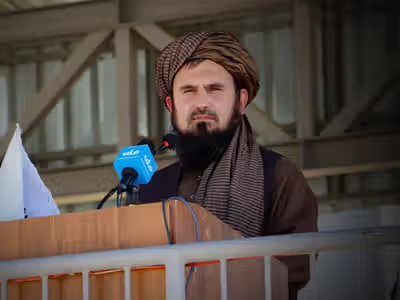
Afghanistan Facing Severe Drought, Says Taliban PM

Mawlawi Abdul Kabir, acting Prime Minister of the Taliban, said that the people of Afghanistan are facing serious problems due to severe drought.

Mawlawi Abdul Kabir, acting Prime Minister of the Taliban, said that the people of Afghanistan are facing serious problems due to severe drought.
During a meeting with Abdul Latif Mansoor, the group’s minister of water and energy on Tuesday, the Taliban acting prime minister said that the water level has decreased in most of the cities and other areas of Afghanistan.
Taliban’s acting prime minister has remarked about the severe drought in Afghanistan while over 200 members of the Iranian parliament have asked for the water rights of Iran from the Helmand River.
These Iranian members of the parliament on Tuesday in a joint statement emphasised that any obstruction to providing water rights is a “violation of Iran nation’s right and is against international laws”.
These parliament members asked for a quick flow of Helmand water toward Iran.
However, the Taliban’s response has been that there is not enough water in Afghanistan.
In the meeting with Abdul Kabir, the Taliban’s minister of energy and water, said that the group is committed to all agreements about the water issues.
The Taliban prime minister’s office in a statement said that Abdul Kabir has stressed on long and short-term programmes to address the drought in Afghanistan.


Hedayatullah Badri, acting governor of the Taliban-controlled Central Bank on Tuesday, claimed that agreements have been signed with international companies for printing new banknotes.
He did not provide further details about these international companies.
British, Polish, and French companies were printing Afghani banknotes earlier.
Following complaints from Afghan citizens regarding the old Afghani banknotes, the United States agreed to print banknotes worth 10 billion Afghanis through a Polish company and transferred that to the Central Bank of Afghanistan.
The printing costs of these banknotes have been paid from Afghanistan’s central bank reserves that is based in Switzerland under the control of the US and Swiss authorities.
Senior Taliban officials are on the blacklist of the UN and have remained under sanctions and aren’t allowed to travel outside Afghanistan. On the other hand, no country has recognised the Taliban government as the legitimate Afghan government. Nonetheless, it is not clear which countries and which companies have reached an agreement with the Taliban over the printing of Afghani banknotes.
The acting governor of the Taliban-controlled Central Bank in a meeting with the Taliban’s acting prime minister once again claimed that as a result of the Central Bank’s policies, the value of Afghanistan’s currency has remained stable.

Despite criticism from Afghans, Norway's Foreign Ministry has once again invited a Taliban delegation to attend a forum on how to resolve conflicts through dialogue in Oslo.
Sources said that Norway has invited low-ranking Taliban officials instead of senior officials of the group, who they had invited in 2022, to Oslo.
In addition to the Taliban officials, other Afghan politicians and activists along with participants from various backgrounds and different parts of the world are also present at the Oslo Freedom Forum, which has been held with the support of the Ministry of Foreign Affairs of Norway.
Public pressure has pushed the Norwegian Foreign Ministry not to invite senior Taliban leaders to the Oslo Forum and instead, the Taliban participants include Abdul Qahar Balkhi, the spokesman of the Taliban Foreign Ministry, and other officials from the Ministry of Interior and the Ministry of Defence of the group.
The presence of Taliban officials at the Oslo Freedom Forum has once again provoked protests from Afghans.
Earlier, Mina Rafiq, Afghan women’s rights activist, protested against the presence of Taliban officials in the Oslo meeting, in front of Norway’s foreign ministry.
On Tuesday, the Afghan Women's Political Participation Network also criticised the presence of the Taliban at the Oslo Forum. The network said in a statement that Norway has welcomed human rights violators who have deprived Afghan women of education, work, and other social activities.
The network has accused Norway of supporting "a terrorist group" by hosting Taliban officials.
The presence of Taliban officials at the Oslo meeting has also been criticised by Afghan citizens on social media.

Shahabuddin Delawar, the Taliban’s Minister of Mines and Petroleum, urged the Chinese contractor of Aynak copper mine to start the extraction process.
However, the Chinese company has stated that the extraction of the Aynak copper mine will start after the transfer of ancient artefacts from the mining site.
The Chinese company, MCC, won the Aynak copper mining contract in May 2007, but since then, they have refused to extract the mine due to "security reasons and the presence of ancient artefacts in the mining area".
During a meeting with the Chinese contractor, Delawar has that the Taliban’s Ministry of Mines and Petroleum has fulfilled its responsibilities according to the contractual agreement and stressed that the Chinese company should not delay the extraction process.
Delawar added that a committee with representatives of the Taliban’s Ministry of Mines and Petroleum, the Ministry of Information and Culture, and the Chinese MCC Company has been formed to transfer the ancient artefacts from Mes Aynak.
Earlier, in a meeting with Mullah Baradar, the Taliban’s deputy prime minister for economic affairs, the Chinese contractor representatives had said that after the complete transfer of the artefacts of the Aynak copper mine area, they will start the extraction process.
The Taliban’s Ministry of Information and Culture, too, said that the ministry has been prepared to transfer these artifacts.
According to the Taliban’s Ministry of Mines and Petroleum, the Chinese company has also promised to provide support for 300 families living in the area where the Aynak copper mine is located.

Local sources in Herat said that Taliban members “shot dead” three young men in this province. According to the sources, Taliban members apparently killed them after accusing them of rape and murder of a pregnant woman and her two children.
Sources said that Taliban members shot these three men on Tuesday afternoon in Zawal area in the south of Herat.
While executing these three people, Taliban didn’t provide details officially, but local sources said that the accused stormed into the house of the murdered woman on Saturday, gang-raped her and then, killed her and her two children.
There is not much information available regarding the trial these accused underwent or what kind of court the Taliban brought them to in less than three days.
Since the takeover of the power by the Taliban, the group has punished a lot of people as they are emphasising on implementing the “Sharia”.
However, the human rights organisations repeatedly criticise that the Taliban does not provide access to a fair trial.
Before this, the Taliban often has been accused of holding drumhead court-martial. Pictures from such courts have been circulated on social media several times and provoked criticism from human rights organisations.

According to a confidential document obtained by Edalat-e Ali (Ali's Justice), a hacktivist group, Tehran had been worried about the consequences of its negotiations with the Taliban before the fall of the former government in August 2021.
The document stated that one of the reasons behind the negotiations with the Taliban was to “determine the position of” Shia groups in Afghanistan.
The document reviewed by Afghanistan International had been issued by the National Security Council of Iran during a meeting of representatives of various Iranian government agencies held on January 9, 2017. In the meeting, the Islamic Republic’s stance was communicated with these agencies after the officials admitted to holding negotiations with the Taliban at Iran’s deputy foreign minister level.
In the document, it had been stated that the Islamic Republic officials were worried about the reaction of the people of Iran and the Shia communities of Afghanistan to Tehran's negotiations with the anti-Shia insurgent group.
Tehran admitted to its negotiations with the Taliban at a senior level after Ali Shamkhani, the Secretary of the National Security Council of Iran visited Kabul in December 2018. The Ministry of Foreign Affairs of Iran announced on December 31, 2018, that a delegation from the Taliban had met Abbas Araghchi, the political deputy of the Iranian Foreign Minister at the time, in Tehran. Photos of the meeting of Javad Zarif, Iran's then foreign minister, with Mullah Baradar and other senior Taliban officials, had also been published.
In the document of the Security Council of Iran, it had been stated that the Ministry of Foreign Affairs and the propaganda organisation of the Islamic Republic in Iran and Afghanistan had been asked to "curate a public opinion inside Afghanistan, especially for the Shia communities of the country, particularly the Fatemiyoun group, that negotiating with the Taliban didn’t mean that it was legitimising the group in Afghanistan”.
According to the document, officials of the Islamic Republic present during the meeting had expressed concerns about the presence of non-Shia refugees in Iran and stressed that having not deported these Sunni refugees in 2017 was an "irresponsible act" of the government of Iran.
The document stated that Iranian officials present at the meeting of the National Security Council believed that if the Taliban would take control of Afghanistan and be considered a legitimate group, the relations between the Afghan Sunni refugees in Iran and the Taliban would be dangerous. Therefore, in the meeting, it had been emphasised that “in media policies the Taliban should not be given importance as it would be in the interest and security of the Islamic Republic”.
In this document, it has been stated that in order to sway the public opinion inside Iran in favour of the government, it should be conveyed that the negotiations with the Taliban contribute to the "national interests and security" of the Islamic Republic.
Following the bloody border skirmish with the Taliban and the group's refusal to comply with Iran's demands, many people and domestic media outlets of Iran have criticised the Islamic Republic's policy and optimistic approach towards the Taliban and consider these policies as a failure.
In the document, it has been further emphasised that the Islamic Republic has started negotiations with the Taliban to "support peace and security in Afghanistan". However, before the fall of Kabul, the American and Afghan authorities had accused the Islamic Republic of providing "weapons and military equipment" to the Taliban.