• العربية
  • پښتو
  • فارسی
Brand
  • Afghanistan
  • Sport
  • Markets
  • Afghanistan
  • Sport
  • Markets
  • Theme
  • Language
    • العربية
    • پښتو
    • فارسی
  • Afghanistan
  • Sport
  • Markets
All rights reserved for Volant Media UK Limited
volant media logo

Iran’s Interior Minister Says Taliban Acquainted With Border Issues

Jun 17, 2023, 14:26 GMT+1

Ahmad Vahidi, the Minister of Interior of Iran, said that negotiations with the Taliban officials regarding border issues had been held. According to ISNA, Vahidi added, "The Taliban has been acquainted with the problems and our borders are calm and open to traffic."

Iranian interior minister stressed that Iranian border guards are strong and decisive in performing their duties. However, he said that if the other side at the joint borders do not have a strong security system in place, the borders will face problems.

Iran's interior minister added, "Of course, the various cases that have occurred have been strongly dealt with, and security has been maintained at the borders. So, there are no problems with the borders of our country."

He said that the terrorists have been looking to infiltrate the borders, but they should know that they will be punished for their actions.

Vahidi said that during the negotiation with the Taliban, they were warned to clarify border issues to their people. He said, "Our border units strongly defend national interests and do not allow anyone to violate the borders.”

Earlier in May, as a result of the border skirmishes between Taliban forces and Iranian border guards in Kong area of Nimroz province, two Iranian border guards and a Taliban fighter had been killed.

Since the Taliban’s takeover of Afghanistan in August 2021, except for scattered clashes, the latest border skirmish had been unprecedented in terms of the use of heavy weapons between the Taliban and Iranian border guards.

The border skirmish took place when tensions between the Taliban and Tehran had been high on the water rights issue from the Helmand River.

Most Viewed

Pakistani Islamist Leader Calls For Reopening Afghan Border Crossings
1

Pakistani Islamist Leader Calls For Reopening Afghan Border Crossings

2

Afghanistan Faces Trade Crisis Due To Pak Border Closure & Hormuz Tensions

3

Taliban Using Administrative Excuses To Shutdown Afghan Media, Says Watchdog

4

Taliban Impose Music Restrictions On Visitors To Nuristan

5

Moscow Supports Conditional Extension Of UN Mission In Afghanistan

•
•
•

More Stories

Russia Accuses Australia of Covering Up War Crimes Of Troops In Afghanistan

Jun 17, 2023, 13:19 GMT+1

Maria Zakharova, the Russian foreign ministry spokesperson, has said that the Australian authorities have been trying in every possible manner to hide the "war crimes" of their soldiers in Afghanistan.

According to Zakharova, Australia criticises other countries regardless of their own problems.

Zakharova quoted a Russian diplomat as saying that new data on "Australian war crimes" showed that "this is an institutional and deeply rooted issue".

These statements have been made while Ben Roberts Smith, Australia’s most decorated war veteran, has been accused of "murdering four Afghans". Australian Civil Court accused the veteran of "murder" in Afghanistan.

Australian Federal Court Judge Anthony Besanko ruled that much of the information released in 2018 about the war crimes of Smith, a former Australian Special Air Force soldier, was true.

Taliban Agreed To Lack of Water Verification By Iranian Experts, Says Envoy Qomi

Jun 17, 2023, 09:29 GMT+1

Hassan Kazemi Qomi, Iran’s ambassador to Kabul, on Saturday emphasised on the water rights of Iran from the Helmand River through the 1973 water rights treaty between Iran and Afghanistan.

Qomi recalled the Taliban’s statement about the lack of water in Afghanistan’s dams and said that the Taliban have agreed that Iranian experts can visit the dams and verify these statements.

In an interview, with Seda Va Sima, Iran’s state news agency, Qomi said that the water rights issue will be pursued seriously.

According to Qomi, agreements have been made that "our experts will go to visit the area" in order to lay the groundwork for the release of water.

Qomi who also serves as Iran’s special envoy for Afghanistan, did not provide details of the Iranian experts' visit to Afghanistan.

The Taliban have not yet commented on their agreement to allow Iranian experts to visit the Helmand River.

However, Sher Mohammad Abbas Stanikzai, Deputy Foreign Minister of the Taliban, earlier told Afghanistan International that the group will not allow the officials of the Islamic Republic to visit the Kajaki Dam.

According to the Taliban official, military installations and dams are sensitive areas and the Taliban does not allow "foreign agents" to visit them.

Provinces Fell To Taliban Without Any Battle, Says Taliban’s Defence Minister

Jun 16, 2023, 15:29 GMT+1

In an interview with TOLOnews, Mullah Yaqoob, the Taliban’s Minister of Defence, said that the Taliban took control of provinces of Afghanistan without any war.

Yaqoob said that the Taliban did not intend to enter the capital, Kabul, but after former president Ashraf Ghani fled Kabul, the group’s forces entered the city on the evening of August 15, 2021.

The Taliban's Defence Minister claimed that the group’s leader had not allowed the capture of provincial capitals. However, he said when they were engaged in a battle in Lashkargah city, the Nimroz provincial capital, fell under Taliban control.

Nimroz was the first province in Afghanistan that fell to the Taliban in 2021.

Mullah Yaqoob said, "They [Taliban members] called from Nimroz province that the province has fallen, the officials all have fled to Iran with their vehicles and weapons, and the city is empty. We ordered them to move towards the provincial center and told them that even if a soldier stands in front of you, don't fight and wait." He emphasised that the soldiers of the previous government did not stand up against the group in Nimroz.

He went on to say that other provinces fell to this group one after the other without any exchange of fire.

Regarding the fall of Kabul, the Taliban’s Defence Minister said, "Our position was that we were waiting. We were working with Zabihullah Mujahid on the statement that we do not intend to fight in Kabul, and we will not enter the city by force. We told our troops to wait around Kabul city and we were voting on the decision. It was reported from Kabul that Ashraf Ghani had fled. Actually, Ashraf Ghani had gone out in the morning, and we decided to enter Kabul at night.”

Mullah Yaqoob added, "The senior officials from within the previous government said that the emirate's forces had entered Kabul city and that theft and looting were going on. I was in Kandahar and the next day, I left for Kabul."

Border conflicts

Regarding the border clashes with Iran and Pakistan, the Taliban’s Defence Minister said that the solution to border tensions is diplomacy, but in some cases, the military option is a solution. Yaqoob mentioned the construction of roads, checkpoints, and barbed wire at the Afghanistan’s joint borders with neighbouring countries as the reason for the border skirmish.

Confirming the border clashes, the Taliban’s Defence Minister added that in some cases, the border forces of Pakistan and Iran had opened fire on the movement of the public and had killed Afghans. He clarified that these countries "build roads and checkpoints or install barbed wire" in the border areas and in the territory of Afghanistan.

After regaining control of Afghanistan, the Taliban had many cases of border skirmishes with border guards of Iran and Pakistan. In the latest case, because of the gunfight between the Taliban and the border guards of the Islamic Republic in Nimroz, one Taliban member and two border guards of the Islamic Republic were killed.

US continues to occupy Afghanistan’s airspace

In his interview with TOLOnews, Mullah Yaqoob once again said that the airspace of Afghanistan is still under the "occupation" of the United States and that the airspace of Afghanistan is being violated. This Taliban official emphasised that the issue is a part of the Doha Agreement, which is being violated by the US.

Negotiations in Doha

The Taliban's defence minister spoke about the negotiations between the Taliban and the United States in Doha and said that these talks had two phases-"one side was with the Americans, and the second side was intra-Afghan negotiations”. He clarified that the Taliban believed that they would not negotiate with the Afghan side until the group reached an agreement with the United States.

Mullah Yaqoob said that the reason why the Taliban refused to talk with the representatives of the previous government of Afghanistan was "because they did not have the authority and competence, and the domestic and foreign policy [of Afghanistan] was in the hands of the Americans."

Yaqoob added that the group's agreement with the United States has annexes, but these annexes are not a confidential issue. He emphasised that these annexes have been about the technicality of the withdrawal of foreign forces or implementation of the Doha agreement.

This senior Taliban official further said that the Americans have repeatedly violated the Doha agreement.

On another issue, the Taliban's defence minister said that their engagement in war in the past 20 years had not been expensive and costly. Mullah Yaqoob said, "We could blow up an American tank which cost millions of dollars, with a yellow barrel.”

The Taliban’s Defence Minister rejected the military support of Pakistan, Iran, China, and Russia to the Taliban and said that over the last five-six years during which he has overseen the war, the group has not received any military or financial aid from these countries. He called the regional countries' support for the Taliban, a propaganda to discredit the group.

On the issue of recognition of the Taliban, the group’s defence minister expressed dissatisfaction with the world's non-recognition of the Taliban government and said that the Taliban has met the conditions set by the international community. However, Mullah Yaqoob said that some of the world's demands are problematic because they contradict the Sharia laws.

On the issue of inclusive government, Mullah Yaqoob said that the group's definition of inclusive government is different from what the world wants. He added, "The world wants us to appoint people according to their orders. In the negotiations, our position was that we would not give foreigners a chance to interfere in the internal affairs of Afghanistan. They include, how the government should be and what structure it should have, who should be in the government and who should not be, and issues such as education and freedom of expression are internal issues of Afghans.”

The Taliban’s Defence Minister also denied any differences between the group’s leaders and said that there is no division, opposition, or resistance within the Taliban.

Mullah Yaqoob also discussed the Tehreek-e-Taliban Pakistan members’ presence in Afghanistan and said that Afghanistan is a vast country with high mountains and large plains and maybe someone is hiding in the villages.

He reacted to the Pakistani authorities’ claims regarding the presence of the Tehreek-e-Taliban Pakistan in Afghanistan and said, "When the TTP operates in Islamabad and other big cities, the Pakistani government cannot prevent it and accuse us."

The Taliban's defence minister also discussed the issue of the general amnesty announced by the group and said that he had heard about the amnesty violations by the Taliban members, but he stressed that the group's senior officials and individuals had not disobeyed the amnesty order. He said, “Maybe in some areas, there has been an individual and retaliations, and we accept that such cases have been there."

Mullah Yaqoob is the son of Mullah Omar, the founding leader of the Taliban. He said that he did not meet his father for thirteen years. Mullah Yaqoob added that Mullah Omar was hiding one and a half kilometers from an American military base, which was the largest military base in southern Afghanistan.

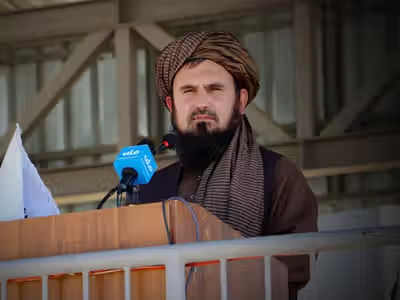
Taliban Will Be Forced To Provide Iran’s Water Rights, Says Iranian Official

Jun 16, 2023, 14:11 GMT+1

Fada Hossein Maleki, a member of the National Security Commission of Iran’s Parliament, accused the Taliban of double standard and said that the group is saying one thing at the negotiating table and something else in public.

Pointing to the earlier warning of the Iranian president to the Taliban, Maleki said that the group will be forced to provide the water rights to Iran.

Ebrahim Raisi, Iran’s president, on May 18, during a visit to Sistan and Baluchistan province of Iran warned the Taliban to give the water rights of Iran from the Helmand River. He said that the group should take the warning seriously.

In response, the Taliban announced that they are committed to the water rights agreement, but there is not enough water in Afghanistan.

After the tension between the two sides, Iranian and Taliban officials have been engaged in negotiations, however, there are no other details regarding the developments on the water rights issue.

Earlier, Hossein Amir Abdollahian, Iranian foreign minister, in an interview published on Fars New Agency, spoke about the “good results” of negotiations with the Taliban.

UN Special Rapporteur Highlights Ongoing Gender Apartheid in Afghanistan Under Taliban

Jun 16, 2023, 12:43 GMT+1

In a report, the UN Special Rapporteur on human rights in Afghanistan said that there has been widespread and systematic discrimination against women and girls in Afghanistan since the Taliban took power in 2021.

However, despite all restrictions, the report highlighted the resilience and strength of Afghan women in the face of such repressive conditions and to continue to exercise their rights through creative, peaceful initiatives.

The report expressed concern that gender persecution is occurring in Afghanistan under the Taliban which constitutes a war crime.

It added that the Taliban are severely depriving women and girls of their fundamental rights, including their rights to substantive equality, quality education, equal participation in economic, social, and political life, equality before the law, freedom from torture and other inhumane acts, freedom from discrimination and freedom of movement, peaceful assembly, and of association and expression.

It also emphasised that the Taliban is punishing those who transgress its rights-violating edicts, enforcing severe deprivation of fundamental rights through acts or crimes of violence, such as arbitrary detention, torture, or inhuman or degrading treatment.

It stressed that the Taliban had physically and sexually tortured activists protesting discrimination and exclusion of women after their arrest.

The ban on higher education and work in the first months of Taliban rule sparked protests by women in different cities in Afghanistan. By resorting to violence, however, the Taliban was able to stop the spread of women's protests.

Bennett in his report said, "Women protesters were brutally beaten. These victims were subjected to gender-based violence, including sexual violence, and torture."

Female activists were later released but did not continue their protests or leave the country despite the Taliban's increasing discrimination and violence against women.

The UN Special Rapporteur on Human Rights said women protesters were released from Taliban prisons on condition that they "give up their protest activities and remain silent about how [the Taliban] treated them as well as the payment of [the group's] money."

The report did not elaborate on the "payment" issue.

Men who protested the Taliban's policies on the streets along with women were also mistreated by the Taliban, the report said.

The report referred to the systematic discrimination against women and girls in Afghanistan by citing the relentless issuance of at least 50 edicts, decrees, declarations and directives restricting their rights.

It added that every aspect of a woman’s life is being restricted under the guise of morality and through the instrumentalisation of religion.

The report asked the Taliban to rescind all discriminatory edicts and instructions issued against women and girls since August 2021, including education and work rights and ensure equal representation and meaningful participation of women and girls.

It also urged the group to desist from committing threats of or acts of violence, including arbitrary detention, sexual abuse, or any form of torture, ill-treatment or punishment against women and girls for allegedly violating the edicts or for protesting peacefully and investigate cases of violence against women.

The report urged United Nations to maintain a commitment to the secure employment of female Afghan staff and ensure ethnic diversity; ensure women’s equal and meaningful participation in different forms of dialogue with the Taliban and continue to take concrete steps towards supporting protection from and accountability for the grave and systematic violations of women’s and girls’ human rights.

The report added women have been excluded from the Taliban's "male, mainly Pashtun" rule. “Taliban have established an entirely masculine and predominantly Pashtun government in Afghanistan and has largely driven women out of the state and society structure,” it stated.

This was while in the last government, women held 27 percent of seats in parliament, 22 percent of seats in the Senate, and 30 percent of civil service seats, and in the executive branch, independent commissions and judiciary played key roles.

It also asked other international players to ensure that the situation of human rights of women and girls in Afghanistan is central to all policy decisions and engagement with the Taliban while ensuring that there is equal and meaningful participation of Afghan women in all deliberations. It also added that stated should grant support and protection to all Afghan women and girls who are outside Afghanistan, and take measures to ensure their long-term security, including by granting them refugee, protective or regular status, facilitating their safe resettlement, and expanding the provision of educational scholarships and mental health services.