Taliban Kills Farmer For Declining To Pay Tithe (Taxes) in Kabul, Say Sources

Local sources said that Taliban fighters killed a farmer and injured his brother in Char Asiab district of Kabul for declining to pay tithe (taxes).

Local sources said that Taliban fighters killed a farmer and injured his brother in Char Asiab district of Kabul for declining to pay tithe (taxes).
An eyewitness told Afghanistan International that the man was killed by Taliban members in Eliaskhel village of Char Asiab district.
The source added that the farmer had previously paid tithe to another group of Taliban members and had a "receipt" for the payment in hand, but the Taliban members who killed him insisted that he had to pay tithe again, however, the farmer had refused to pay the tithe twice.
According to this eyewitness, the tenacity of this farmer angered the Taliban members and resulted in his killing by the group members.
The eyewitness added that the people protested against the murder of this farmer, carried his body to the Char Asiab district headquarters, and then closed the Kabul-Logar highway for two hours for traffic.
The protesters demanded the arrest and punishment of the perpetrators for shooting this farmer.
Several drivers on the Kabul-Logar highway also confirmed to Afghanistan International that the Kabul-Logar highway was closed to traffic for several hours.
The Taliban have not yet officially commented on the killing of this farmer in Kabul.
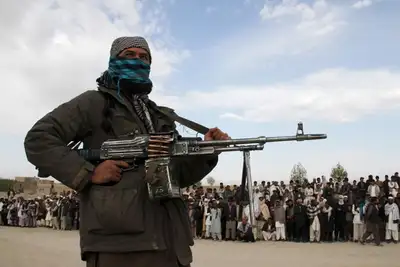

Iran’s police chief Ahmadreza Radan has announced that the Taliban has not been serious in its counter-narcotics efforts and has only issued statements about fighting drugs.
According to Radan, drug cultivation in Afghanistan has increased by 32 percent which is alarming.
On Monday, the police chief of Iran addressed a conference on countering narcotics and said that along with opium production, the increase in the production of industrial substances is another dangerous trend that indicates the rise of challenges in counter-narcotics efforts.
According to Iran's state-run news agencies, Radan urged all countries to cooperate in the fight against narcotics and offered Iran’s experience in anti-drugs efforts.
The Chief of Police of Iran, in the meantime, said that recently Pakistan has performed better in the fight against drugs.
Earlier, the United Nations Office on Drugs and Crime, in a new report announced that Afghanistan produced about 80% of the world's opium in 2022. The report stated that Afghanistan has become one of the major producers of methamphetamine in the region too.

Sources told Afghanistan International that Sibghatullah Takal, a unit commander of Taliban’s Mansoori Corps in southeastern Afghanistan, was killed during a skirmish with Pakistani border guards on Monday.
The sources added that the border skirmish took place in the Angor Ada area of Barmal district of Paktika province.
The area is located close to the Durand line near the joint borders between Afghanistan and Pakistan.
According to local sources, four other members of the Taliban were also injured during this border skirmish.
So far, the reason behind the border skirmish between the Taliban and Pakistani border forces is not clear and officials from both sides have not commented on the issue.
Some sources said that Pakistani forces have also suffered casualties during the border skirmish.
This is not the first time that Taliban and Pakistani border guards have clashed in the border areas. Earlier, the Taliban forces have also clashed with Pakistani border guards in the border areas of Kunar, Nangarhar, Paktika, and Kandahar provinces.

In a new report, United Nations Assistance Mission in Afghanistan (UNAMA) stated that between 15 August 2021 and 30 May 2023, majority of civilian casualties resulted from ISIS attacks in Afghanistan.
It added that there has been a significant increase in targeted and explosive device attacks against civilians.
At least 3,774 civilians have been killed and wounded by the attacks since the Taliban took over the country in 2021, the organisation said.
The report stressed that there has been a rise in attacks on places of worship and against the minority Hazara community.
The report also said that the number of civilian casualties as a result of IED attacks carried out by ISIL-KP significantly increased in the immediate aftermath of the Taliban takeover on 15 August 2021.
IED attacks on places of worship, mostly Shia Muslim sites, accounted for more than one-third of all civilian casualties recorded during the reporting period, the report stated.
In addition to attacks on Shia places of worship, the report said there were at least 345 (95 killed, 250 wounded) casualties as a result of attacks targeting the predominantly Shia Muslim Hazara community in schools and other educational facilities, on crowded streets and on public transportation.
"These attacks on civilians and civilian objects are reprehensible and must stop," said Fiona Frazer, chief of UNAMA's Human Rights Service.
The UN urged the Taliban to uphold their obligation to protect the right to life by carrying out independent, impartial, prompt, thorough, effective, credible, and transparent investigations into IED attacks affecting civilians.
According to the report, published on Tuesday, 1,095 people were killed and 2,679 injured in the attacks.
The UN mission also said that victims of violent attacks in Afghanistan previously did not have access to the necessary health services and support, and with the Taliban's dominance, this type of support has diminished.

Afghanistan International has accessed documents that show that the leader of the Taliban has ordered the group's cabinet to assess the plan to shut down access to Facebook in Afghanistan.
In a decree attributed to the Taliban leader Hibatullah Akhundzada, it has been stated that the Taliban’s Supreme Court should prepare this plan in coordination with the relevant Taliban agencies and submit it to the cabinet.
On June 16, the Administrative Office of the Taliban’s Prime Minister referred the decree of the Taliban leader to the group’s supreme court regarding the removal of access to Facebook in Afghanistan.
According to the letter from the Administrative Office of the Taliban’s Prime Minister, the decree of the Taliban leader said, "You [Supreme Court] should prepare a plan to limit or ban Facebook in coordination with the relevant departments."
The decree also asked relevant bodies to assess the financial costs associated with this plan.
In response to a question about the authenticity of this letter, Mohajer Farahi, Taliban’s Deputy Minister of Information and Culture, on Monday said that no decree has been issued regarding shutting down access to Facebook, but there are discussions around the issue.
Earlier, the New York Times had reported that Meta, the parent company of Facebook, is gathering information and considering a plan to block the user accounts of Taliban members on WhatsApp.
The New York Times called WhatsApp the "backbone" of the Taliban's communication system.
Since taking power in Afghanistan in August 2021, the Taliban has imposed restrictions on access to international media, such as the BBC and Voice of America in Afghanistan. The group has also banned domestic media from broadcasting entertainment programmes such as soap operas and movies.

Reporters in Logar province have said that the Taliban warned the media outlets in the province to not broadcast women’s voices or they will be punished.
Rafiullah Samim, the Taliban’s provincial director of information and culture, issued the warning to the local media outlets in Logar on Sunday during a meeting with journalists.
The meeting with journalists was attended by Rafiullah Samim, Hematullah Mohajer, the spokesperson of the group's provincial intelligence directorate, and Ikramullah spokesperson of the provincial directorate of promotion virtue and prevention of vice.
Media executives and journalists of Logar media outlets told Afghanistan International that these Taliban officials asked them to not broadcast women’s voices anymore.
According to our sources, when the media officials and journalists asked why women’s voices shouldn't be broadcast in Logar while it is being broadcast in Kabul, the Taliban officials argued that "the environment in Logar is different from Kabul".
Sources added that Taliban officials forced these media executives and journalists to sign a letter that if they continue to broadcast women’s voices, they will be severely punished.
However, the Taliban officials in Kabul and media support groups have not reacted to the Taliban’s latest restrictions on media in Logar province.