Islamic Republic Executed 61 People, Including 4 Afghans In July, Says Rights Group
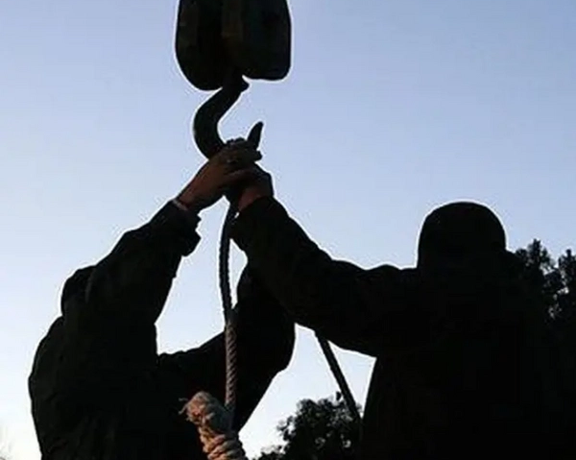
Hengaw Organisation for Human Rights announced that in July alone, at least 61 people had been executed inside Iranian prisons, four of whom had been Afghans.

Hengaw Organisation for Human Rights announced that in July alone, at least 61 people had been executed inside Iranian prisons, four of whom had been Afghans.
The rights group added that in the last two days, 11 Baluch and one Afghan citizen have been executed in Iran.
According to Hengaw, a prisoner from Behbahan was also executed on Tuesday at Shiban prison in Ahvaz city.
According to the rights group, in one of the latest cases on Tuesday, an Afghan citizen named "Masoud Ishaqzehi" was executed in connection with drug crimes in Iran.
Last month, the Islamic Republic of Iran also publicly executed two Afghans for organising the attack on the "Shah Cheragh" shrine, in Shirzad city.

Taliban’s foreign minister Amir Khan Muttaqi and Mutlaq al-Qahtani, Qatar’s special envoy for counterterrorism and mediation of conflict resolution, met in Doha.
Zia Ahmad Takal, Deputy Spokesman of the Taliban’s Foreign Ministry, said that the two sides discussed various political, economic, and commercial issues.
According to Takal, during the meeting, al-Qahtani called the current situation in Afghanistan “satisfying”.
The Qatari envoy also said that the countries of the region and the world should engage in a "constructive manner with Afghanistan and not miss the available opportunities."
So far, the Qatari foreign ministry has not released any statement about the meeting of the country’s envoy with the Taliban’s foreign minister.

Mawlawi Amir Khan Muttaqi, the Taliban’s Foreign Minister, met with special representatives and ambassadors of several countries for Afghanistan in Doha.
Muttaqi urged these representatives and ambassadors to reopen their country’s embassies in Kabul.
on Wednesday, Zia Ahmad Takal, the Taliban’s foreign ministry deputy spokesperson, announced that Muttaqi met with the ambassadors and representatives of the United Kingdom, United States, Spain, South Korea, Netherlands, Australia, and Canada.
According to Takal, the foreign minister of the Taliban asked the ambassadors to observe the ground situation closely by being present in Afghanistan.
The Taliban’s foreign minister also mentioned the achievements of the Taliban government over the last two years and claimed that the group "has achieved success despite the problems in economic and political” arenas.
Takal added that some other members of the Taliban delegation also discussed their activities with the ambassadors and representatives.
Following the fall of the Islamic Republic of Afghanistan and the country’s takeover by the Taliban, many countries shutdown their diplomatic missions in Kabul and instead operate their missions through Doha in Qatar.

Zamir Kabulov, Russia's Special Envoy for Afghanistan, announced that there is no progress in the formation of an inclusive government by the Taliban.
Kabulov told TASS news agency that the issue of the inclusiveness of the Taliban government will be on the agenda for the next Moscow meeting on Afghanistan.
He said that the meeting will be held in Kazan, Russia at the end of September.
The previous meeting of the Moscow format on Afghanistan was held in Moscow last November.
Representatives of Russia, India, Iran, Kazakhstan, Kyrgyzstan, China, Pakistan, Tajikistan, Turkmenistan, and Uzbekistan had been present during the last Moscow format meeting.
Russia did not invite the Taliban to last year's meeting due to the group's failure to form an "inclusive government” with representation of all ethnic and political groups.
However, according to the Taliban foreign ministry, the group’s foreign minister has received an invitation from Russia’s ambassador in Kabul to participate in the upcoming Moscow format meeting.

Sources in Kabul told Afghanistan International that the Taliban has resumed house-to-house search operations in the northern areas of the capital.
According to these sources, the Taliban started the search operation of residential buildings in the 315 area of Khair Khana on Tuesday morning.
In the past two years, the Taliban has repeatedly conducted search operations of residential buildings in Kabul.
Sources said that male Taliban fighters searched the houses on Tuesday morning without the presence of female agents of the group.
A source in Kabul said that the Taliban raided their house with their military shoes, and an all-male team and they were looking for weapons and former members of the government’s security forces.
The 315 Khair Khana area is located in district 11 of Kabul city. The inhabitants of this area are mainly members of the Tajik ethnicity.
Afghans living in the capital city have repeatedly criticised the search operations conducted by the Taliban.
However, Taliban officials have not yet explained the reason behind the door-to-door search of residential buildings in Khair Khana area of Kabul.

Ali Maisam Nazary, the head of foreign relations of the National Resistance Front (NRF), reacted to the US officials’ meeting with Taliban representatives and called for the use of military pressure against the Taliban.
Nazary said that the expectation that “this criminal organisation [Taliban] could be swayed merely through diplomatic engagement, without the use of military pressure, is wishful thinking”.
The NRF senior member added that the way to liberate Afghanistan from the existing nightmare is to support the resistance forces fighting for freedom in Afghanistan.
On Monday, Nazary added that if the Taliban could be persuaded through engagement and dialogue to adopt universal norms and values, establish a legitimate government based on the will of the people, and renounce terrorism and extremism, this had to happen over the two past years.
The NRF senior member stressed that “discussions held outside of Afghanistan with terrorists will not improve the lives of its people, especially women. The issue demands a more robust and multifaceted approach than mere dialogue”.
The National Resistance Front led by Ahmad Massoud has waged a resistance against the Taliban since the fall of Afghanistan to the group in 2021 and has lost some of its prominent commanders in the past two years. This front mainly fights in Panjshir, Andarab, and Badakhshan regions.
On July 30 and 31, US Special Representative for Afghanistan Thomas West; Special Envoy for Afghan Women, Girls, and Human Rights Rina Amiri, and Chief of the US Mission to Afghanistan based in Doha Karen Decker, along with other US officials met and discussed issues of critical interest with senior Taliban representatives and the group’s technocrats in Doha.
