Railways To Connect Afghanistan With Chahbahar Port, Claims Taliban

The Taliban Railway Authority announced that Bakhturrahman Sharafat, the group's director of Railway Authority visited Iran's Chabahar port.

The Taliban Railway Authority announced that Bakhturrahman Sharafat, the group's director of Railway Authority visited Iran's Chabahar port.
Sharafat said that Afghanistan will soon be connected to the Chabahar port through the Roznak railway route and Milak port in Nimroz province.
In a statement on Friday, the Taliban Railway Authority added that the "Chabahar-Zahedan-Nimroz/Milak" railway project is under construction in Iran.
The statement, quoting Iranian officials in the Ministry of Roads and Urban Development, said that Tehran is working to complete the project in the near future.
Iranian officials stressed that they expect the Taliban to start the construction of the border railway route in Milak port of Nimroz province.
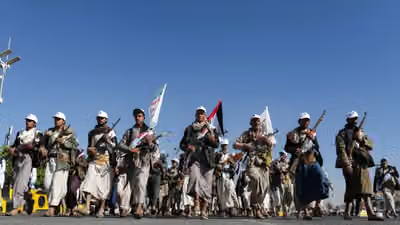

Rasoul Mousavi, Iran’s assistant foreign minister, reacted to Amir Khan Muttaqi’s implicit criticism of Iran’s desire to establish an inclusive government in Afghanistan.
Mousavi posted on social media platform X and stated, "You cannot escape international responsibilities by making the issue bilateral and personal.”
On Wednesday, Taliban’s foreign minister Amir Khan Muttaqi, while responding to those countries which are pressurising the Taliban to form an inclusive government, said that the group has fewer prisoners than executions carried out in such countries.
Addressing the Taliban’s Ulema gathering in Kabul on Wednesday, Muttaqi sarcastically questioned those countries and asked, “Do you have an inclusive government?”
“Thousands of people have disappeared in your country, but no one dares to ask about it," he continued.
The foreign minister of the Taliban did not name any country in his speech, but the Islamic Republic of Iran is one of the countries which has been accused of cracking down on its opponents and executing them and has repeatedly asked the Taliban to form an inclusive government.
Reposting the video clip of Muttaqi’s address on social media platform X, Mousavi said, "An inclusive government in Afghanistan guarantees peace, stability, security and sustainable development."
He added that the formation of an inclusive government was sought in the UN Security Council’s Resolutions 2513 and 2593 and the statement of foreign ministers of Afghanistan's neighbouring countries including Iran, Pakistan, China, and Turkmenistan called for the same.
This Iranian official reacted to the statements of the Taliban even though last week a delegation from the Iranian parliament had visited Afghanistan and met with the foreign minister and other senior officials of the group.
The Islamic Republic of Iran has had close relations with the Taliban over the past two years, but issues such as the water rights from Helmand River have escalated tensions between the two sides.

Hassan Kazemi Qomi, Iranian ambassador in Kabul, stressed that history has proved that a single movement has never been able to survive in Afghanistan.
Qomi said that a government which only represents one segment of the society has not been able to address all the crises.
Qomi, who also works as the special representative of Tehran for Afghanistan affairs, in an interview with Al-Alam TV channel, said, "Today Afghanistan is facing a crisis built over several decades, so a government which is made up of only one part of the society will not be capable of solving all the problems.”
Qomi stated that "security and development in Afghanistan depend on political stability”.
Despite relatively close relations with the Taliban, Iran has not officially recognised the group. Iran has also repeatedly called for the formation of an inclusive government in Afghanistan; a demand which the Taliban consider as interference in their internal affairs.
Amir Khan Muttaqi, the Foreign Minister of the Taliban, indirectly addressed the Iranian government on Wednesday, during a gathering of pro-Taliban clerics in Kabul, and sarcastically questioned them, “Do you have an inclusive government? Thousands of people have disappeared in your country, but no one dares to ask about it," he continued.
However, Kazemi Qomi said, "We are a country that is affected by the developments in Afghanistan. So, if the Islamic Republic of Iran says something about benevolence, it is within the framework of the interests of the Afghan people and their political system, as well as the security of the region and our national security, and it is not interference at all.”
Qomi also stressed that there are no Shias in the Taliban government.
He explained, "The point is that the presence of Shias and other ethnic groups in the government is still not desirable for them."
He expressed hope to see a government with the representatives of all the people of Afghanistan.

On Thursday, Amnesty International said that by installing thousands of new security cameras, the Taliban are creating a total surveillance system on Afghan citizens.
This organisation said that the Taliban has installed 62,000 security cameras in Kabul and other parts of the country.
On Wednesday, the Taliban's Ministry of Interior announced that it had installed security cameras to ensure the security of Kabul city and parts of the capital.
Hedayatullah Hedayat, Taliban’s Deputy Director General of Radio Television Afghanistan (RTA), wrote on social media platform X, that with the cooperation of the people, 60,000 security cameras had been installed in parts of Kabul city.
Amnesty International has warned that the Taliban is violating the freedom and privacy of people, especially women, by installing these surveillance cameras under the guise of providing security.
Matt Mahmoudi, Amnesty International’s researcher said, "This surveillance architecture would also erode the rights to privacy and freedom of assembly and expression, which have been under unprecedented attack since the Taliban came to power, resulting in the rule of law fading away.”
It has been said that the Chinese company, Huawei, is cooperating with the Taliban in setting up this system.
The Taliban have said that these cameras are necessary to fight crime and other threats.
Rights groups have repeatedly warned that authoritarian governments, such as China and Iran, use these cameras to identify and arrest their opponents.

A week after the Taliban's foreign ministry announcement of giving out passports to Afghan immigrants in Iran, the Afghan embassy in Tehran, which is under the group’s control, suspended issuance of passports to adults.
The embassy said that passports have been distributed to children who are under 10 years of age.
On Thursday, Fazl Mohammad Haqqani, the Taliban’s acting ambassador in Tehran, told Islamic Republic of Iran Broadcasting news agency, that the process of issuing passports in the embassy is only for children under the age of 10, students and holders of electronic ID cards.
However, he spoke about the suspension of the passport issuance for adults for an indefinite period and requested Afghan immigrants to not go to the embassy.
In addition, this Taliban official in Tehran had recently demanded a solution to the issue of documentation of newborns Afghans and birth certificates not being recognised by the Iranian Ministry of Foreign Affairs.
This comes as about a week ago, the Taliban's Ministry of Foreign Affairs had announced the start of the passport issuance process for Afghan citizens in Iran.
On Monday, August 28, Zia Ahmad Takal, the deputy spokesperson of the Taliban’s foreign ministry, had said that priority will be given to newborn children. In addition to not having a passport, having no electronic ID cards is one of the other problems of Afghan immigrants in Iran.

Hossein Roustaei, the commercial attaché of Iran in Afghanistan, said that the issue of the legitimacy of the Taliban is one of the biggest challenges in Iran.
He did not explain more about the issue of legitimacy, but said that Afghanistan currently has a good opportunity to import goods from Iran.
During a meeting with the members of the private sector of Iran on Thursday, Roustaei announced an increase in the export of goods from Iran to Afghanistan.
According to him, in the first quarter of this year, Iran's exports to Afghanistan increased by two percent and reached 508 million dollars.
Roustaei added that last year, Iran exported goods worth about 1.7 billion dollars to Afghanistan.
The commercial attaché of Iran in Kabul explained that most of the imports in Afghanistan are related to food, agriculture, fuel, flour, wheat, sugar, edible oil, plastic products, eggs, vegetables, citrus fruits, ceramic tiles, medicine, medical equipment, and construction materials.
Roustaei quoted Taliban officials as saying that Iran is the biggest trade partner of the group.
He said that Afghanistan is the only country that imports more than 92% of its needs from neighbouring countries, especially Iran.
Although the Islamic Republic has not recognised the Taliban, it enjoys close ties with the group.