Qatari Emir Urges Taliban Not to Repeat Past Mistakes

At the UN General Assembly, Tamim bin Hamad Al Thani, Emir of Qatar, urged the Taliban to adhere to the Doha agreement and avoid repeating "past mistakes”.

At the UN General Assembly, Tamim bin Hamad Al Thani, Emir of Qatar, urged the Taliban to adhere to the Doha agreement and avoid repeating "past mistakes”.
Al-Thani emphasised that the people of Afghanistan, especially minorities and women, should have their human rights, such as the right to education and work.
The Emir of Qatar, whose country hosted the political representation of the Taliban and the group's peace talks with the United States, said that he raised this issue so that the humanitarian crisis in Afghanistan does not become more complicated.
He also added that his country wants dialogues within the framework of the United Nations in Afghanistan and stressed on respect for human rights and girls' access to education in Afghanistan.
He stated that it must be ensured that the people of Afghanistan have access to international aid.
As the host of negotiations between the Taliban and the US, Qatar has played a prominent role in the return of the Taliban to power in Afghanistan.
In accordance with the Doha agreement, the Taliban had committed to upholding the rights of women and Afghan citizens. However, it has been two years since girls have been denied access to education, and women have been unjustly deprived of their rights to work and social life.

In a new report, the United Nations has confirmed that the Taliban has committed more than 1,600 cases of human rights violations during the detention of individuals in 19 months.
The United Nations Assistance Mission in Afghanistan (UNAMA) reported that the Taliban subjected the detainees to “severe pain and suffering through physical beatings, electric shocks, asphyxiation, stress positions and forced ingestion of water, as well as blind-folding and threats”, in order to get a confession or other information.
This report has been published on Wednesday. UNAMA said that it has recorded cases of human rights violations by the Taliban from January 1, 2022, to July 31, 2023, in 29 provinces.
The UN agency emphasised that nearly 50% of these violations include torture and other "cruel, inhuman or degrading treatments".
According to the report, cases of torture and inhumane behaviour mainly took place during arrests and in detention centres under the group’s Ministry of Interior Affairs and Taliban’s Intelligence agency.
UNAMA said that the violation of procedural safeguard, including the lack of access to lawyers, has become a common practice in Afghanistan under the control of the Taliban.
UNAMA has documented violations despite the issuance of directives by Taliban leadership aimed at enhancing the protection of prisoners' human rights and regulating the conduct of security personnel.
Volker Türk, UN High Commissioner for Human Rights in this report said, “The personal accounts of beatings, electric shocks, water torture, and numerous other forms of cruel and degrading treatment, along with threats made against individuals and their families, are harrowing. Torture is forbidden in all circumstances.”
He stressed that torture is being used as a tool instead of effective investigation. Türk called on Taliban officials to take concrete measures to stop these bad behaviours and make the perpetrators accountable.
UNAMA asked the Taliban authorities to take steps to create a stronger legal framework and address the high volume of arbitrary arrests “with no effective judicial oversight".
The report also highlighted that the arbitrary and prolonged detention of individuals awaiting the completion of investigations exposes them to an elevated risk of abuse.
Roza Otunbayeva, the UN Secretary-General's Special Representative for Afghanistan, acknowledged that while there have been some positive indications, such as leadership directives and a willingness among many Taliban officials to cooperate with UNAMA and permit prison visits, the documented evidence underscores the imperative need for immediate and urgent action by all parties involved.

Melanie Joly, Canada's foreign minister, said that the Taliban’s policies to remove Afghan women and girls from social life are devastating.
She asked the United Nations General Assembly to hold the Taliban accountable for their actions against Afghan women and girls.
Joly further emphasised that the actions of the Taliban places girls at risk of underage marriages, jeopardising the future of numerous young girls, and the exclusion of women from economic participation exacerbates the country's predicament.
She stressed that the international community should continue to support Afghan girls and women and monitor what is happening in the country.
Joly asked the United Nations to hold the Taliban accountable for the group's actions, "because women's rights are non-negotiable”.
Canada's foreign minister said that the failure of the United Nations and the international community to support Afghan girls and women would constitute a betrayal of one of the fundamental principles upon which the United Nations is founded.
The United Nations General Assembly met on Tuesday. Leaders from a number of countries addressed this meeting.
During this meeting, UN Secretary-General Antonio Guterres also emphasised that the Taliban has systematically deprived Afghan women and girls of their rights.

The Afghanistan Freedom Front (AFF) on Tuesday claimed that a Taliban commander had been killed in an attack conducted by the front’s forces in Pul-e-Khomri city of Baghlan province.
AFF released a "video recording of the attack on the Taliban commander" and said that four other Taliban members had also been killed and wounded as a result of the attack.
Local sources told Afghanistan International that a hand grenade had been thrown at a Taliban Ranger vehicle in Pul-e-Khomri city. However, independent sources have not yet confirmed the death of this Taliban commander.
The Afghanistan Freedom Front claimed that this Taliban commander was inspecting people's houses in Baghlan and apprehending individuals based on suspicions of their affiliation with Taliban’s opposition factions.

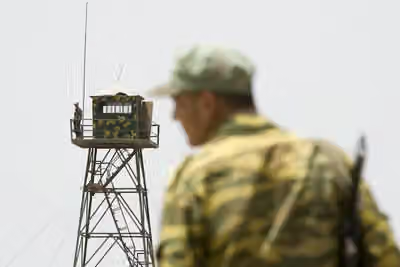
Taliban military officials have announced the establishment of more than a hundred border outposts along the border with Pakistan in the eastern provinces of Nangarhar, Kunar and Nuristan.
A Taliban commander said that these border outposts have been built under the orders of the group’s Ministry of Defence.
Qari Meraj, the commander of the Taliban border brigade in Nangarhar, told Radio Hurriyat that the communication routes of these checkpoints have been built and other border patrol facilities are ready for operation.
The announcement comes following a series of border tensions between Pakistan and the Taliban on the eastern borders of Afghanistan.
Meraj did not mention the skirmishes, but stressed that the Taliban forces "will not allow anyone to invade".
Taliban commanders have claimed that during the previous government in Afghanistan, Pakistanis did not allow these outposts to be built.
According to them, during the previous regime, the border checkpoints were constructed 15 kilometres behind the border zero points.
Recently, Pakistan's Foreign Ministry announced that the Taliban have constructed a border post "within their territory," and they have been urged to cease such activities.
Earlier, following the Taliban's attempt to build an outpost in Torkham, a skirmish occurred between the border forces of the two sides, and caused the closure of Torkham border crossing.
Pakistani officials said that the outpost was being built inside Pakistan and Pakistani forces intervened to prevent it from happening. However, the Taliban claimed that the outpost was situated on Afghan soil.
Earlier, Fasihuddin Fitrat, Taliban’s chief of staff had said that the group has built nearly 600 border posts near the borders of neighbouring countries, and the group's border guard forces have increased by 44 percent.
According to him, 20 provinces of Afghanistan share a border with six neighbouring countries, and 600 border guard posts have been established within the framework of 63 units of border forces to respond to security challenges.
In the last two years, Taliban fighters have repeatedly clashed with the border guards of neighbouring countries. Most of these conflicts have occurred on the western borders with Iranian forces and on the southern and eastern borders with Pakistani forces.

Neda Parwani, an Afghan female protester, along with her husband and child have been arrested by the Taliban, according to local sources.
The sources told Afghanistan International that Taliban members arrested Parwani and her family members on Tuesday from her house in Khair Khana area of Kabul.
Zholia Parsi, the leader of a protest movement, told Afghanistan International that the Taliban fighters first arrested Arash Parwani, the husband of Neda Parwani, and then, detained her and transferred them to unknown location.
The Taliban have not reacted to the arrest of the Parwani family yet.
Parwani is a member "Afghanistan's Spontaneous Protest Movement" which has repeatedly held protests against the Taliban's restrictions on women.
This protest group is among several similar groups which have emerged in response to the Taliban's strict policies against women in Afghanistan.
Over the past two years, the Taliban has imposed strict restrictions on Afghan women. These restrictions include preventing Afghan girls and women from right to education and work and access to public spaces across Afghanistan.
Women's protest movements have staged numerous demonstrations over the past two years to oppose the exclusion of women from social life.
On the other hand, during this period, the Taliban has repeatedly suppressed the gathering of women protesters and arrested and beaten up women activists.