Russia’s FM Will Not Meet Taliban Delegation

Zamir Kabulov, Russia's Special Representative for Afghanistan, said that the Russian Foreign Minister Sergey Lavrov has no plan to meet the Taliban’s foreign minister.

Zamir Kabulov, Russia's Special Representative for Afghanistan, said that the Russian Foreign Minister Sergey Lavrov has no plan to meet the Taliban’s foreign minister.
Amir Khan Muttaqi, the Taliban’s Foreign Minister, has travelled to Russia to participate in the Moscow Format meeting.
This meeting is being held on Friday in Kazan.
Kabulov said that the Russian Foreign Minister has not invited the Taliban delegation to participate in the Moscow format meeting.
The Russian Foreign Minister bears no obligations towards "the guests I have personally invited”, said Kabulov.
The Russian representative stated, "I want to emphasise that the Taliban are not participants, but guests of the Moscow format meeting. There is a fundamental difference between the two," he said.
He added that Moscow Format has the participation of 10 countries, including Russia, China, Pakistan, Iran, India Kazakhstan and Kyrgyzstan.
According to him, representatives of Saudi Arabia, United Arab Emirates, Qatar and Turkey are also present as observers in the Moscow Format meeting.
Forming an inclusive government in Afghanistan is one of the topics that is going to be discussed in the meeting.
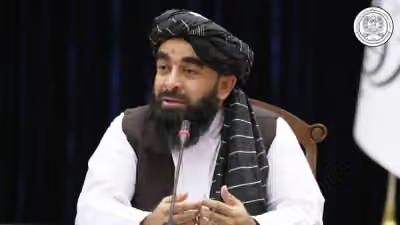
A day after the Taliban denied the presence of Pakistani fighters in Afghanistan, Jalil Abbas Jilani Pakistan’s acting foreign minister, announced that members of the Tahreek-e-Taliban Pakistan (TTP) had been arrested in Afghanistan.
He urged the Taliban to address the issues in accordance with their legal obligations.
During a press conference held on Thursday, Jilani responded to media reports, including Afghanistan International’s, concerning the arrest of these militants. He mentioned that the Taliban had informed the Pakistani delegation during their visit to Kabul on September 11 about the arrest of TTP members.
Taliban has not yet commented on the issue. Zabihullah Mujahid, the groups’ spokesperson on September 27, emphasised that foreign militias, including the Pakistani Taliban, are not present in Afghanistan.
Pakistani officials have not yet announced the number of arrested militants who are said to be held at the Pul-e-Charkhi and Jalalabad prisons. According to the reports, around 200 militants have been arrested by the Taliban.
These militants had been arrested following the attack of TTP on Pakistan’s security forces in Chitral region on September 6. The attack was followed by criticism from Pakistani officials regarding the Taliban's failure to uphold to their commitment to control the Pakistani militias in Afghanistan. According to Islamabad, these militias are based in Afghanistan and use the country as a base to infiltrate Pakistani territory.
According to Pakistani media outlet Express Tribune, Pakistan's Foreign Minister referred to the visit of the Pakistani delegation led by Asif Durrani, the country's special representative for Afghanistan affairs, on September 11 as "highly valuable." He expressed optimism that the Afghan Taliban would honour their commitment to Pakistan.
In this meeting, Taliban promised to stop the activities of TTP in Afghanistan. Also, they agreed on reviewing the management and security of both sides of the border.
Jilani stressed that if the TTP threat is not eliminated, Pakistan will explore all options to protect itself. Earlier, the Pakistani officials had threatened that the country's forces would attack the militias in Afghanistan.

Zamir Kabulov, Russia's Special Representative for Afghanistan, quoted the country's foreign minister as emphasising that achieving peace in Afghanistan is improbable without the inclusion of all ethnic groups in the government.
Addressing the Moscow Format in Kazan, Kabulov added that the Taliban has not been effective in fighting terrorist groups, especially the ISIS.
Kabulov called the performance of the Taliban against ISIS, a concern for the region.
The Russian representative stressed that the Taliban has also failed to find a solution to Afghanistan's "economic problems".
Kabulov also underscored the importance of establishing an inclusive government, citing Russian Foreign Minister Sergei Lavrov's statement that Moscow is striving to establish a foundation for dialogue and peace in Afghanistan.
He stated that the regional countries have the responsibility to seek a fundamental solution for the future of Afghanistan.
Moscow Format meeting started on Friday in Kazan, Russia.

The Moscow Format meeting on Afghanistan started on Friday in Kazan city of Russia.
Rustam Minnikhanov, president of Tatarstan, was the first speaker at the meeting. Amir Khan Muttaqi, the Taliban’s Foreign Minister, is also one of the guests present for the Moscow Format meeting this year.
The current situation and the formation of an inclusive government in Afghanistan is one of the major topics to be discussed during the Moscow Format meet.
Representatives from Russia, India, Iran, Kazakhstan, Kyrgyzstan, China, Pakistan, Tajikistan, Turkmenistan, and Uzbekistan are participating in the meeting.
Saudi Arabia, United Arab Emirates, Qatari, and Turkish representatives have also been invited as observers to this year’s Moscow Format.
Earlier, the Council of National Resistance for the Salvation of Afghanistan had warned against the "unilateral" inclusion of the Taliban in this meeting.
In a statement, it demanded the presence of all parties from Afghanistan at the Moscow Format.
On the other hand, Zamir Kabulov, Russia's special representative for Afghanistan, stated that the Russian Foreign Minister Sergey Lavrov has no plans to meet with the Taliban delegation.
He added, "The Russian Foreign Minister did not invite the Taliban delegation to participate in the Moscow format meeting, I did."
The Russian Foreign Minister bears no obligations towards "the guests I have personally invited”, said Kabulov.
The Russian representative stated, "I want to emphasise that the Taliban are not participants, but guests of the Moscow format meeting. There is a fundamental difference between the two," he said.

At the UN General Assembly, Tamim bin Hamad Al Thani, Emir of Qatar, urged the Taliban to adhere to the Doha agreement and avoid repeating "past mistakes”.
Al-Thani emphasised that the people of Afghanistan, especially minorities and women, should have their human rights, such as the right to education and work.
The Emir of Qatar, whose country hosted the political representation of the Taliban and the group's peace talks with the United States, said that he raised this issue so that the humanitarian crisis in Afghanistan does not become more complicated.
He also added that his country wants dialogues within the framework of the United Nations in Afghanistan and stressed on respect for human rights and girls' access to education in Afghanistan.
He stated that it must be ensured that the people of Afghanistan have access to international aid.
As the host of negotiations between the Taliban and the US, Qatar has played a prominent role in the return of the Taliban to power in Afghanistan.
In accordance with the Doha agreement, the Taliban had committed to upholding the rights of women and Afghan citizens. However, it has been two years since girls have been denied access to education, and women have been unjustly deprived of their rights to work and social life.

In a new report, the United Nations has confirmed that the Taliban has committed more than 1,600 cases of human rights violations during the detention of individuals in 19 months.
The United Nations Assistance Mission in Afghanistan (UNAMA) reported that the Taliban subjected the detainees to “severe pain and suffering through physical beatings, electric shocks, asphyxiation, stress positions and forced ingestion of water, as well as blind-folding and threats”, in order to get a confession or other information.
This report has been published on Wednesday. UNAMA said that it has recorded cases of human rights violations by the Taliban from January 1, 2022, to July 31, 2023, in 29 provinces.
The UN agency emphasised that nearly 50% of these violations include torture and other "cruel, inhuman or degrading treatments".
According to the report, cases of torture and inhumane behaviour mainly took place during arrests and in detention centres under the group’s Ministry of Interior Affairs and Taliban’s Intelligence agency.
UNAMA said that the violation of procedural safeguard, including the lack of access to lawyers, has become a common practice in Afghanistan under the control of the Taliban.
UNAMA has documented violations despite the issuance of directives by Taliban leadership aimed at enhancing the protection of prisoners' human rights and regulating the conduct of security personnel.
Volker Türk, UN High Commissioner for Human Rights in this report said, “The personal accounts of beatings, electric shocks, water torture, and numerous other forms of cruel and degrading treatment, along with threats made against individuals and their families, are harrowing. Torture is forbidden in all circumstances.”
He stressed that torture is being used as a tool instead of effective investigation. Türk called on Taliban officials to take concrete measures to stop these bad behaviours and make the perpetrators accountable.
UNAMA asked the Taliban authorities to take steps to create a stronger legal framework and address the high volume of arbitrary arrests “with no effective judicial oversight".
The report also highlighted that the arbitrary and prolonged detention of individuals awaiting the completion of investigations exposes them to an elevated risk of abuse.
Roza Otunbayeva, the UN Secretary-General's Special Representative for Afghanistan, acknowledged that while there have been some positive indications, such as leadership directives and a willingness among many Taliban officials to cooperate with UNAMA and permit prison visits, the documented evidence underscores the imperative need for immediate and urgent action by all parties involved.
