Pakistani Police Warn Migrants About Deadline To Leave Country Through Mosques
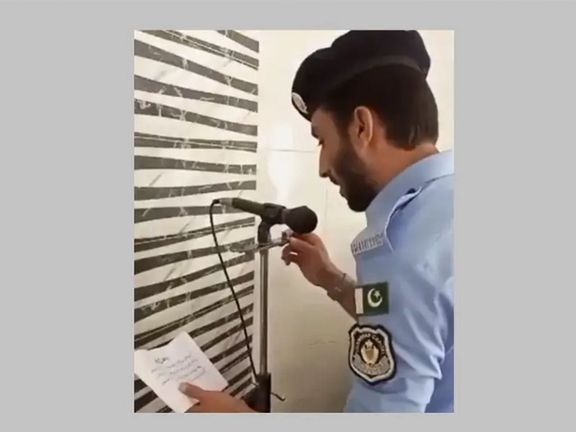
As the one-month deadline set by the Pakistan government for migrants expires, the country's police are using mosques to warn them and urge them to leave the country.

As the one-month deadline set by the Pakistan government for migrants expires, the country's police are using mosques to warn them and urge them to leave the country.
Pakistan's interior minister has also warned that action will be taken against those who shelter illegal immigrants, including Afghan nationals.
According to the video clips obtained by Afghanistan International, using the mosques, the Pakistani police have urged the country’s citizens to cooperate in identifying illegal immigrants.
In one of these video clips, it has been seen that the police are destroying a migrant camp in an area of the country’s capital city, Islamabad. It is said that immigrants who do not have a residence permit live in this camp.
Recently, the interim government of Pakistan gave a one-month to the immigrants who do not have legal residency documents to leave the country. Pakistani officials have said that there are about 1.7 million undocumented migrants who must leave the country. The Pakistani government’s deadline ends on Wednesday and most of these illegal migrants are citizens of Afghanistan.
Despite human rights organisations calling on the Pakistan government to reverse the decision to deport Afghan refugees, the country's authorities have not changed the decision to deport them.

The European Union (EU) delegation based in Kabul has allocated £15 million to the United Nations Development Program (UNDP) in Afghanistan to facilitate women-led local businesses' access to financial services.
Raffaella Iodice, the Head of the EU Delegation in Afghanistan, emphasised the economic importance of empowering Afghan women. In a recent post on the social media platform X, she announced that the European Union will provide £15 million to the UNDP in Afghanistan to bolster Afghan businesses led by women and young entrepreneurs in six provinces.
This humanitarian aid aims to sustain job opportunities for women in Afghanistan, given the extensive restrictions imposed by the Taliban on women's rights to work and education. Since taking control in Afghanistan in 2021, the Taliban has enforced stringent limitations on Afghan women and girls.
Over two years later, the Taliban's policies concerning women's employment in governmental and non-governmental organisations, as well as various other professions, remain unaltered.

Following a United Nations call to Pakistan to halt mass deportation of Afghan immigrants on Monday, Islamabad announced that all "illegal" migrants, regardless of nationality, would be deported.
The Ministry of Foreign Affairs of Pakistan announced that the deportation of illegal migrants is in accordance with international laws.
The ministry has asked the countries of the world to deal with the issue of immigrants and cooperate with Pakistan.
Earlier, the government of Pakistan announced that 1.7 million migrants "without residence documents" have until November 1 to leave the country. Pakistan has warned that these migrants will face detention and deportation if they don’t leave by the November deadline.
The deportation decision of the government of Pakistan has faced international reactions. Earlier, in an open letter to the interim prime minister of Pakistan, Amnesty International urged him to reverse the decision to forcibly deport migrants, especially Afghans without documents.
In addition, the United Nations High Commissioner for Refugees recently called on Pakistan to stop the "massive deportation of Afghan refugees”.
The UN agency said that Pakistan's decision will affect hundreds of thousands of undocumented Afghan immigrants living in Pakistan.
UNHCR also stressed that if Afghan migrants are deported, they will be at serious risk of human rights violations, including arbitrary detentions, torture, and cruel treatment under the Taliban government.
However, the Ministry of Foreign Affairs of Pakistan said in a statement on Monday that the decision to deport migrants is in accordance with Pakistan's internal laws and international principles.
The ministry said that all foreign nationals who are legally living in Pakistan will not be deported.
Meanwhile, the Minister of Interior of Pakistan said that in the first stage, immigrants without valid legal documents will be deported, and in the next stages, refugees registered in the United Nations and people with Pakistan Government Registration Certificate (POR) cards will also be deported.
Earlier, the Pakistani government had assured that it would not deport the migrants registered with the United Nations.

Human Rights Watch (HRW) strongly criticised Pakistan's deadline for the deportation of migrants. The organisation said that the Pakistani government uses threats, abuse, and detention to coerce asylum seekers.
Fereshta Abbasi, Afghanistan researcher at Human Rights Watch, said, "Pakistan’s announced deadline for Afghans to return has led to detentions, beatings, and extortion, leaving thousands of Afghans in fear of their future."
She warned that the situation in Afghanistan remains dangerous for many of those who fled from the country, and their deportation exposes them to significant security risks.
Earlier, Pakistan’s Ministry of Interior warned Afghans without legal documentation to leave the country voluntarily before November 1.
The government of Pakistan has announced that it is sticking to its plan and from Wednesday, November 1, it will take measures against people who are staying illegally in the country, including the confiscation of all movable and immovable assets.
An Afghan refugee in Islamabad who worked as a sports journalist in Kabul told Human Rights Watch that since Pakistan's warning, even Afghans registered with the United Nations High Commissioner for Refugees are not immune to detention or deportation.
"There are police checkpoints everywhere," he said. "Even if you have a valid visa, you will still be transferred to the police station, and in most cases, you need to pay a bribe to get released."
According to him, in most cases, Afghan refugees must pay a bribe between USD 36 to USD 144 to the Pakistani police.
Human Rights Watch stressed that the government of Pakistan should end the police abuse of Afghan refugees and stop forced deportations.
This organisation asked Pakistan to cooperate with the United Nations High Commissioner for Refugees to resume the registration of Afghan refugees.
Human Rights Watch also asked the United States, UK, Germany, and Canada to speed up the resettlement of Afghans at risk, including human rights activists, journalists, the LGBTQ community, women, and girls.

Rasool Parsi, an Afghan university professor, has been sentenced to 16 months in prison on charges of "insulting Islamic sanctities and propagandising against the regime".
A reliable source told Afghanistan International that on Monday, the Taliban court sentenced Parsi to four months in prison on the charge of blasphemy and 12 months in prison on the charge of propagandising against the regime.
Parsi was a university professor and expert on religious affairs and was arrested by the Taliban in March 2023.
He openly criticised extremism and violence on social media in Afghanistan.

A group of Afghan immigrants held a demonstration in front of a non-governmental organisation (NGO) partner of the United Nations Refugee Agency, in Islamabad.
This demonstration was held on the eve of the Pakistani government's deadline for the deportation of illegal Afghan immigrants from the country.
The protesters, who are defence lawyers, journalists, human rights activists, and others at risk from the Taliban, said that the UN refugee agency has not processed their cases in the past two years.
They said that the Pakistani embassy in Kabul does not extend the visas of Afghan refugees and that the refugee agency is not ready to provide the refugees with an official card to protect them from the harassment of the Pakistani police.
Zarghuna, one of the protesters, said that her case was registered two years ago at the United Nations office in Islamabad, but she has not seen any progress so far.
The protesters said that due to the UN refugee agency’s neglect, they face the threat of deportation from Pakistan.
According to the protesters, if they are deported from Pakistan, their lives will be in danger due to the anti-human rights practices and behaviour of the Taliban.
A group of Afghan women's lawyers, who were among the protesters, criticised the indifference of the UN Refugee Agency to the migrants' protests too.
At the same time, some refugees claimed that the employees of the NGO partner of the United Nations Refugee Agency had mistreated them.
At least two Afghan refugees told Afghanistan International that the employees of the NGO in Islamabad "beat them up with sticks".
Almost a month ago, the interim government of Pakistan announced that more than 1.7 million migrants "without official residence documents" in the country should leave Pakistan by November 1, 2023. Pakistan has warned that if the migrants do not leave the country, they will be imprisoned and deported.
Meanwhile, the spokesperson of the United Nations High Commissioner for Refugees in Pakistan, in an interview with Afghanistan International, asked registered asylum seekers to refer to the organisation’s lawyers if they face police harassment.
Qaisar Afridi said that the lawyers of the UN organisation are available to asylum seekers all over Pakistan.
Afridi confirmed that there had been reports in recent months that Pakistani police had even harassed asylum seekers who had official documents from the UN Refugee Agency and were registered with the agency in Pakistan.
