Over 19,000 Afghan Immigrants Returned To Afghanistan Through Torkham Border, Says Pak
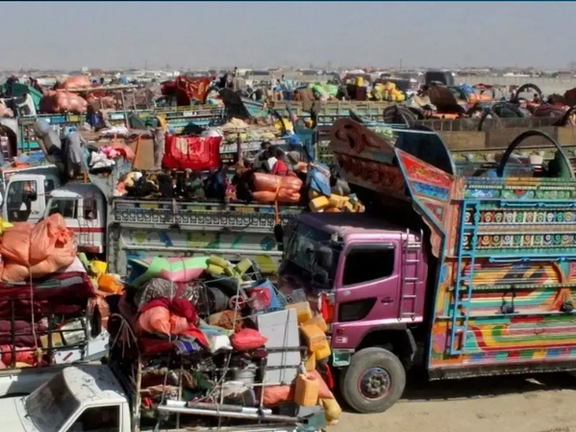
The Commissionerate for Afghan Refugees in Pakistan announced that on Thursday, 19,320 people returned to Afghanistan from the Torkham crossing.

The Commissionerate for Afghan Refugees in Pakistan announced that on Thursday, 19,320 people returned to Afghanistan from the Torkham crossing.
The organisation added that these immigrants returned to their country "voluntarily".
According to Pakistani officials, these immigrants included 1,453 families.
The Pakistani government had given immigrants without legal documentation a deadline until November 1 to leave the country.
Following the expiration of this deadline, Pakistan has started the process of arresting "illegal" immigrants.
According to Pakistani officials, about 1.7 million Afghan individuals are included among these immigrants.
Human rights organisations have expressed concern over the decision of the expulsion of Afghan refugees by Pakistan.


Reliable sources in Herat told Afghanistan International that the Taliban has detained Faridoon Fakuri, the theatre manager of the Directorate of Information and Culture of Herat province.
According to sources, Fakouri had been detained on Tuesday, October 31, in Herat city when he was returning home.
The Taliban has not yet explained the reason for the detention of this Herat city government employee.
Sources said that in recent months Fakuri had performed plays criticising the Taliban’s policies in Herat.
One of his plays had been performed during Zabihullah Mujahid, Taliban’s spokesperson’s visit to Herat in the summer.
According to local sources, Fakuri had organised a play about the consequences of banning girls' education at the ceremony attended by the Taliban spokesperson.

On Thursday, local sources reported an explosion in the city of Pol-e Khomri, the capital of Baghlan province.
According to the residents of Baghlan, the explosion happened around 6:00pm local time near the Taliban intelligence headquarters and gunfire was heard too.
There is no information about the type of the explosion and its possible casualties.
Taliban sources have not yet commented on the explosion.

As Pakistan starts nationwide deportation of immigrants without official residence documents in the country, the state of Sindh has decided to extend the refugee card of Afghans until December 31.
In an official letter, the province of Sindh has asked the Karachi police not to deport Afghans with "refugee cards".
In the letter seen by Afghanistan International, the state of Sindh has written to the Inspector General of the Sindh State Police, the Rangers security force of the state, and the Karachi Police that the issue of the renewal of the Afghan Refugee Card (POR) will be decided after December 31, 2023.
A POR card is a document issued to Afghan refugees, based on which Afghan refugees can legally stay in Pakistan.
According to the information published on the website of the United Nations High Commissioner for Refugees, this card is valid throughout Pakistan.
The United Nations has asked all Afghans to always carry this identity card with them so that they are not to arrested.
However, on Thursday, video clips from Rawalpindi City, reached Afghanistan International showing Pakistani police detaining Afghan refugees holding UN refugee cards.
Earlier, the UN Refugee Agency office in Islamabad confirmed to Afghanistan International that there are reports about the detention of migrants with official residence documents.
Earlier, the government of Pakistan asked the immigrants without official residency documents to leave the country before November 1.
With the end of this deadline, the Ministry of Interior of Pakistan has intensified the detention and forced deportation of Afghan immigrants throughout the country.

The National Resistance Front (NRF) and Afghanistan Freedom Front (AFF) announced that the three young men who were shot by the Taliban in Balkh were not members of their groups.
A video clip was published of three young men who were shot and labelled as "rebels", a term that the group usually uses to refer to anti-Taliban resistance fighters.
Two reliable sources from the NRF and AFF told Afghanistan International on Thursday, that the three people shot in Balkh "were civilians".
On Wednesday morning, local media outlets reported that three members of the Afghan National Resistance Front, including the head of the northern zone of this front, were killed in a clash with the Taliban intelligence forces in the "Sarki" area of Balkh district.
Attaullah Zaid, the Taliban spokesperson for Balkh province, said that several other NRF members were also arrested.
Meanwhile, the video clip published on social networking sites show that the Taliban shot the three young men in a civilian vehicle.
In this video recorded by the Taliban, the group’s members search the vehicle for weapons.
However, in this 78-second-long video, there is no sign of the gun belonging to the people who were shot in the car.

Three aid organisations announced that around 10,000 Afghan refugees enter Afghanistan from Pakistan daily. Norwegian Refugee Council, Danish Refugee Council, and the International Rescue Committee said that these migrants had "nowhere to go”.
On Thursday, these organisations asked donor countries to increase their financial aid to meet the needs of migrants.
All three organisations asked Afghanistan's neighbouring countries to continue supporting vulnerable Afghans until the conditions for the safe return of refugees to Afghanistan are met.
In a joint statement published by these three organisations on Thursday, they said that they have seen chaotic and desperate scenes during the meeting with the deported immigrants.
Earlier, the government of Pakistan had given November 1 as the deadline for immigrants without official residency documents to leave the country. Reports show that the Ministry of Interior of Pakistan has intensified the process of detention and deportation of Afghan immigrants throughout the country.
According to the Pakistani Ministry of Interior in October, 140,322 Afghan migrants have returned to Afghanistan.