Pakistani Media Reports Closure of Torkham Border By Taliban

On Tuesday, Pakistani media outlets reported that the Taliban has closed the Torkham border crossing with Pakistan.

On Tuesday, Pakistani media outlets reported that the Taliban has closed the Torkham border crossing with Pakistan.
The crossing was closed after Pakistan implemented visa requirement for truck drivers at Torkham to visit the country, starting Tuesday.
According to reports, Sarfraz Bugti, Pakistan’s Caretaker Minister of Interior, has emphasised on border security and the passage of people with visas from Afghanistan.
Taliban officials have not yet commented on the matter.
Visa requirements for truck Afghan drivers to enter the country is a new step taken by the Pakistani government.
In recent weeks, the interim government of Pakistan implemented a similar decision at the border between Chaman and Spin Boldak of Kandahar province too. In response to the newly enforced passport and visa policy, thousands of people have initiated a sit-in at the Chaman border on the Pakistani soil.
Meanwhile, Torkham border crossing reopened for businessmen and travellers on September 15 after being closed for nine days.
The Torkham border was closed due to a clash between Pakistani border guards and Taliban fighters.
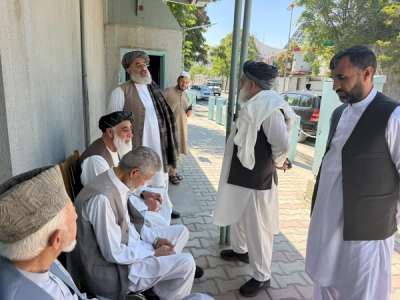

The Academy of Sciences, controlled by the Taliban, asked the Ministry of Education and Higher Education of the group, to include "hudud [penal laws] of and qisas [retribution] education" in the schools and universities programme.
It also asked the Taliban to implement Islamic Sharia against the people whom the group calls "rebels".
On Sunday, Bakhtar News Agency which is controlled by the Taliban, reported that the sciences academy of the group hosted a programme about "the implementation of hudud and qisas and its role in providing security”.
The participants of the programme have issued a resolution which states that "hudud and qisas should be implemented in public for the admonition of as many people as possible".
Following the takeover of power in August 2021, the Taliban have publicly flogged many people on various charges. The group is accused of using "double standards" against its own people and other citizens.
The Taliban has also been accused of not adhering to principles of a fair trial in the arrest and trial of individuals.

The Afghanistan Freedom Front (AFF) announced that it attacked a Taliban outpost in the Bagram district of Parwan province on Monday morning.
According to the front, two Taliban members were killed, and four others got wounded in the attack.
In a statement, it said that a Taliban vehicle was also destroyed during the attack.
Taliban has not yet commented on the matter.
The group usually does not react to the statements of its opposition fronts and tries to downplay the activities of these fronts.
However, the Taliban has confirmed that over the past two years, it has arrested numerous individuals from various provinces on charges of being members of the Taliban's armed resistance fronts.

Afghan Witness (AW), an online portal focused on human rights, has raised alarm bells over escalating cyber violence targeting Afghan women activists.
In a recent report, AW reveals a troubling increase in offensive online posts aimed at Afghan women, noting a threefold rise over the past two years.
The report, released on Monday, scrutinises around 78,000 posts in Farsi and Pashto languages on the X social media platform. These posts, related to 100 Afghan women activists, underscore a worrying trend of escalating online violence, particularly since the Taliban's ascent to power.
AW's analysis indicates that the majority of the abusive posts originate from low-ranking Taliban and pro-Taliban social media users, though users of other political and ethnic backgrounds are also implicated in such harassment. Francesca Gentile, the project's senior investigator, remarks that social media in Afghanistan has drastically shifted from a platform of social and political expression to one rife with abuse and suppression, especially targeting women.
Women activists, as per the report, face severe online harassment, including receiving pornographic messages and threats of sexual violence and death. One interviewee expressed the stigma attached to women's online presence, saying, "If you are an active woman and have a presence on social media, you are seen as a prostitute.”
The study also sheds light on the profound mental health impact of this online abuse. Many Afghan women, in response to the incessant harassment, have resorted to minimising their social media presence or self-censoring to mitigate backlash and derogatory comments.
Afghan Witness, operating under the umbrella of the Centre for Information Resilience, a UK-based non-profit, is dedicated to documenting human rights abuses, war crimes, and disinformation in regions like Afghanistan, Ukraine, Myanmar, and Sudan.

Sources told Afghanistan International that on November 23, prominent anti-Taliban figures, such as Ahmad Massoud and Amrullah Saleh, will speak at a meeting about Afghanistan in Russia.
The meeting has been organized by several political and research groups in Moscow.
According to the agenda, a copy of which has been reviewed by Afghanistan International, this "international conference" will be held under the name "Afghanistan between past and present".
In the Moscow meeting, only prominent anti-Taliban figures such as Ahmad Massoud, the leader of the National Resistance Front; Amrullah Saleh, former vice-president; Mohammad Mohaqiq, the leader of People's Islamic Unity Party; Fazl Ahmad Manawi, a member of the Resistance Front, and Mohammad Sadiq Taha, son of Ismail Khan, former governor of Herat, are scheduled to speak.
Other speakers of the conference include Fawzia Koofi and Shukria Barakzai, two female political and civil activists. No one from the Taliban or figures close to the group have been invited to the meeting.
Massoud is going to explain his views on the situation in Afghanistan and Saleh will talk about the Doha agreements between the US and the Taliban. Mohaqiq will talk about the international community’s engagement with the Taliban.
Taha is supposed to talk about the role of the countries in the region in Afghanistan, and Manawi will talk about the relationship between the Taliban and Al-Qaeda.
The Moscow international meeting will be organized by Russian political parties and research groups including the non-profit, the Just World Institute, and “A Just Russia Party” in cooperation with the Russian Academy of Sciences. Even though the Russian government does not seem to have a direct role in organising the meeting, several Russian participants are also from the Russian parliament.
Also, officials from the Russian Foreign Ministry were invited, but their names and positions were not included in the agenda.
According to the agenda reviewed by Afghanistan International, other invited participants of the meeting include senior NRF member Mahmoud Saiqal; former deputy speaker of the Afghan senate Mohammad Alam Izdyar, and other Afghan figures such as Bahauddin Jilani, Mashkur Kabuli, Khalil Andarabi, Zalmi Younusi, Sayed Baqer Mohseni, Munira Tarakhel, Baz Mohammad Ahmadi, Atiqullah Baryalai, Dadullah Qane, Noor Rahman Akhlaqi, and Shamsullah Arianfar.
Additionally, other invited figures include Abdullah Abdullah, the former Chairman of the High Council for National Reconciliation, and Hamid Karzai, the former president; Mohammad Ismail Khan, Habib Ur Rahman Sayyaf, Tadin Khan, Almas Zahid, Sattar Hosseini, Rangin Dadfar Spanta, Faizullah Zaki, Nazir Ahmad Hanafi, Zahir Tamim, Rahmatullah Yarmal, Pir Mohammad Khaksar, Alia Yilmaz and Khalid Pashtun.
However, it is not clear how many of these well-known politicians will attend the meeting. Previously, the Taliban prevented Abdullah and Karzai from participating in international meetings on Afghanistan.

A credible source at the Taliban’s Prime Minister’s office revealed to Afghanistan International that Sirajuddin Haqqani, the Taliban's interior minister, received nearly four billion afghanis as "operational fund" in the last 11 months.
This is in addition to the ministry's standard and development budgets.
The source added that the group’s finance minister was dismissed from his position due to the tension with Haqqani over this budget.
Sources informed the Pashto section of Afghanistan International that the Taliban's Ministry of Interior received around four billion Afs as operational funds in five stages, in addition to its regular and developmental budgets.
During the previous governments, operative money was given by the president to a number of government officials whose purpose was to expand influence, attract loyalty and give financial concessions to influential ethnic, political and intelligence figures.
The source revealed that in early 2023, a dispute over funds beyond the allocated budget arose between Sirajuddin Haqqani and Hidayatullah Badri, the Taliban's then finance minister. The tension prompted the intervention of Hibatullah Akhundzada, the group's leader, ultimately resulting in Badri's resignation from the Ministry of Finance.
Badri was later appointed as the head of the Central Bank of Taliban.
The source said, "Hidayatullah Badri was also unhappy with the unreasonable request for fund from Mullah Hibatullah’s office and criticised it. However, the tension with Haqqani caused him to be dismissed from the Ministry of Finance.”
Following Badri's dismissal, a source in the Ministry of Finance disclosed that the financial requests from the Taliban's Interior Minister were swiftly executed. Additionally, individuals favoured by Haqqani were appointed to various directorates within the Ministry of Finance.
The information shows that the budget for Taliban’s high-ranking offices is not transparent. A source in the Ministry of Finance said that the allocation and receipt of money by the offices of Mullah Hibatullah, Mullah Hasan Akhund, the group’s prime minister, Haqqani and Taliban Defense Minister Mullah Yaqoob are completely confidential and there is no supervision over it.
According to the source, a number of other high-ranking officials of the Taliban also receive money every month. A source close to the Taliban's interior minister also confirmed the receipt of operational fund and said that officials such as Mullah Yaqoob and Abdul Haq Wasiq, the head of the Taliban's intelligence, are receiving out of budget funds.
He said that Haqqani paid money to tribal elders, civil activists and journalists during his provincial trips. A reporter told the Pashto section of Afghanistan International that Haqqani had given between 20,000 to 50,000 Afs to a number of people during one of his trips to Khost province.
The spokesperson of the Taliban's Ministry of Interior did not respond to Afghanistan International's questions regarding the operational fund.
During the former government, the president provided operational funds to ministers, governors, parliament and senate speakers, and other officials. The exact amount of this money remains undisclosed due to its confidential nature, but reports suggest it ranged between 500,000 to 3,000,000 Afs.