Formation of Democratic Gov. Discussed in The British Parliament, Says Former Afghan Amb.
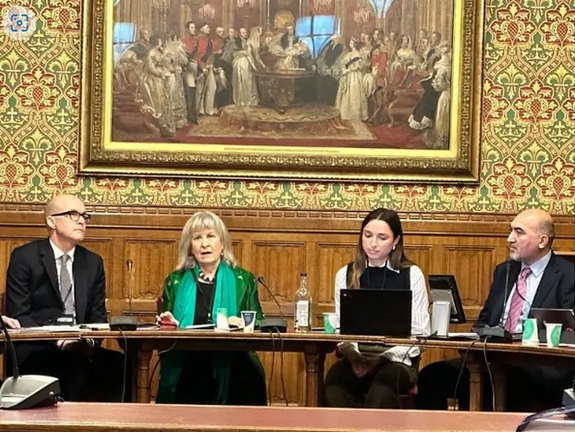
On Wednesday, Afghan politicians and members of civil society convened in the British Parliament Hall to discuss matters concerning Afghanistan.

On Wednesday, Afghan politicians and members of civil society convened in the British Parliament Hall to discuss matters concerning Afghanistan.
Nasir Ahmad Andisha, Former Afghanistan's ambassador in Geneva, said that two members of the British Parliament and a representative from the country's Ministry of Foreign Affairs were also in attendance at the meeting.
He told Afghanistan International that the primary focus of these discussions was the establishment of a democratic system in Afghanistan.
According to Andisha, in this meeting, the necessity of the participation of civil society institutions and political groups under one umbrella was emphasized.
He emphasized that the world has now taken note of the activities of Afghan political and civil groups outside Afghanistan. He added that the British Parliament, particularly members of the Labour Party, is paying attention towards in the civic and political endeavors of the Afghan diaspora.

Pakistan has extended the deadline for the deportation of Afghans who do not have residency documents and are waiting for settlement in Western countries, until February 29, 2024.
Murtaza Solangi, Pakistan's Minister of Information, said that the decision was taken to encourage immigrants to obtain legal documents or finalise their "evacuation process".
Earlier, the Pakistani government had set November 1 as the deadline for deporting immigrants without official residency documents.
Solangi said that Afghan immigrants must pay a fine of $100 per month after the deadline.
He stated that the government wants the Afghan immigrants to evacuate to another country as soon as possible or to get legal documents to stay in Pakistan.

Hossein Amir-Abdollahian, Iran's foreign minister, called Afghan immigrants a "serious challenge" for Iran's public resources, including health and education, and demanded their return to their country.
He stated that Iran cannot continue providing services to Afghans, many of whom are trying to immigrate to Europe.
In a speech at the Global Refugee Forum in Geneva, Amir-Abdollahian said, "The plight of Afghan refugees cannot be resolved without their return to their home country."
He asked the United Nations High Commissioner for Refugees, neighbouring countries, donor countries, and other interested parties to cooperate effectively with Afghanistan in order to create necessary economic, security and political infrastructure to attract refugees back to their country.
The Iranian foreign minister called the Taliban as primarily responsible for the preparations for the return of Afghans to their country.
Amir-Abdollahian said that despite the "inhuman sanctions of the United States”, the people of Iran have generously shared their limited resources with the Afghan refugees. However, he added that Iran is facing "increasing pressure" on its limited national resources to help an influx of Afghan refugees.
He stated, "This is an unprecedented challenge as our public infrastructure in the healthcare system, basic education, employment, energy, and water sectors are under immense pressure due to the huge number of refugees."
Earlier, an Iranian official had said that they had raised the issue of the return of Afghan immigrants to their country during the visit of a Taliban delegation. However, the group requested for additional time from Iran.
Over the past two months, Taliban has been facing serious challenges with the deportation of immigrants from Pakistan.
According to the interior minister of Pakistan, nearly half a million undocumented Afghan migrants have left Pakistan in the past two months.

Rahmatullah Nabil, the former head of Afghanistan's National Directorate of Security (NDS), in an interview with Afghanistan International, revealed that Pakistan is pressuring the Taliban to form a 'confederation' with it.
This arrangement would grant Afghanistan some independence but make it subordinate to Pakistan in specific areas.
No official statement from Pakistani authorities has confirmed the push for Afghanistan to join a Pakistan-led confederation. However, historical reports, such as a 1954 New York Times article, suggest that General Ayub Khan, then Pakistan's military leader, had similar aspirations. His goal was to counter perceived threats from India and the former Soviet Union by aligning Afghanistan's foreign policy with Pakistan's.
Analysts have long noted Pakistan's efforts to influence Afghanistan's foreign policy, particularly through support for the Taliban and other groups. The former Afghan intelligence chief elaborated that Pakistan's current pressure aims at a confederation where Afghanistan retains some independence whilst being partly subject to Pakistan's authority.
He also mentioned Pakistan's long-term investment in the Taliban, suggesting that Pakistan wouldn't readily abandon its influence for issues like the Tehreek-e-Taliban Pakistan, which Pakistan reportedly had a hand in creating.
Additionally, the interview touched on the Taliban's connections with Al-Qaeda, highlighting the recent killing of Ayman al-Zawahiri in Afghanistan. The former intelligence head claimed that despite reports of Al-Qaeda's diminished capacity, the group remains active and influential in Afghanistan, supported by financial resources and the freedom to recruit and train.
He concluded by emphasising the unbreakable relationship between the Taliban and Al-Qaeda, suggesting that groups like Hamas draw inspiration from the Taliban's successes.

Pakistan's security forces have intercepted a shipment of advanced US-manufactured weapons at the Torkham border crossing with Afghanistan.
The Torkham customs officials reported that the seized cache included M4 rifles, Kalashnikovs, rifle grenades, night vision sights, laser bombs, and thousands of rounds of ammunition. Notably, these weapons were ingeniously concealed in bags filled with onions.
The driver of the vehicle transporting these weapons has been apprehended by the Pakistani security forces. This incident has raised serious concerns in Islamabad, particularly contradicting the Taliban's assurances that Afghan soil is not used for hostile activities against Pakistan.
In response to this event, Pakistani authorities have called on the Afghan Taliban to halt arms smuggling into Pakistan and to actively counter the activities of Tehreek-e-Taliban Pakistan operating from Afghan territory.
This discovery of American weapons at the Torkham border comes amidst ongoing reports from Pakistan about the involvement of Afghan nationals in terrorist attacks against Pakistani security forces, often using American-supplied arms.

The National Resistance Front (NRF) has claimed responsibility for attacks in Kabul and Nuristan provinces, resulting in the deaths of four Taliban members.
In addition to the fatalities, the NRF asserts that it also wounded four other Taliban fighters during these operations.
In a statement released on social platform X on Tuesday, the NRF detailed their offensive against Taliban forces in Nurgaram district of Nuristan province on Sunday night. According to the NRF, this operation led to the deaths of two Taliban fighters and injuries to four others.
The NRF further stated that on the same night, their forces successfully targeted Haji Jailani, a Taliban commander from Helmand province, along with his bodyguard, in the Shakardara district of Kabul, resulting in their deaths.
As of now, Taliban officials have not issued any statement or reaction to these reported attacks by the National Resistance Front.
