Taliban Publicly Flogs 4 Individuals in Kandahar
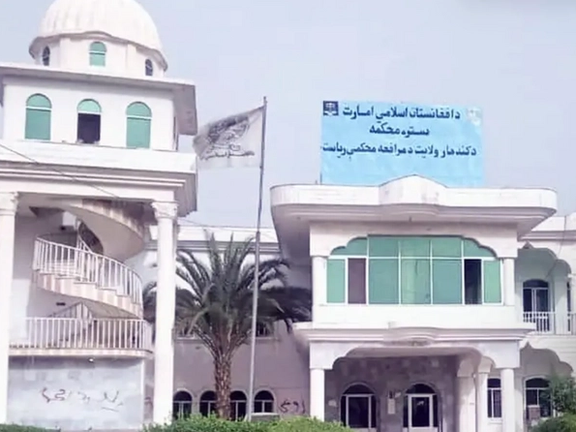
On Sunday, the Taliban's Supreme Court announced the public flogging of four individuals, each sentenced to 39 lashes for “sodomy” in Kandahar province.
On Sunday, the Taliban's Supreme Court announced the public flogging of four individuals, each sentenced to 39 lashes for “sodomy” in Kandahar province.
Additionally, they received 18-month prison terms.
This statement, shared on the Taliban's user account on X social media platform, stated that the flogging occurred in the court in Kandahar, in front of the people.
The Supreme Court of Taliban has not announced the identity of these individuals.
In July, the Taliban publicly flogged two individuals at Laghman's Eid Gah mosque for having “illicit relationships”.
Human rights organisations and the international community have repeatedly urged the Taliban to cease punishments such as flogging, hand amputation, and execution.
Nonetheless, the Taliban maintains that they are implementing Islamic Sharia law and insist that other countries and international organisations should not interfere in Afghanistan's internal affairs.
Earlier, Afghan Witness, a human rights group, reported that the Taliban had issued and executed orders for the flogging of over 400 individuals within a year.

Hassan Kazemi Qomi, Iran’s Special Representative for Afghanistan, met the Deputy Prime Minister of the Taliban, Abdul Kabir, on Sunday.
As per the Taliban's statement, Qomi conveyed Iran's stance and assured the group’s official that Iran does not back the opponents of the Taliban and is actively working towards integrating Afghanistan into the regional framework.
He emphasised that efforts aimed at creating discord between Iran and Afghanistan will not succeed.
Even though Iran does not recognise the government of the Taliban and insists on the establishment of an inclusive government in Afghanistan, the country has expanded its political and economic relations with the Taliban over the last two years.
Iran is one of the first countries that handed over the Afghan embassy in Tehran to the Taliban following the took over of power by the group.
During the meeting with Qomi, Kabir considered the policy of the Taliban as “positive role for the security and stability of the region" and said that "there is no danger to anyone from Afghanistan, including Iran”.
This Taliban official pointed out that Afghanistan poses no threat to Iran, which is in contrast to the US intelligence claims of ISIS’s Afghanistan branch being involved in recent suicide attacks in Kerman, Iran.
The Taliban-controlled Al-Mirsaad website refuted the US claims, highlighting their efforts in suppressing ISIS in Afghanistan. The website stated that ISIS leaders are located in various regional countries.
Meanwhile, in this meeting, Qomi also mentioned Iran's efforts for regional joint transit and said that by using these opportunities, Afghan goods will reach Turkey and the markets of European countries directly.
The Iranian official, in the meeting, discussed the willingness of Iranian investors to collaborate in the agricultural sector with their Afghan counterparts.
Abdul Kabir, on his part, spoke about the Taliban's focus on an "economy-oriented" policy, expressing a desire for Afghanistan to become a pivotal hub for economic stability and regional development.
Recently leaked audio files on WhatsApp groups of educational centres reveal the deployment of "spies" in schools to monitor the attire of female students by the Taliban's Ministry of Propagation of Virtue and Prevention of Vice.
In these files, female students have been warned that they will be arrested if they do not follow the Taliban’s instructions regarding women's clothing.
The Taliban's Ministry of Propagation of Virtue and Prevention of Vice reportedly employs female staff to daily inspect courses in Kabul and transfer individuals not wearing Taliban’s required hijab to the relevant security organs.
In an audio file, an official from a private education centre in Kabul has revealed that the Taliban ministry has mandated that women and girls should not wear clothing that is above the knee.
In another audio file, seemingly from a Taliban official, all school principals have been instructed to ensure that their students "adhere to Sharia clothing both inside and outside the school”.
The audio file states that an operation has commenced in Kabul city, detaining women not observing Taliban’s hijab mandate. It issues a warning for everyone to adhere to the hijab in order to avoid arrest or closure of educational centres.
Recently, Taliban's Ministry of Propagation of Virtue and Prevention of Vice confirmed to the media that several women were detained in Kabul for not observing Taliban’s hijab mandate. However, the ministry did not provide the exact number of detainees.
Earlier, sources had informed Afghanistan International that Taliban ombudsmen had "beaten up” and detained numerous girls in western Kabul for not adhering to the required hijab imposed by the group.
As per the sources, the Taliban have transferred these girls to an unknown location.
Following the suicide of a female protester in Kunduz, a human rights organisation, Freedom Now, has said that protesting women face violence and abuse from the Taliban for demanding their rights.
This organisation has emphasised on the protection of the lives of civil activists.
“We are deeply saddened by reports from Afghanistan that an activist has committed suicide following her release from Taliban’s prison,” stated Freedom Now.
Afghanistan Women's Solidarity Movement confirmed that a member of this protest group committed suicide in Kunduz province.
Officials from this women's rights activist group said that Bibi Gul, a 21-year-old, was detained at the onset of the Taliban regime. Following her release from prison, she struggled with persistent thoughts of suicide.
They said that Bibi Gul, who had thrown herself into a well in Kunduz province on December 23, died at a hospital in this province on December 31.
Zahra Haqparast, the head of the Afghanistan Women's Solidarity Movement, confirmed her suicide to Afghanistan International.
The Afghanistan Women's Solidarity Movement members stated that the 21-year-old girl, who participated in anti-Taliban protests using the alias “Zahra Mohammadi”, was arrested by the Taliban alongside another group of women's rights activists in Kunduz province in September 2021.
Sara Hamdam (alias), a member of the movement closely associated with Bibi Gul, revealed that following her release from a Taliban prison, Bibi Gul consistently expressed thoughts of suicide whenever confronted with the group's restrictions.
Hamdam mentioned that Bibi Gul had completed high school in Kunduz before the Taliban came to power. However, following the group's closure of universities to girls, she was unable to take the entrance examination and pursue higher education.
Bibi Gul's family and Taliban officials in Kunduz have not commented on this matter.
Following the detention of several women in Kabul for not wearing the mandated hijab, Amnesty International has said that the Taliban’s suppression and arbitrary arrests is a violation of women's freedom of movement and expression.
This organisation called for an immediate stop to the arbitrary arrests and release of women and girls.
In the past few days, Taliban officials were seen enforcing hijab compliance in various areas in Kabul. There are reports of beatings and arrests of several girls who did not adhere to the mandated hijab, with the individuals subsequently taken to an undisclosed location.
Sources informed Afghanistan International that families in Dashte Barchi area of Kabul, seeking the release of their daughters from the Taliban police station, were asked by Taliban officials to participate in a march supporting the Taliban's hijab mandate in exchange for the girls' release.
Richard Bennett, UN Special Rapporteur, also urged Taliban to release women detained for the group’s required hijab non-compliance.
Local sources informed Afghanistan International that ISIS fighters have beheaded a man, Wali Gul, after accusing him of spying for the Taliban in Chawkay district of Kunar province.
This incident reportedly occurred two days ago in Sapidar village.
According to local sources, this individual was neither a member of the Taliban nor was he on an official duty; he was a mere worker. However, in a statement on Friday, ISIS claimed to have killed a "Taliban spy" in Chawkay district of Kunar province.
The Taliban has not commented on the issue yet.
Several sources have confirmed to Afghanistan International that ISIS is present in three districts of Kunar province. Additionally, it has been reported that Taliban members have displaced families from areas where ISIS is active.
According to the sources, ISIS is present in parts of Mano Gai, Chawkay and Ghaziabad districts of Kunar.
As per the sources, foreign fighters are also present among the ISIS.
Mullah Yaqoob, the Taliban's defence minister, stated in a recent press conference that Pakistani and Tajik fighters carried out various attacks.
Despite the Taliban's claims of suppressing ISIS, residents of Kunar and Nangarhar recently informed Afghanistan International Pashto that the ISIS group has intensified its recruitment efforts. In the Ghaziabad district of Kunar, members of the Taliban are reportedly killing people in mosques, leading to an increased interest from individuals wanting to join the ISIS ranks.
This marks the first significant action by ISIS following a prolonged period of silence.
ISIS has resumed its activities in the areas near the eastern borders of Afghanistan. Recently, the Al-Mirsaad website, closely associated with the Taliban, accused Pakistan of supporting ISIS and claimed that Pakistan is providing refuge to ISIS leaders within its territory.