7 Civilians Hurt After Bomb Explodes In Herat, Says Taliban Police
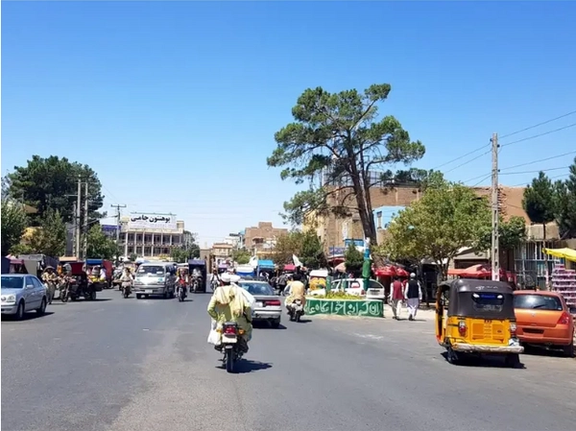
In Herat, a bomb explosion in the city's second district resulted in injuries to seven civilians, which has been confirmed by the Taliban police spokesperson Abdullah Insaf.
In Herat, a bomb explosion in the city's second district resulted in injuries to seven civilians, which has been confirmed by the Taliban police spokesperson Abdullah Insaf.
The incident involved an attempted grenade attack on a Taliban police vehicle. The explosion took place on Wednesday in the Darb-e Khosh area of Herat.
Insaf further added that while the grenade missed its intended target, it caused injuries to civilians who were present in the vicinity.
Following the incident, authorities arrested one individual who is suspected of being involved in the attack.

Habibullah Badr, the Deputy for Military Affairs of the Taliban's Prisons Authority, has reported that there are 19,000 detainees, including 800 women, in Taliban-run prisons across Afghanistan.
He asserts that all are held for criminal offenses, denying the presence of any political prisoners.
During an interview with Taliban-controlled Radio Television Afghanistan (RTA), Badr acknowledged a few foreign prisoners without specifying their numbers. He also noted that 9,000 female police officers are employed in these prisons.
The United Nations Assistance Mission in Afghanistan (UNAMA) indicated in June 2023 that around 15,000 individuals were imprisoned by the Taliban. UNAMA's report detailed instances of torture, including electric shocks, inflicted by the Taliban.
A subsequent UNAMA report in September raised concerns over torture in facilities managed by the Taliban's intelligence agency and interior ministry. Despite documented cases of torture, Badr refuted these claims.
Human rights groups have criticized the Taliban's prison system, highlighting detainees' lack of access to fair trials and legal representation.
After declaring a general amnesty in 2021, the Taliban have continued arresting former government staff, military personnel, women's rights activists, journalists, and university professors on various allegations.
The Iranian Foreign Ministry has issued a statement titled "The Necessity of Resolving the Afghan Issue," asserting that Afghanistan cannot afford another failure.
The ministry insisted that merely opening new issues without resolving past conflicts will not lead to a solution for Afghanistan's challenges.
On Wednesday, the ministry called for Afghanistan's prompt involvement in international frameworks and underscored the formation of Iran's regional contact group dedicated to Afghan affairs.
In a related development, Iran's representative in Kabul critiqued the appointment of the new United Nations representative for Afghanistan, labeling it "inappropriate." The ministry underscored that Afghanistan's approach to aligning with neighboring countries will set the stage for its role in the global system.
The Foreign Ministry proposed that practical and reassuring outcomes should precede the adoption of new "gender-focused" approaches in addressing Afghanistan's persistent issues. The statement emphasized the need for the United Nations to prioritize stability, security, and humanitarian concerns in Afghanistan and the surrounding region.
Furthermore, the ministry warned of severe consequences for international peace and security if the current challenges in Afghanistan are not successfully navigated.
Despite not officially recognizing the Taliban, Iran has deepened its political, diplomatic, and economic ties with the group over the past two years, with Iranian officials stating they will maintain relations despite the lack of formal recognition.
Hassan Kazemi Qomi, Iran's Special Envoy for Afghanistan, stated that Amir Khan Muttaqi, the Taliban's Foreign Minister welcomed Iran's proposal for forming a regional contact group on Afghanistan.
According to Qomi, Muttaqi expressed willingness to host a joint meeting of special representatives from regional countries in Kabul.
The Iranian Embassy in Kabul announced this development on Tuesday. After participating in the Moscow Format regional meeting, Qomi had mentioned that parties considered Iran's suggestion for enhancing regional cooperation on Afghanistan through a contact group.
Later, the Iranian Embassy in Kabul reported that Qomi met with J.P. Singh, an official from the Indian Ministry of External Affairs, who also supported the formation of the contact group.
However, Iran has yet to successfully establish this group and has not provided details on its mechanism. Iran hopes this group will encourage more coordinated regional involvement in Afghan affairs and with the Taliban.
During his meeting with Muttaqi, Qomi reaffirmed Iran's readiness to expand cooperation and assist the Afghan people. They also discussed mutual support for Palestine.
Meanwhile, the Iranian Embassy in Kabul stated that the Taliban's Foreign Minister reiterated his condemnation of the recent Kerman attack, describing it as a "savage and seditious act" and a "shared pain" for both nations.
While condemning the Kerman attack, the Taliban has refrained from labelling it as a terrorist act. ISIS claimed responsibility for the attack in Kerman, where two suicide bombers detonated explosives.
Although the Taliban condemns ISIS for organizing suicide attacks, the group itself has carried out deadly suicide missions in Afghanistan over the past two decades. Taliban officials have even mobilized special suicide units within their military ranks since gaining control of Afghanistan.
Vahid Jalazadeh, head of the National Security and Foreign Policy Commission of the Iranian parliament, has called for increased diplomatic pressure on the Taliban in response to the recent explosions in Kerman.
He urged Iran's Ministry of Foreign Affairs to engage with Pakistan, Afghanistan, and other nations linked to supporting terrorism.
Addressing the parliament on Tuesday, Jalazadeh stressed the importance of a more assertive stance from Iran's security and intelligence agencies against terrorism.
Meanwhile, Mohammad Bagher Ghalibaf, Speaker of Iran's Parliament, met with Tajik counterpart Rustam Emomali in Tehran to discuss concerns about ISIS's activities in Afghanistan.
Contrastingly, Hassan Kazemi Qomi, Iran's Special Representative for Afghanistan, met with Abdul Kabir, the Taliban's Deputy Prime Minister for Political Affairs, in Kabul, emphasizing cooperation with the Taliban. This meeting was reported by the Taliban to have taken place on Sunday, highlighting Iran's policy of cooperation with the Taliban government, as evidenced by several signed agreements.
Despite not officially recognizing the Taliban government, Iran maintains close relations with the group, having transferred control of the Afghan embassy in Tehran to them.
The recent Kerman explosions, claimed by ISIS, have intensified criticism of Iran's ties with the Taliban.
Khalid Zadran, Taliban’s spokesperson of police in Kabul, confirmed that at least three people have been killed and four others got injured due to an explosion in a car in eastern Kabul.
Zadran shared on a social media platform that the incident resulted after the detonation of an Improvised Explosive Device (IED) within a vehicle.
The explosion occurred at approximately 4:00 PM local time in the Alokhil area of the 16th police district in Kabul. Zadran mentioned that the group's security forces were present at the site, and arrested a suspect believed to be connected to the explosion.
As of now, no individual or group has claimed responsibility for the incident.
Earlier, Afghanistan International received reports from local sources indicating an explosion within a passenger car in the Qala-e-Zaman Khan area. This marks the second recent explosion in Kabul city.
On Saturday evening, a passenger bus was targeted in an explosion in the Dashte Barchi area in western Kabul. UNAMA reported that at least 25 individuals, mostly from the Hazara community, lost their lives or sustained injuries in the incident.