• العربية
  • پښتو
  • فارسی
Brand
  • Afghanistan
  • Sport
  • Markets
  • Afghanistan
  • Sport
  • Markets
  • Theme
  • Language
    • العربية
    • پښتو
    • فارسی
  • Afghanistan
  • Sport
  • Markets
All rights reserved for Volant Media UK Limited
volant media logo

Jihadi Education Taught in Urdu Language at Multiple Madrassas in Kandahar Province

Jan 16, 2024, 14:33 GMT+0

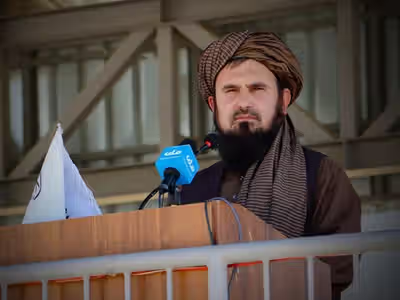
Several families in Kandahar informed Afghanistan International that in a number of religious schools in this province children are being taught "Jihadi education" in Urdu language.

They claimed that a madrassa called “Talim ul-Islam”, belonging to an adviser of the Taliban leader, is one of them.

The videos and pictures forwarded by these families to the Pashto section of Afghanistan International indicate that the children attending this madrassa range from eight to 14 years of age.

Afghanistan International's findings show that Talim ul-Islam madrassa has been active in Kandahar for the past 17 years and started teaching in Urdu following the takeover of power by the Taliban.

Mohammad Omar Khattabi, the head of this madrassa, has other madrassas in Uruzgan and Helmand provinces, where hundreds of children are engaged in religious education.

Afghanistan International has acquired videos in which a mullah from Tailm ul-Islam madrassa imparts teachings to students about Jihad, non-Muslim countries, and urges them to engage in a fight against these nations.

He suggests that in the event of losses from non-Islamic countries, they should undertake “practical jihad”.

With the seizure of power in Afghanistan, the proliferation of such madrassas has remarkably increased, particularly in the southern region—the historical stronghold of the Taliban. According to statistics from the Taliban’s Ministry of Education, there are currently nearly 20,000 madrassas and religious centres in Afghanistan, predominantly operated by the Taliban and their supporters.

Sources in Kandahar said that a number of high-ranking officials of the Taliban in this province, including Abdul Ghani Baradar, the Taliban’s deputy prime minister for economic affairs; Abdul Hakim Haqqani, the chief justice of the group and Mullah Fazil, the deputy of the Ministry of Defence of the Taliban, have started to establish new madrassas to expand and consolidate their influence.

Most Viewed

Taliban Issue New Family Law Rules On Marriage & Divorce
1

Taliban Issue New Family Law Rules On Marriage & Divorce

2

Pakistan Dismisses Taliban Denial Over Bannu Police Attack

3

UN Funding Should Support Trump Policy Goals, Says US

4

More Than One Million Added To Afghanistan’s Poor Under Taliban Rule, Says UN

5

Taliban-Backed Man Seeks Forced Marriage, Says Woman In Daykundi

•
•
•

More Stories

Taliban Imprison & Torture Women Under Various Pretexts, Say Afghan Activists

Jan 16, 2024, 12:49 GMT+0

Tamana Paryani, alongside several other activists, ended their fifth sit-in on Monday in Bochum city of Germany, protesting against the gender apartheid imposed by the Taliban in Afghanistan.

In a resolution, they protested against the detention of women by the Taliban for their clothing and said that the Taliban imprison and torture women under various pretexts.

The activists emphasised that the intense pressures and restrictions imposed by the Taliban have had severe consequences on the well-being of women and girls in Afghanistan, leading some to resort to suicide.

Paryani and the activists participating in the sit-in tent condemned the Taliban's treatment of women as a “crime against humanity”. They said that the group has deprived women of all political, civil, and social rights and freedoms by issuing numerous decrees.

In their resolution, they raised concerns about Afghanistan becoming a hub for international terrorism. They urged countries worldwide to cease their relations and financial aid to Afghanistan.

Last year, Paryani and several other activists initiated a sit-in and hunger strike for the first time, advocating for the recognition of gender apartheid in Afghanistan by Germany and other countries worldwide.

Following the conclusion of their first hunger strike, they declared their intention to establish protest tents in various cities worldwide to raise awareness and international support for the acknowledgment of gender apartheid.

The activists in Bochum voiced their opposition to the UN Secretary-General convening a meeting of special representatives for Afghanistan. They aim to convey their dissatisfaction about the engagement with the Taliban by physically being present at the meeting venue.

The United Nations has not yet specified the date and location of the meeting. However, they have stated that the UN Secretary-General will soon convene with the special representatives to discuss matters concerning Afghanistan and strategies for engaging with the Taliban.

Torkham Border Remains Closed As Talks Between Pakistan And Taliban Fail

Jan 16, 2024, 11:35 GMT+0

Four days after the closure of the Torkham border crossing for trucks, Taliban and Pakistani border officials met to discuss the reopening of this crossing.

On Tuesday, Pakistani Geo News media reported that the negotiations between the two sides to ended in a stalemate.

On Saturday, the border authorities of Pakistan closed the Torkham crossing for the Afghan trucks.

According to the Geo News, in this meeting, the Taliban officials said that the suspension of trade activities is against social and international standards and has caused discomfort to the traders, patients, and other citizens.

As per the report, the meeting emphasised on the resumption of both vehicular and pedestrian movement at the Torkham crossing.

Under the recently implemented policy by Pakistani authorities, crossing the Torkham border is now possible only upon possessing a valid visa and passport. Drivers lacking these documents will not be permitted to traverse the crossing.

In reaction to Pakistan's measures, the Taliban has prohibited the entry of Pakistani commercial trucks into Afghanistan.

According to the Geo News report, Taliban officials stated that 90 percent of Afghan drivers and patients lack passports, citing resource constraints that hinder their ability to issue these documents.

The group officials asked Pakistan to allow entry for patients on a humanitarian basis.

Geo News, quoting Taliban officials, wrote that closing the border without prior notice would compel Afghanistan “to build a wall at the Torkham border to stop passage forever”.

Taliban Announces Completion of Construction of Afghanistan-China Connecting Road

Jan 16, 2024, 10:03 GMT+0

Mohammad Ayub Khalid, the Taliban’s governor in Badakhshan, announced that the construction of the Little Pamir Road from Badakhshan to the Chinese border has been completed, officially connecting Afghanistan to China through this province.

Khalid added that efforts are underway to initiate the asphalt paving of this road “in the near future”.

He made these statements during an interview with the Taliban-controlled Bakhtar news agency.

On January 2, Abdul Ghani Baradar, the Taliban’s Deputy Prime Minister for Economic Affairs, announced during his trip to Kandahar that the construction of a road between Afghanistan and China is ongoing.

He added that the construction of this road will establish a direct connection between Afghanistan and China through the Wakhan corridor in Badakhshan province, fostering increased trade between the two countries.

Indian & Iranian Foreign Ministers Emphasise on Continuous Discussions About Afghanistan

Jan 16, 2024, 09:01 GMT+0

Indian Foreign Minister Subrahmanyam Jaishankar discussed the situation in Afghanistan during a meeting with his Iranian counterpart, Hossein Amir Abdollahian, on Monday.

During a news conference, they expressed their commitment to sustaining the ongoing dialogue on stability and security of Afghanistan.

The Indian foreign minister stated that he had a brief discussion with his Iranian counterpart about Afghanistan.

Both sides also discussed the expansion of India's transit route to Central Asia and Afghanistan through Chabahar port.

Iran's Foreign Minister, Amir Abdollahian, shared on the X social media platform that during the meeting, they discussed “the expanding bilateral and multilateral relations within the Shanghai Cooperation Organisation and BRICS, as well as the status of strategic connections, the progress of the Chabahar port, and the significance of the North-South transit route”.

During the press conference, the Indian Foreign Minister also declared that the Indian government has decided to incorporate Persian as one of the nine classical languages of India in its new educational strategy.

Iranian Official Claims Massive Saffron Smuggling To Afghanistan

Jan 15, 2024, 15:45 GMT+0

Gholam Reza Miri, chairman of the Iranian Saffron Exporters and Sellers Union, has claimed that most of Iran's saffron is smuggled to Afghanistan and packed in Spain.

According to the Fars news agency, Miri said that high Customs duties and embargoes are among the factors for the trafficking of this product.

On Sunday, Fars news agency quoted him as saying that almost half of the value of Iran's annual saffron production ends up in the pockets of smugglers.

As per Miri, in the previous year, 90 tonnes of saffron, accounting for 40% of Iran's total production of 225 tonnes, were subjected to smuggling.

He said that Afghanistan and Spain hold 21% and 16% of the global saffron markets, respectively.

On January 9, the Islamic Republic News Agency (IRNA) reported that Iranian saffron is facing a new competitor. The report highlighted the growing saffron production in Afghanistan and its increasing export to global markets, narrowing the gap between the two countries and positioning Afghanistan as a formidable competitor to Iran.

IRNA stated, "If the increasing production and export of Afghan saffron persist in the years to come, and due attention is not given to strengthening and expanding saffron cultivation and production in Iran, it will undoubtedly escalate the seriousness of the matter, bringing the competition closer and intensifying its nature."

In Afghanistan, Herat province boasts of the highest production of saffron. Afghan saffron has earned the title of "the best saffron in the world" multiple times, surpassing contenders from dozens of countries.

Bakhtar news agency, under the control of the Taliban, quoted officials of the group as saying that 441 acres of land in the central and district areas of Kandahar province had been cultivated with saffron.