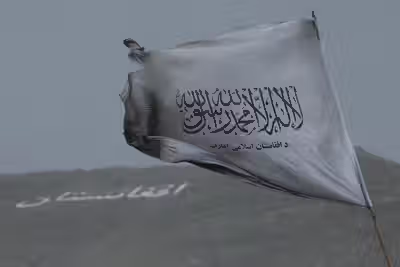
Hundreds Across Globe Protest Against Hazara Killings & Gender Apartheid in Afghanistan
Hundreds of Afghan citizens protested in Italy, France, Sweden, Germany and other countries against the "genocide of the Hazaras" and "gender apartheid" in Afghanistan under the control of the Taliban.
They called for a cessation of violence against Hazaras and advocated for women's rights in the country.
Following the repeated and violent attacks of ISIS on Hazaras in western Kabul over the past weeks, concerns within the Hazara community, both inside and outside Afghanistan, have heightened regarding the potential "genocide" of this ethnic and religious group.
At the same time, following the prohibition of work and education for women, the Taliban arrested several girls for not observing the hijab required by the group which faced with strong internal and external reactions.
Most of those detained were Hazara girls in Kabul and Daikundi provinces, which heightened concerns both within and beyond Afghanistan.
On Sunday, demonstrators in multiple German cities, including Berlin and Frankfurt, rallied against the situation of women in Afghanistan, chanting "Hijab is an excuse, the elimination of women is the aim”. They specifically condemned the Taliban's detention of girls.
In Berlin, protesters gathered in front of the German parliament and asked the world to take action to prevent the mass killing of Hazaras and discrimination against women in Afghanistan.
Germany has not yet agreed to the request of Afghan women activists in this country to recognise gender apartheid in Afghanistan.
In Rome, the capital of Italy, demonstrators denounced the "Hazara Massacre" as the "longest genocide in history" and expressed their protest. They were specifically referencing to the 19th-century massacre and suppression of the Hazaras by Abdul Rahman Khan.
During the marches protesting against the "genocide of the Hazaras" in European cities, individuals from various Afghan ethnic groups participated. A protester expressed solidarity, during a gathering of Afghans in Strasbourg city of France, stating, "As a Pashtun girl, I stand by my Hazara compatriots.”
Afghan citizens residing in Stockholm, Sweden, organised demonstrations, and considered the situation of women in Afghanistan as an example of "gender apartheid" and the targeted killings of Hazaras as a example of a “genocide”. The protesters called upon the international community to condition aid to Afghanistan on the guarantee of women's rights and the cessation of the "genocide of the Hazaras" in the country.
Members of the "Afghanistan Women's Movement for Justice" in Kabul have shared a video with Afghanistan International, saying that people from all ethnicities in Afghanistan stand united in defending the Hazaras “against genocide”.
Additionally, a group of women in Kabul, through a video, emphasised that the Taliban's nature encompasses a combination of "gender apartheid," "genocide of Hazaras," and “ethnic and linguistic oppression”.
In Tehran, a group of women activists conveyed a similar sentiment in a video. Meanwhile, Afghan women in Islamabad, Pakistan, voiced concerns that the Taliban has taken Afghan women hostage.
The Taliban attributes the violent attacks on Hazaras and Shias in Afghanistan to ISIS and ISIS also claims responsibilities of these attacks. The Taliban has committed to enhancing security measures to safeguard Shia and Hazara citizens.
Sources close to the family of Ali Gul Haidari, a former member of Afghan special forces told Afghanistan International, that Haidari was arrested and shot dead in western Kabul on January 16.
Sources attributed the incident to the Taliban intelligence department.
According to them, Haidari had recently returned to Afghanistan from Iran.
Afghanistan International has not been able to independently confirm the reported killing of this former member of the Afghan security forces.
A copy of the announcement of Haidari’s funeral ceremony indicates that his relatives held the funeral ceremony for him in Tehran, on January 19.
Sources added that the Taliban intelligence had detained him about a year and a half ago for 40 days. Subsequently, Haidari was later released and fled to Iran.
Since taking over power in 2021, the Taliban has repeatedly declared that security forces and employees of the previous government are exempt from prosecution and punishment by the group. Nevertheless, human rights organisations report that the Taliban has allegedly tortured and killed hundreds of former military forces, contradicting their proclaimed commitment to refrain from such actions.
Farid Dehqan, the Taliban’s police spokesperson in Kunar province, has confirmed to Afghanistan International that after an explosion in a residential complex in Chapa Dara district, three people died and six got injured.
He stated that the area has been surrounded by the group’s forces and investigation into the causes of the explosion is underway.
There are no further details available regarding the incident.
Earlier, there has been reports about the presence of ISIS in parts of Kunar province.
On January 5, sources had told Afghanistan International that ISIS fighters beheaded a man accused of spying for the Taliban in Chawkay district of Kunar province.
The Taliban have conducted a public examination aimed at enrolling 50,000 students in seminaries or jihadi madrassas across Kabul and various Afghan provinces.
The Ministry of Higher Education of the Taliban announced the commencement of this "annual exam" on Saturday, which is scheduled to continue until Thursday, January 25.
Neda Mohammad Nadeem, the Taliban's Minister of Higher Education, visited the exam center in Balkh province on the first day of the exams, as reported by the ministry.
These examinations are being held at a time when the Taliban has, for the past two years, barred girls from participating in university entrance exams. Since their return to power, the group has imposed restrictions on education for girls above the sixth grade and has closed universities to female students.
Human Rights Watch has observed a marked decline in the quality of education in boys' schools under Taliban rule. The organization also noted an increase in the punishment of boys in schools within the current regime in Afghanistan.
Kazem Gharibabadi, Iran's Deputy Chief Justice for International Affairs, visited Kabul, as reported by Iranian media on Saturday. Gharibabadi met with Taliban Foreign Minister Amir Khan Muttaqi during his visit.
The state-run IRNA news agency indicated that discussions focused on sharing Iran's judicial experiences with the Taliban. The talks covered the fight against terrorism and takfiri groups, and the proposal to establish a joint judicial committee to tackle these issues. They also discussed matters concerning the transfer of convicts and extradition of criminals between the two countries.
This visit occurs amidst international criticism of Iran's judicial system, which has been under scrutiny for human rights violations.
Photographs from the meeting also show the presence of Hassan Kazmi Qomi, Iran's special representative for Afghanistan affairs.
Gharibabadi's trip to Kabul reportedly came at the invitation of the head of the Taliban's judicial council. The Taliban, however, have not yet issued any official statements regarding the visit of the Iranian judicial official.
Zabihullah Mujahid, the Taliban's spokesperson, dismissed the Russian Foreign Minister's call for the formation of an inclusive government in Afghanistan.
On Saturday, Mujahid claimed that the existing Taliban government already incorporates diverse elements, thereby rendering it inclusive. He stated that the Taliban has successfully ended “instability" in Afghanistan.
Mujahid called on other countries to avoid meddling in Afghanistan's "internal affairs," asserting that the Taliban similarly respects the sovereignty of other nations and refrains from intervening in their internal policies.
Russian Foreign Minister Sergey Lavrov, during his annual press conference in Moscow, recognized the National Resistance Front of Afghanistan, led by Ahmad Massoud, active in the country's northern areas. Lavrov stressed the need for dialogue between this front and the Taliban, advocating for a bridging of differences.
Lavrov also acknowledged notable Afghan politicians like Hamid Karzai and Abdullah Abdullah, suggesting that the Taliban should broaden its governance by including varied political forces. He emphasized the importance of forming a government representative of all ethnic groups in Afghanistan, though he conceded that achieving such inclusivity would be challenging.