• العربية
  • پښتو
  • فارسی
Brand
  • Afghanistan
  • Sport
  • Markets
  • Afghanistan
  • Sport
  • Markets
  • Theme
  • Language
    • العربية
    • پښتو
    • فارسی
  • Afghanistan
  • Sport
  • Markets
All rights reserved for Volant Media UK Limited
volant media logo

Iranian Official Views Decrease In Pakistan-Afghanistan Trade as Opportunity for Iran

Jan 29, 2024, 13:03 GMT+0

Ahmad Ariafar, the Director-General of Industry, Mining, and Trade in South Khorasan province of Iran, has stated that the limited exports from Pakistan to Afghanistan present an opportunity for Iran.
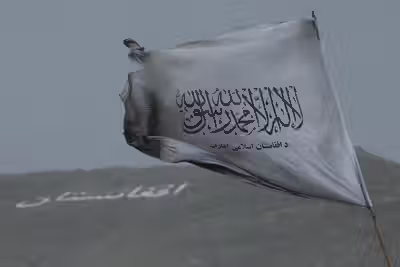
The Governor of South Khorasan too has expressed a desire to increase Iran's exports to Afghanistan, proposing to make the Mahirud border crossing operational around the clock.

The Mahirud border crossing, also known as the Mil 78 Point, is a major gateway between Iran and Afghanistan.

According to a report by IRNA on Sunday, Ariafar, speaking at an event in South Khorasan, described Afghanistan as a country with significant potential for Iranian services.

Officials of the Islamic Republic have indicated that construction materials and food products continue to be exported from Iran to Afghanistan.

Based on figures provided by Iranian authorities, the country has exported 67,000 tonnes of agricultural products to Afghanistan this year alone.

Most Viewed

Pakistan Hosts Regional Meet On Afghanistan Without Taliban
1

Pakistan Hosts Regional Meet On Afghanistan Without Taliban

2

Taliban Ignore Afghanistan’s Interests By Backing Militants, Says Pakistan Army Chief

3

Taliban Delegation Travels To Russia To Facilitate Medicine Imports

4

Germany’s Interior Minister Defends Deportations To Afghanistan

5

United Nations Delivers Education Kits To Four Million Afghan Children

•
•
•

More Stories

Only Way To Counter Misogynist Taliban is Through Military Means, Says NRF Leader

Jan 29, 2024, 11:26 GMT+0

Ahmad Massoud, leader of National Resistance Front (NRF), highlighted "gender apartheid" in Afghanistan during a meeting in London and said that the only solution to counter the Taliban is through military means aimed at dismantling the group.

He also announced the expansion of the NRF’s operations and activities in Afghanistan.

On Sunday, a commemoration was held in London to mark the first anniversary of the death of Khair Mohammad Khairkhah Andrabi, a commander of the National Resistance Front in Afghanistan. Andrabi, along with some of his forces, lost their lives in December 2022 during a battle with the Taliban in Andrab.

Participating in the online event on Sunday, Massoud urged for collective and united efforts of anti-Taliban fronts.

He stressed on the importance of unity to overcome "the evil of the Taliban and the oppression and tyranny of this group”.

He referred to the deplorable situation of women under the Taliban regime and said that he has raised the issue of gender apartheid with international legal and judicial authorities.

Massoud also mentioned the detention of women by the Taliban and called it unprecedented in the history of Afghanistan.

The NRF leader further stated that the international community, by refusing to recognise the Taliban, anticipates that the Afghan people will resist the Taliban through various means.

He characterised the Taliban as an "extremist, terrorist, and tyrannical" group. He reiterated his call for the Taliban to accept a challenge through the elections, stating, "If the Taliban believe their will aligns with the will of the people, they should trust in the people's vote."

He also mentioned the difference of views among the opposition groups and fronts against the Taliban and said that the difference of views should not cause strategic differences and must not create rifts among the people.

According to him, the NRF's activities against the Taliban are growing, and he urged other anti-Taliban groups to broaden their efforts too.

During this meeting, two other prominent figures also spoke. Yunus Qanooni, the former vice-president, expressed that the formation of an inclusive government in Afghanistan is not the solution; instead, there should be a fundamental national change in the country's situation.

He described Afghanistan as a haven for terrorist groups.

Additionally, Atta Mohammad Noor, a member of the National Resistance Council for the Salvation of Afghanistan, called for the inclusion of political factions and women's representatives in the United Nations meeting in Doha.

Afghanistan’s Regional Cooperation Initiative To Begin Today, But With Delays

Jan 29, 2024, 10:22 GMT+0

Radio Television Afghanistan (RTA), controlled by Taliban, announced that “Afghanistan’s Regional Cooperation Initiative” meeting will be held at 4:30pm local time.

The meeting was scheduled to begin before noon on Monday, however, according to the RTA, it was delayed due to bad weather.

This is the first time that the Taliban is hosting a regional meeting in Kabul with the presence of ambassadors and special representatives of neighbouring countries and the region.

According to reports, ambassadors and special representatives from four regional countries will participate in this meeting.

This meeting will be held while the Secretary General of the United Nations is scheduled to host the second meeting on Afghanistan in Doha on 18 and 19 of February.

Taliban Minister Says There Is No Official Border Between Afghanistan & Pakistan

Jan 27, 2024, 15:39 GMT+0

Noorullah Noori, Taliban’s Minister of Borders and Tribal Affairs, has said that there is no "official border" and "zero point" between Afghanistan and Pakistan.

The Ministry of Borders and Tribes Affaires of the Taliban released a video in which Noori referred to the Durand as the "hypothetical line" between the two countries.

Noori visited the Torkham crossing along with Khalilur Rehman Haqqani, Taliban’s Minister of Refugees and Repatriations.

During this trip, he has said that there is no "official border" between Afghanistan and Pakistan, and the Durand Line is hypothetical line. He said that sometimes problems happen between the Taliban and Pakistan along this line.

These statements can further fuel the disagreement and tensions between Pakistan and the Taliban.

The government of Pakistan acknowledges the Durand Line as an internationally recognised border between the two countries. However, many Afghan governments have referred to the Durand Line as a "hypothetical line" and have raised questions about the validity of the "official border" between the two nations.

During the past few decades, individuals residing on either side of the border could travel freely using Pakistani or Afghan identity cards. However, towards the end of last year, the Pakistani government implemented a new policy at all border crossings between the two countries, in addition to a decision to deport Afghan immigrants.

Islamabad now requires a visa and passport to pass through the crossings. The decision caused widespread protests to be held in the Chaman region of Baluchistan, Pakistan.

The protesters said that the government cannot separate the tribes and families on both sides of the border, but the government insists that travel between the two countries should be made legal and that the traditional customs of the past are no longer acceptable.

Current Situation to Persist, Says Former Iranian Diplomat Regarding Doha Meeting

Jan 27, 2024, 10:37 GMT+0

Mohammad Reza Bahrami, former Iranian envoy in Kabul, stated that given the diverse positions of various parties regarding Afghanistan in the forthcoming Doha meeting, the "most probable" option is the continuation of the current situation.

The Doha meeting is scheduled for February 18-19 and will be hosted by the Secretary General of the United Nations.

In an article on the "Khabar Online" website, Bahrami writing about the upcoming meeting in Doha, stated that the existing conditions in Afghanistan will persist. He emphasised that the country must align its course with other significant current events and crises.

Bahrami has said that the primary purpose of the Doha meeting is the completion and finalisation of the third and fourth components of the Doha agreement between the US and the Taliban. These components prioritise the initiation of intra-Afghan dialogue and the consensus on the future political roadmap for Afghanistan.

He indicated that, as per the report from Feridun Sinirlioglu, the UN special coordinator, the agenda for the upcoming Doha meeting encompasses four fundamental issues. These include the designation of a special representative of the United Nations, the establishment of a contact group involving diverse countries, the facilitation of communication between the Taliban and their opposition groups, and the "arrangement of incentives to be provided to the Taliban if they engage in this process”.

Nevertheless, the former Iranian diplomat stated that the appointment of a special representative would be futile without the companionship of the Taliban. He noted that, as of now, Kandahar has not granted approval for this meeting.

Bahrami is referring to the remarks of the Taliban's foreign minister, who expressed reservations, stating that he does not deem the appointment of a new UN representative for Afghanistan as "appropriate" given the current situation and the existence of UNAMA.

During the upcoming UN meeting in Doha, decisions will be reached regarding the proposals outlined in the UN special coordinator's report on Afghanistan affairs.

This meeting will bring together special representatives for Afghanistan from various countries.

Taliban Imposed Significant Restrictions on Media Support Organisation, Says AFJC

Jan 27, 2024, 09:28 GMT+0

The Afghanistan Journalists Center (AFJC) called the suspension of "Nai", an organisation supporting open media in Afghanistan, as a “significant loss" for the Afghan media community.

AFJC reported that the Taliban had implemented significant restrictions affecting the organisation’s ability to carry out its work.

Nai had announced that it has temporarily stopped its activities in Afghanistan.

Ahmad Quraishi, director of the AFJC, said that NAI has a long history of supporting journalists and promoting free media in Afghanistan.

“We look forward to the swift resumption of Nai's vital work and trust that the necessary conditions will be established to allow this organisation, alongside other entities working towards the same goal, to continue supporting journalists and fostering a free media in Afghanistan,” said Quraishi.

AFJC reported that over the past 18 years, Nai has collaborated with the backing of various international institutions to aid journalists and promote free media. Their efforts have particularly been focused on training journalists and providing legal assistance to the media community.

It added that the senior officials of this organisation were forced to leave Afghanistan following the takeover of the Taliban.

On January 25, Mujeeb Khelwatgar, executive director of Nai announced the temporary suspension of organisation, saying that once the conditions of the institution improve, it can resume its activities in the future.

He mentioned that he will provide further details regarding the reasons for the temporary suspension of Nai's activities at a later time.