• العربية
  • پښتو
  • فارسی
Brand
  • Afghanistan
  • Sport
  • Markets
  • Afghanistan
  • Sport
  • Markets
  • Theme
  • Language
    • العربية
    • پښتو
    • فارسی
  • Afghanistan
  • Sport
  • Markets
All rights reserved for Volant Media UK Limited
volant media logo

U.S. Congressman Claims Targeted Assassinations Of Ex-Afghan Security Personnel

Feb 1, 2024, 10:22 GMT+0

Brian Mast, US congressman, said on Wednesday, that contrary to the statements of the officials of the Biden administration and the Taliban, members of the former security forces of Afghanistan are being killed by the Taliban.
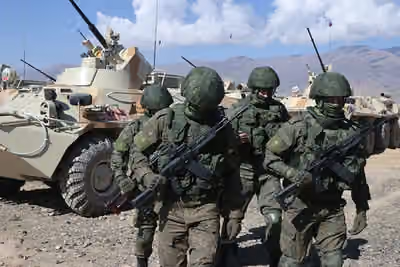
He accused the officials of the Biden administration of lying and said that they do not accept the reality of the targeted killing of former security forces members and other former partners of the US government in Afghanistan.

The Taliban has dismissed reports from international organisations and news agencies regarding the killing and torture of former members of security forces, attributing it to personal enmity.

Mast highlighted multiple reports from international organisations, citing them as evidence confirming the deliberate murder of former security forces members.

The U.S. Congress Foreign Relations Committee recently conducted a meeting focused on investigating the Taliban's retaliatory actions against former Afghan collaborators of the U.S. military. This bipartisan session saw participation from both Republican and Democratic members, as well as veterans who supported these local partners. An Afghan journalist was also present, contributing to the discussions on the ongoing situation in Afghanistan and the plight of those who previously assisted U.S. forces.

Most Viewed

Pakistan Hosts Regional Meet On Afghanistan Without Taliban
1

Pakistan Hosts Regional Meet On Afghanistan Without Taliban

2

Taliban Delegation Travels To Russia To Facilitate Medicine Imports

3

Taliban Ignore Afghanistan’s Interests By Backing Militants, Says Pakistan Army Chief

4

Germany’s Interior Minister Defends Deportations To Afghanistan

5

United Nations Delivers Education Kits To Four Million Afghan Children

•
•
•

More Stories

Taliban & Uzbekistan Officials Meet to Discuss Border & Economic Cooperation

Feb 1, 2024, 09:17 GMT+0

Mullah Yaqoob, the Taliban's Defence Minister and Abdusalom Azizov, the head of Uzbekistan's State Security Service, discussed border issues along with economic and transit cooperation.

During a meeting with Azizov on Wednesday, Mullah Yaqoob stated that "more work needs to be done to strengthen the two countries' borders”.

According to the Taliban's Ministry of Defence, Mullah Yaqoob assured the Uzbek side that they would protect Uzbekistan's "development projects and investments" in Afghanistan.

Uzbekistan perceives the presence of Uzbek militants in northern Afghanistan, such as the Islamic Movement of Uzbekistan and the Imam Bukhari Battalion, as a security threat. The country had relations with the Taliban even during the previous government.

Uzbekistan and other Central Asian countries hope that the Taliban will control the activities of foreign militant groups inside Afghanistan, a promise the Taliban has repeatedly made to neighbouring countries.

Mullah Yaqoob told Azizov, "We have done a lot of work on the country's borders over the past year and are determined to do more in the future to strengthen our borders."

Like other countries, Uzbekistan has not yet recognised the Taliban. Despite criticising the Taliban for constructing the Qosh Tepa water canal, the country has maintained its trade and political relations with the Taliban.

In 2022, the Taliban announced the construction of the Qosh Tepa canal in northern Afghanistan, worth more than seven billion Afghanis. The construction of this canal has faced considerable criticism and concerns from neighbouring countries, especially Uzbekistan.

The President of Uzbekistan had warned in September that the Taliban were constructing the Qosh Tepa water canal, which could fundamentally alter the water regime and balance in Central Asia.

The Qosh Tepa canal diverts part of the Amu Darya River's water to areas in the northern provinces of Balkh, Jowzjan, and Faryab provinces.

China Conditions Taliban’s Recognition On Addressing Global Security Concerns

Jan 31, 2024, 16:32 GMT+0

The Chinese Foreign Ministry has declared that its recognition of the Taliban hinges on the establishment of an inclusive government and a forceful battle against terrorism in Afghanistan.

This statement came after the Taliban ambassador, Bilal Karimi, presented his credentials to China's President Xi Jinping.

Previously, the Taliban had claimed that China had acknowledged their regime, a view bolstered by Karimi's recent diplomatic interaction. However, Wang Wenbin, a spokesperson for the Chinese Foreign Ministry, clarified that accepting diplomatic credentials is a standard procedure and does not necessarily imply formal recognition.

Wang emphasised that China would consider recognising the Taliban only after the group addresses international apprehensions and demonstrates a commitment to combating terrorism within Afghanistan.

The Chinese Foreign Ministry, in its statement, reassured its dedication to a friendly foreign policy towards the Afghan people and confirmed the ongoing diplomatic relations and cooperation with Afghanistan in various domains.

Amidst these developments, the Chinese Foreign Ministry is advocating for heightened dialogue and interaction between the Taliban and the international community.

This diplomatic development has been met with criticism from Afghan political factions. Both the National Resistance Front and the National Resistance Council for the Salvation of Afghanistan have reacted to China's symbolic diplomatic gestures as a violation of international norms. Moreover, the United States has sought clarity from China regarding its stance on Taliban recognition, particularly after the US State Department acknowledged the ambiguity of Beijing's position following the acceptance of the Taliban ambassador's credentials.

Al-Qaeda Established 8 New Training Camps in Afghanistan, Reports UNSC

Jan 31, 2024, 15:22 GMT+0

In a recent report, the UN Security Council revealed that the Taliban has maintained its ties with Al-Qaeda and that the terror group has established eight new training camps in Afghanistan.

Four al-Qaeda camps have been established in Ghazni, Laghman, Parwan and Uruzgan provinces. Additionally, it has established a weapons depot in Panjshir.

Taliban's Close Ties With Al-Qaeda

In its report, the Security Council has stated that the relationship between the Taliban and Al-Qaeda is still close, and this terrorist organisation has managed to maintain itself in a "sustainable" mode in Afghanistan under the control of the Taliban.

According to the report, senior Al-Qaeda officials are present in Afghanistan and it is still a threat to the country and beyond.

The UN Security Council reported that the Taliban is trying to make sure that its ties with the Al-Qaeda are not detectable. It has stated that some operational commanders of the Taliban have a common working method and ideology with the Al-Qaeda, however, they do not have the global ambitions of the group.

The Security Council wrote that the efforts of the Taliban to limit some activities of Al-Qaeda have led to differences between these two groups.

However, the report states that the remaining and old members of Al-Qaeda in Afghanistan are not capable of planning and organising large-scale attacks. A member of the security council said that the number of senior Al-Qaeda leaders in Afghanistan who have historical ties to the Taliban is less than ten.

The report also states that several member countries of the Security Council spoke about people who are said to have travelled to communicate between Saif al-Adel, the leader of al-Qaeda, "based in Iran", and its other senior members in Afghanistan, including Abdul Rahman al-Ghamdi. However, one UN Security Council member state has denied the presence of Al-Qaeda members in Iran.

The report also states that six Al-Qaeda members have been transferred to eastern Afghanistan to join “Katiba Umer Farooq” unit under the leadership of "Abu Ikhlas al-Masri".

Eight New Training Camps

The UN Security Council reported that Al-Qaeda has established eight new training camps in Afghanistan.

According to this report, four al-Qaeda camps have been established in Ghazni, Laghman, Parwan and Uruzgan provinces, and it has also established a new weapons depot in Panjshir province.

According to the report, Hakim al-Masri, an Al-Qaeda member, is in charge of training camps and also provides instructions on suicide bombings to Tehreek-e-Taliban Pakistan (TTP) members in Kunar province.

The Security Council also wrote that five Al-Qaeda madrassas operate in Laghman, Kunar, Nangarhar, Nuristan and Parwan provinces. Al-Qaeda also has facilities in Helmand, Herat, Farah and Kabul provinces.

TTP Receives Aid Packages From Afghan Taliban

The United Nations Security Council reported that several attacks by TTP have been supported from Afghanistan.

The report also stated that a number of TTP commanders and their families receive regular aid packages from the Taliban.

As per the report, the TTP has seen a rise in the number of Taliban members joining its ranks. According to the report, some Afghan Taliban members view supporting the Pakistan Tehreek-e-Taliban as their "religious duty”.

The report states that the Afghan Taliban group is generally aligned with the goals of the TTP.

The Security Council noted that, aside from supplying equipment and weapons to the Pakistani Taliban, Al-Qaeda has also played a role in training the group's forces for overseas operations.

The report states that the short-term detention of 70 to 200 members of the TTP by the Afghan Taliban and their relocation in northern Afghanistan was done to divert pressure from Islamabad.

As per the report, the TTP, alongside its anti-Pakistan activities, has also carried out assassinations of Taliban members who joined ISIS in Khorasan.

ISIS Threats

According to the Security Council report, despite territorial losses, casualties, and the decrease of forces, including key leaders, ISIS remains a significant threat to Afghanistan and the broader region.

The primary target of ISIS in Afghanistan is the Shia community. Taliban comes in the second place.

The Security Council reported a decrease in ISIS attacks due to Taliban pressure and their influence on ISIS. However, there are indications of considerable influence from ISIS within the Taliban.

The report states that despite the Taliban's claim of defeating ISIS, the group continues its attacks in Afghanistan.

The Security Council report also highlighted a divergence of opinions within the Taliban leadership regarding how to address ISIS. According to the report, ISIS has implemented a more inclusive strategy by welcoming non-Salafi forces, recruiting disillusioned Taliban fighters, and foreign combatants.

Contrary to earlier reports from some Pakistani media outlets, the Security Council has confirmed that Sanaullah Ghafari, also known as "Shahab al-Muhajir," the leader of the Khorasan branch of ISIS, is alive. The Taliban also did not confirm the reported killing of Ghafari at that time.

Several Security Council member states reported that the leader of ISIS' Khorasan branch was targeted and wounded, possibly while leaving the Jamaat al-Ahrar training centre in Kunar.

Other groups

The Security Council report indicated that groups such as the Islamic Movement of Uzbekistan, Islamic Jihad Union, and Khatiba Imam al-Bukhari remain active in Afghanistan. Additionally, the Jamaat Ansarullah group receives funding from both the Taliban and Al-Qaeda.

As per the report, the East Turkestan Islamic Movement has relocated from Badakhshan to settle in Baghlan province, with its operational network expanding into several other provinces.

According to the report, the East Turkestan Islamic Movement primarily focuses on training reserve forces and recruiting women. Security Council member states have expressed concern about its collaboration with other terrorist groups, including the TTP, in recruiting troops, training, and planning operations.

The report notes that Al-Qaeda provides ideological training to the East Turkestan Islamic Movement. Additionally, ISIS has recruited some of its forces by exploiting dissatisfaction with perceived restrictions imposed by the Taliban.

China Recognises Taliban Govt, Says Group After Acceptance of Ambassador's Credentials

Jan 31, 2024, 13:40 GMT+0

The Taliban's official website considered the Chinese president's acceptance of the group's ambassador's credentials as a form of recognition for the Taliban government.

According to the Taliban, China is the first country to breach the "fence" and take an unprecedented step to officialise their relationship with the group.

On Wednesday, the Taliban's Foreign Ministry announced that Chinese President, Xi Jinping has officially accepted the credentials of the group's ambassador, Bilal Karimi.

However, China has not yet officially announced that it recognises the Taliban government as the government of Afghanistan.
So far, no other country or international organisations have recognized the Taliban government.

Earlier, the Prime Minister of the group had accepted the credentials of the Chinese ambassador.

The Taliban stated that regional and global powers who have failed and withdrawn from Afghanistan, seek to isolate the country and pose political and economic challenges to the Taliban government.

The Taliban has claimed that since the takeover of power by the group, many countries wanted "good and deep" relations with the Taliban. However, according to the Taliban, regional powers have prevented them from recognising the Taliban.

The group has not specified any country; however, it has emphasised that these powers have exerted pressure on nations willing to recognise the group.

In the article titled "Another Step Towards Recognition," it has been stated, "China is the first country to break this fence and challenge the power dynamics in the region, marking an unprecedented step in recognising Afghanistan based on its bilateral interests in the country."

The article expresses the Taliban's hope for other nations to follow China in recognising them. It also said that the US power is declining.

Following the Chinese president's acceptance of the Taliban ambassador's credentials, Matthew Miller, a spokesperson for the US State Department, stated that Beijing's stance on recognising the Taliban remains unclear.

He added that he wants to have clarity in this regard before making any formal statement.

US Seeks Clarity On China's Recognition Of Taliban Following Acceptance Of Group’s Envoy

Jan 31, 2024, 09:48 GMT+0

Following the Chinese president's acceptance of the Taliban ambassador's credentials, Matthew Miller, a spokesperson for the US State Department, stated that Beijing's stance on recognising the Taliban remains unclear.

“I’ve seen those reports, and I think I would let the Chinese Government speak to what this means in terms of their relationship and whether they have formally recognised the Taliban or not,” he said.

He emphasised once again that the current relations between China and the Taliban will not change the US policy towards the recognition of the Taliban and that the group should take specific steps, including improving the rights of women, to gain recognition.

On Tuesday, publishing a picture, the Taliban's Foreign Ministry announced that Chinese President Xi Jinping accepted the credentials of Asadullah Bilal Karimi as the ambassador and representative of the Taliban.

Abdul Qahar Balkhi, Taliban’s foreign ministry spokesperson, wrote in a statement that Bilal Karimi's credentials were presented to Xi Jinping in a special ceremony along with the ambassadors of 41 other countries.

However, Miller stated that he is refraining from specific comments because he has also seen statements from the Chinese Government saying that their recognition of the Taliban has not changed.

He added that he wants to have clarity in this regard before making any formal statement.

Miller urged countries that are engaging with the Taliban to urge improvement in women and girls’ rights in Afghanistan.