Türkiye Arrests 17 Suspected Members of ISIS-Khorasan

Anadolu News Agency reported that Türkiye’s National Intelligence Organisation (MIT) has arrested 17 members of ISIS-Khorasan in an operation in Istanbul city.

Anadolu News Agency reported that Türkiye’s National Intelligence Organisation (MIT) has arrested 17 members of ISIS-Khorasan in an operation in Istanbul city.
The media outlet stated that this operation dealt a "significant blow" to ISIS-Khorasan, which recently claimed responsibility for an attack on a church in Istanbul.
The report notes that "as a result of intelligence efforts, the so-called Istanbul province head of ISIS-Khorasan and terrorists active with him were identified”.
Anadolu News Agency added, "In an operation conducted in collaboration with Istanbul police, the Turkish National Intelligence Organisation arrested 17 suspects, inflicting a major blow to ISIS-Khorasan's recruitment, financing, and logistics activities."
Turkish media have not released information about the identities of the arrested individuals.
Last Sunday, two attackers targeted the Italian Santa Maria Church in Istanbul, resulting in one casualty.
Following the incident, ISIS released a statement claiming responsibility for the attack.
Ali Yerlikaya, Turkiye’s Interior Minister, had previously announced the arrest of two individuals suspected of involvement in the attack. The detainees at that time were identified as citizens of Russia and Tajikistan.
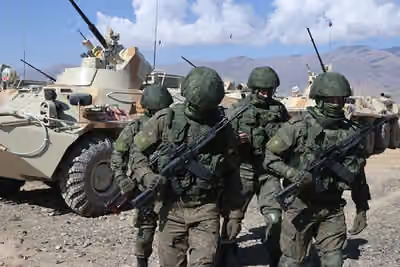

The Telegram channel "Modafeen Haram" - Defenders of the Shrine- reported that Ali Hosseini, Hamzeh Alavi, Mohammad Ali Akbari, and Mohammadreza Sadat Alavi, four members of the Fatemiyoun brigade, were killed in a US strike in Syria.
Ali Hosseini was said to be one of the commanders of the Fatemiyoun brigade in eastern Syria.
Published images show him alongside Qasem Soleimani, the dead commander of the Quds forces.
The US military conducted a strike in eastern Syria early on Saturday, targeting militants affiliated with the Islamic Republic of Iran. The US stated that this attack was in response to the killing of their soldiers in Jordan.
Last week, three US soldiers were killed in drone attacks by Iran-supported groups in northeastern Jordan.
The Fatemiyoun Brigade, under the supervision of Iran's Quds Force, consists of Afghan migrants in Iran and had been sent to fight in Syria since several years.
The previous Afghan government in 2020 had asked the Islamic Republic of Iran to dissolve the Fatemiyoun brigade. Afghan officials at that time emphasised that the use of Afghan migrants in proxy wars is inconsistent with international laws.
Observers and human rights activists have consistently criticised the Islamic Republic for exploiting the dire residency and living conditions of Afghan refugees in Iran to recruit them to participate in regional conflicts, including in Syria.
Fars News Agency, affiliated with the Islamic Revolutionary Guard Corps, published a brief biography of one of the Fatemiyoun members killed in the recent US strike in Syria.
It has been reported that 65-year-old Hamzeh Alavi, originally from Parwan province in Afghanistan, was a veteran member of the Fatemiyoun brigade, killed on Saturday, in Syria.
According to Fars, Alavi had also participated in the Iran-Iraq war while serving in the Iranian military forces.

According to a Sunday report by Pakistani daily Express Tribune, sources indicate that China, Russia, Pakistan, and Iran have lodged a quiet protest against Taliban government over the uncontrolled activities of terror groups in Afghanistan.
The newspaper detailed that the representatives of these countries expressed their dissatisfaction regarding the Taliban's failure to exert control over terrorist organisations within Afghanistan.
The Express Tribune's sources revealed that these representatives, who attended a regional meeting in Kabul, conveyed their joint protest to the Taliban.
The meeting saw participation from representatives of India, Turkey, Indonesia, Uzbekistan, Turkmenistan, China, Pakistan, Russia, and Iran.
While the Taliban deemed this regional meeting involving multiple countries as a significant accomplishment, they did not publicly acknowledge the concerns presented by the attending delegates.
Both China and Pakistan have consistently voiced their objections, through official and private channels, about the presence of the Tehreek-e-Taliban Pakistan and Uyghur Islamist separatists in Afghanistan. Notably, Islamabad has adopted a more assertive approach towards the Afghan Taliban in response to attacks conducted by Pakistani militants operating from Afghan territory.

The Afghanistan Freedom Front (AFF) claimed responsibility for an assault at a Taliban checkpoint in the Khoshal Khan Mina area of Kabul on Sunday.
This attack led to the death of two Taliban members and the injury of another.
In a post on the social media platform X, AFF stated that the Taliban personnel stationed at this checkpoint had been engaged in the harassment of Afghan girls.
Previously, AFF has launched attacks on Taliban checkpoints which had been accused of arbitrarily detaining women. On January 11, AFF targeted a Taliban intelligence convoy in the 500 Family area, who had allegedly been involved in the plot to apprehend girls. This operation resulted in the death of three Taliban members and injuries to two others.
AFF has declared that those affiliated with the Taliban and involved in illegal activities are considered valid targets for their actions.
Over the past several months, AFF has intensified its campaign against the Taliban, frequently targeting their bases and checkpoints, leading to multiple Taliban casualties.

Following heavy snowfall in many provinces of Afghanistan, several highways have been closed to traffic.
As per the local media outlets, key routes such as Salang, Kabul-Ghor route, Shatu mountain pass, and communication routes in Bamiyan and Daikundi are currently inaccessible to traffic.
The Salang crossing, which recently reopened, had to be closed to traffic again on Saturday due to severe snowfall and storm.
Officials overseeing the Salang crossing are advising travellers to refrain from using this route at the moment. Salang holds significant importance as it connects nine northern and northeastern provinces along with four commercial ports in Afghanistan.
Bakhtar News Agency, under the control of the Taliban, has reported, quoting officials from the group in the Ministry of Public Works, that heavy snowfall on Saturday led to the closure of the Ghor-Kabul highway. Additionally, communication routes between the centre of Ghor province and six districts have also been affected.
The Shatu mountain pass, connecting the Yakawlang districts, has been closed as well due to adverse weather conditions.
Furthermore, the Qonaq mountain pass along the route connecting Daikundi to Kabul province, along with various district routes leading to the capital of Daikundi province, have been closed since Saturday morning.

Ayatollah Wa'ezzada Behsudi, a prominent Hazara-Shia cleric, criticised the Taliban for their actions against the Hazara community, during a meeting attended by the group’s officials.
He highlighted the Taliban's errors in killing Abdul Ali Mazari, a prominent Hazara leader; banning Ja'fari jurisprudence; and detaining Hazara women.
Behsudi attended the meeting at the request of Taliban intelligence officials. In his speech, he criticised the Taliban's violent behaviour towards Hazara-Shia women and their strict enforcement of the hijab.
He expressed his concerns about the Taliban's announcement of taking serious action and bringing in the military to impose their desired policies with regard to people’s personal lives.
He emphasised that while Afghanistan faces significant issues, the Taliban is focusing on trivial matters such as clothing and appearance.
The cleric noted that the Taliban's approach should be cautious and non-violent, stressing that they are not superior to biblical figures like Moses and Aaron, and the people are not like Pharaoh.
Behsudi identified three major mistakes by the Taliban in their dealings with the Shia-Hazara community: the killing of Abdul Ali Mazari, the removal of Ja'fari jurisprudence from the educational curriculum, and issues related to women and their honour. He stated that these actions have led to a lack of trust and distancing of the community from the Taliban.
Additionally, Behsudi highlighted the Taliban leader's reluctance to engage with Shia representatives. He criticised Mullah Hibatullah Akhundzada for not meeting with Shia Ulema Council representatives, while a Pakistani cleric managed to meet all Taliban officials within two days. He stressed that such behaviour creates further discontent and alienation among the Shia community.
In his critique, Behsudi reaffirmed the community's commitment to Islamic values, including hijab, but opposed the Taliban's harsh and violent methods. He also noted that the Taliban's attempt to homogenise religious practices in Afghanistan is counterproductive and increases the rift between the regime and the people. He concluded by saying that declaring people of the Qibla as infidels does not resolve issues and is not acceptable.