• العربية
  • پښتو
  • فارسی
Brand
  • Afghanistan
  • Sport
  • Markets
  • Afghanistan
  • Sport
  • Markets
  • Theme
  • Language
    • العربية
    • پښتو
    • فارسی
  • Afghanistan
  • Sport
  • Markets
All rights reserved for Volant Media UK Limited
volant media logo

Will Not Comply With Regional & Global Decisions Which Are Adverse To Group, Says Taliban

Feb 26, 2024, 12:06 GMT+0

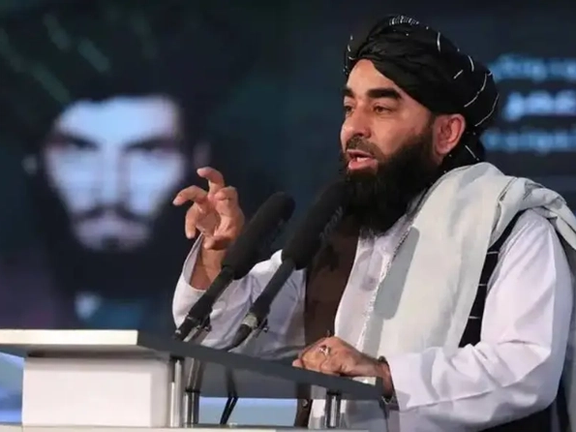
Zabihullah Mujahid, spokesperson for the Taliban, firmly declared that decisions from regional and global forums which are contrary to their interests would not be executed.

This assertion precedes the scheduled United Nations Security Council meeting on Afghanistan, set for Monday.

During an interview with Afghanistan National Radio, now under Taliban control, Mujahid expressed the group's favour towards international and regional meetings that align with the Taliban’s objectives.

Suhail Shaheen, leading the Taliban's political office in Qatar, emphasised to the press, the necessity of incorporating the Taliban's viewpoint in global resolutions to bridge disparities.

Today's United Nations Security Council session on Afghanistan unfolds in private, aiming to deliberate on the Doha discussions' aftermath and the designation of a special envoy to Afghanistan.

While Taliban’s opposing political and military factions endorse the special envoy's nomination, the Taliban deems such an appointment "unnecessary”.

Most Viewed

Female Ismaili Entrepreneur Shot Dead In Badakhshan
1

Female Ismaili Entrepreneur Shot Dead In Badakhshan

2

French Parliament Hosts Two-Day Meeting On Afghanistan

3

Afghanistan May Not Remain Intact In Future, Says Pakistani Analyst

4

Taliban, Iran Working On Surveillance App For Afghan Users, Say Sources

5

Pakistan Welcomes Local Ceasefire Agreement In Kunar & Nuristan Border Areas

•
•
•

More Stories

Taliban Enforces Capital Punishment At Jowzjan Stadium

Feb 26, 2024, 10:48 GMT+0

The Taliban's Supreme Court has disclosed that under the endorsement of Hibatullah Akhundzada, their leader, an individual accused of murder has been executed at a stadium located in Sheberghan, the principal city of Jowzjan province.

A formal declaration from the court on Monday revealed the condemned as Nazar Mohammad, the son of Amanullah.

According to the Supreme Court's assertion, Nazar Mohammad was found guilty of fatally stabbing Khal Mohammad, the son of Abdul Ali, two years ago.

The dispatch detailed that the execution verdict underwent validation by three distinct Taliban judicial bodies before receiving finalisation from Hibatullah Akhundzada, the group’s supreme authority.

Further, the communique verified the dispatch of a Taliban official from Kabul to Jowzjan for the direct oversight and observation of the execution. Preceding this event, Jowzjan's Taliban governance had circulated an invitation to the residents, urging them to come to the stadium to witness the execution deemed as "retribution.”

Additionally, on the preceding Thursday, the judicial arm of the Taliban had similarly proclaimed the execution of two individuals, accused of murder, at a Ghazni province stadium.

Eyewitnesses present at the Ghazni stadium told Afghanistan International that the Taliban executed the duo by the firing squad.

These judicial actions are unfolding against a backdrop of international apprehension, voiced by human rights entities over the Taliban courts' adherence to fair trial standards.

The human rights organisation, Rawadari, in a detailed investigative report, criticised Taliban tribunals for engaging in prejudiced rulings, employing torture, eliciting coerced confessions, and a glaring deficiency in judicial independence and impartiality, thereby infringing on the foundational principle of the presumption of innocence.

Taliban Leader Prohibits Human Appearances On TV Broadcasts In Kandahar

Feb 26, 2024, 09:58 GMT+0

Hibatullah Akhundzada, the Taliban's supreme leader, has issued a verbal directive to officials in Kandahar Province, instructing them to abstain from participating in video interviews, as confirmed by sources to Afghanistan International.

Kandahar National Television revealed a new policy which prohibits any human appearances on television broadcasts.

This directive comes close on the heels of a similar order issued by Mullah Shirin, the Taliban-appointed governor of Kandahar. He mandated that all government entities and local residents should avoid capturing and disseminating images or videos featuring living beings.

Further discussions with the Pashto section of Afghanistan International revealed that the Taliban's top leader has extended this ban to include video interviews with media outlets, indicating a significant shift in the group's media engagement strategy.

A reliable source disclosed, "Sheikh Sahib (Hibatullah Akhundzada) expresses frustration over the unnecessary media exposure and video interviews conducted by some ministers."

In response to these developments, it was noted that future media reports in Kandahar would exclude images and videos of living creatures.

Anonymous informants hinted at Akhundzada's intentions to implement these restrictions across additional provinces, signalling a broader enforcement of media control.

Afghanistan National Television in Kabul has reported unverified claims regarding the potential expansion of these image and video publication bans.

An impending meeting scheduled for next Tuesday between Taliban officials and media representatives is expected to clarify the scope of these new prohibitions.

Recent practices include publishing interviews with Taliban officials, such as Khalid Hanafi, the Minister of Vice and Virtue, in an audio format only, avoiding any visual content.

The group has also resorted to using archival images for publicising events, such as the Taliban foreign minister Amir Khan Muttaqi's visit to Turkmenistan, avoiding the release of current photos or videos.

Recalling their initial reign from 1996 to 2001, the Taliban had imposed a strict ban on photography, filming, and television viewing, categorising these activities, along with music and the depiction of living beings, as un-Islamic.

Despite these historical restrictions, since reclaiming power in August 2021, the Taliban has not reinstated a complete ban on visual media, utilising it instead for widespread propaganda dissemination.
Pity Doha Meeting Failed to Organise Dialogue With Taliban, Says Chinese Envoy

Feb 24, 2024, 14:21 GMT+0

Yue Xiaoyong, China's Special Envoy for Afghanistan, said that Beijing and regional countries sought dialogue with the Taliban during the Doha meeting, expressing regret that the meeting "failed" in achieving this objective.

Xiaoyong said that the United States should take responsibility for the reconstruction of Afghanistan, unfreeze Afghanistan’s assets and lift sanctions.

He also called for more humanitarian aid and moderate governance, along with providing educational opportunities for women and girls.

The Chinese envoy emphasised that his country is ready to work with the United Nations and regional partners, especially during the meeting of foreign ministers of Afghanistan's neighbouring countries, and other regional platforms to enhance engagement with the Taliban.

Xiaoyong said that the Doha meeting provides a platform to reflect all concerns about Afghanistan to ensure that the country does not become a hotbed of terrorist activities and that "it has inclusive institutions.”

The Doha meeting on Afghanistan was hosted by Antonio Guterres, the Secretary General of the United Nations, on February 18 and 19 with the participation of at least 25 countries and international organisations.

The representatives of the Taliban were not present in this meeting. However, five members of the civil society, including three women, were present on behalf of Afghanistan.

Global Community Committed To Address Women’s Rights Issue In Afghanistan, Says US Envoy

Feb 24, 2024, 11:56 GMT+0

Referring to the Doha meeting, US Special Envoy, Rina Amiri, said that the international community is committed to supporting the Afghan people, women's rights issues, and addressing their other problems.

Amiri added that the representatives of the Afghan civil society also asked the world to consider the deteriorating situation of women in the country.

On her X social media platform, she wrote, "The meeting reinforced that the international community remains largely united and committed to supporting the Afghan people and their struggle for economic stability, security, and respect for their rights, particularly addressing the plight of Afghan women and girls.”

The Doha meeting on Afghanistan was hosted by Antonio Guterres, the Secretary General of the United Nations, on February 18 and 19.

Following this meeting, the Secretary-General of the United Nations said in a press conference that the condition of women in Afghanistan has deteriorated. Additionally, he highlighted that the matter of addressing terrorist sanctuaries remains unresolved, and there has been no establishment of an inclusive government in the country.

Thomas West, the US Special Representative for Afghanistan, was one of the other members of the US delegation at the Doha meeting.

After the meeting, he said that the United States called on the United Nations to provide a road map for Afghanistan's full integration into the international system.

Officials From China & Turkmenistan Discuss Afghanistan

Feb 24, 2024, 10:36 GMT+0

Yue Xiaoyong, China's special envoy for Afghanistan, announced that he met Turkmenistan's Deputy Foreign Minister, Ahmet Gurbanov, and discussed the situation in Afghanistan.

He said that China backs Turkmenistan’s claim to hold the fifth meeting of the foreign ministers of Afghanistan’s neighbouring countries in 2024.

The Chinese special envoy wrote on X social media platform on Friday that they are enhancing their joint effort to help the reconstruction of Afghanistan.

The fourth meeting of the foreign ministers of Afghanistan's neighbouring countries had been held in Uzbekistan. Foreign ministers and representatives from Iran, China, Russia, Pakistan, Uzbekistan, Tajikistan, and Turkmenistan attended the meeting.

One of the objectives of these meetings is to address and find solutions to Afghanistan's political challenges through diplomatic discussions among the neighbouring nations.