Afghanistan Is Biggest Threat To Central Asia, Says Russian Defence Minister

In a meeting with senior military officials, Russian Defence Minister Sergei Shoigu declared Afghanistan as the primary threat to Central Asia on Tuesday.

In a meeting with senior military officials, Russian Defence Minister Sergei Shoigu declared Afghanistan as the primary threat to Central Asia on Tuesday.
"The situation in the region is still challenging," Shoigu stated. "The most significant threat persists from Afghanistan."
Explaining the threat to Central Asia, Shoigu added, "In the past year, the number of ISIS fighters has increased by 15 percent."
The Russian Defence Minister further stated that the primary goal of ISIS is to propagate radical ideology and engage in terrorist activities along the southern borders of the member states of the Collective Security Treaty Organisation.
Shoigu added, "A 20 percent increase in narcotics production and trafficking through the Central Asian republics is expected." At the same time, he emphasised, they are implementing preventive measures.
According to him, addressing the crisis situation in the countries of the region and participating in seven exercises in the territory of Kazakhstan, Kyrgyzstan, and Tajikistan are among the military plans of Russia and its allies in the member countries of the Collective Security Treaty Organisation.
In a meeting with his counterparts from Central Asia in Bishkek, the Secretary of the Russian Security Council, Nikolai Patrushev, warned that 20 terrorist organisations, with more than 23,000 fighters, are present in Afghanistan under the control of the Taliban.
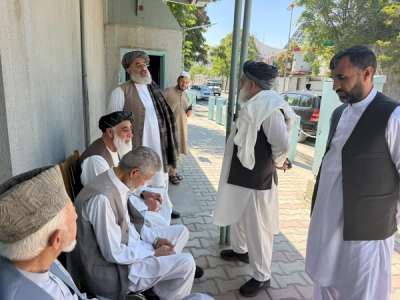

The officials of the Iranian Ministry of Justice have reported the handover of 1,136 Afghan prisoners to the Taliban over the past year.
The head of the Iranian ministry's prisoner transfer committee stated that these individuals were transferred to Afghanistan to serve out the remainder of their sentences.
Iranian Students’ News Agency, ISNA, reported on Tuesday, that Askar Jalalian, Iran’s deputy justice minister for human rights, raised this issue in a meeting with the Taliban ambassador in Tehran.
As per the report, Jalalian said, “Agreements regarding the transfer of prisoners, the extradition of criminals, and judicial assistance in civil and criminal matters have been finalised between the two countries. This stands as a clear example of the diligence and efforts to enhance legal and judicial relations between Iran and Afghanistan."
This Iranian official added that since 2013, 3,150 Afghan prisoners have been handed over to the Afghan authorities.
ISNA reported that Fazl Mohammad Haqqani, the Taliban ambassador in Tehran, appreciated the cooperation of the Iranian government for the implementation of the agreement on the transfer of prisoners to the country.
Earlier this year, Taliban officials announced that they had received 401 Afghan prisoners from Iran on multiple occasions.
In May 2023, the Taliban stated that 200 of the prisoners they received from Iran had been sentenced to death. Subsequently, in June 2023, the Iranian government transferred 180 Afghan prisoners to the Taliban in Herat, followed by another 101 prisoners separately.
During a visit to Kabul last month, the Iranian deputy justice minister, Jalalian, reportedly reached an agreement with the Taliban regarding the transfer of eligible prisoners to Afghanistan.
As per the Islamic Republic News Agency (IRNA), Jalalian emphasised that the prisoners' consent is a prerequisite for their transfer to their home country.

After a significant UN Security Council session on Afghanistan held on Monday, 11 countries issued a strong statement condemning the Taliban's ongoing gender discrimination and systemic oppression of women and girls.
These nations insisted on the Taliban's accountability for perpetrating human rights violations and targeting women.
The closed-door session featured a presentation by the UN's Deputy Secretary-General, covering various topics, including the crucial appointment of a special representative for Afghanistan.
The joint statement, backed by France, Japan, Switzerland, the UK, the USA, Ecuador, Malta, Slovenia, Sierra Leone, South Korea, and Guyana (the current rotating president of the Security Council), was publicly shared at the session's conclusion.
Highlighting the pathway to Afghanistan's stability and sustainable progress, the statement underscored the importance of an inclusive political process, adherence to the rule of law, and the upholding of human rights, with a special focus on women's rights. The countries denounced the Taliban's discriminatory and systematic abuses against women and girls, demanding the immediate cancellation of all women-suppressive policies, including restrictions on education, employment, and freedom of speech.
While the UN spokesperson withheld specific details about the discussions, it was noted that there was a clear division among the council's permanent members over handling the situation in Afghanistan, particularly between China and Russia versus Western nations. The latter group prioritised the respect for women's rights as a critical condition for any normalisation of relations with the Taliban, more so than some regional powers.
The statement also highlighted the acute humanitarian crisis in Afghanistan during the winter, calling on the Taliban to allow women's participation in aid organisation activities.

The UN Security Council's session on Afghanistan, held on Tuesday behind closed doors, ended without any official announcement of specific results or decisions.
Sources told Afghanistan International that serious disagreements among the permanent members over engagement with the Taliban complicated the decision-making for the council.
Western Countries' Concerns
The sources mentioned that the USA, UK, and France opposed China and Russia's demands for expanding economic relations of neighbouring countries with the Taliban.
They argued that expanding relations before forming a global consensus on engagement with the Taliban would diminish the international community's leverage to influence Taliban policies.
China and Russia, have cordial relations with the Taliban and support the normalisation of relations and easing of sanctions against the group. However, they oppose the Western priority of human rights in relation with the Taliban.
The disagreements among members has prevented the Security Council from issuing a joint statement on the meeting's content and their expectations from the Taliban. Stephane Dujarric, the spokesperson for the UN Secretary-General, briefly mentioned in a press conference after the Security Council session that the Deputy Secretary-General presented a report on Afghanistan to the members, but refrained from providing further details about the meeting.
Human Rights and Women's Rights
As anticipated, some countries, including the rotating president of the Security Council, insisted on observing women's rights and establishing an inclusive government in Afghanistan during the session.
Carolyn Rodrigues-Birkett, the rotating president of the Security Council, emphasised on the right to education, rights, and fundamental freedoms of women in Afghanistan.
The council's statement stressed that Afghanistan is a signatory to the Human Rights Declaration and a member of conventions on eliminating discrimination against women, children's rights, international civil rights covenants, and other human rights treaties.
Rodrigues-Birkett called on the Taliban to adhere to Afghanistan's international commitments.
Additionally, she strongly condemned the Taliban's enduring and structural gender discrimination and suppression of Afghan women and girls, urging the immediate repeal of all misogynistic policies and orders.
Meanwhile, sources told Aref Yaqubi, Afghanistan International's correspondent at the UN headquarters, that the USA, UK, Switzerland, France, South Korea, Japan, Malta, Sierra Leone, and Slovenia issued a joint statement after Monday’s session.
These countries also underscored human rights values in Afghanistan.
Special Representative
Sources indicated that appointing a special representative, who would be responsible for dealing with the Taliban on behalf of the international community with the support of countries involved in Afghanistan, was a significant topic of the session.
The Taliban have opposed the appointment of a special representative, asserting that with UNAMA's presence in Afghanistan, there is no need for another UN representative. The Taliban's Deputy Foreign Minister stated this week that Afghanistan's situation is not critical, hence the UN should not appoint a special envoy.
However, the UN Secretary-General's spokesperson stated in a press briefing that the issue of appointing a special UN representative for Afghanistan is being seriously pursued and work is ongoing.
Extension of UNAMA's Mission
Sources told Afghanistan International that participants in the Security Council session discussed UNAMA's mandates and operational structure and the special representative.
They also deliberated on extending UNAMA's mandate, which ends on March 17. UNAMA's one-year extension is expected and likely to be addressed in the next Security Council session in early March. Furthermore, according to sources, economic development, governance, aid delivery, and human rights in Afghanistan will also be discussed.
The session is expected to include the Secretary-General, the Special Coordinator, and representatives of aid organisations.
The inconclusive UN Security Council session indicates that after two years, the permanent members' positions on Afghanistan and the Taliban have not converged, and countries are reluctant to resolve differences.

On Monday, the National Resistance Front (NRF) declared that it had effectively "fired three rockets" at the Kabul Airport.
The assault, as stated by the Front, was directed towards the airport's military sector, resulting in the death of four Taliban air force members and injuries to three others.
The Front conveyed through the X social media network that this offensive took place at 6:40pm on Monday.
Further details provided by the NRF highlighted that the military zone of the Kabul Airport and Taliban helicopters were the specific targets of this operation.
This incident is notably the first instance of an armed opposition group successfully executing a rocket attack towards the Kabul Airport, marking a significant moment in the ongoing conflict with the Taliban.

The 55th session of the UN Human Rights Council kicked off on Monday, at the Council's headquarters in Geneva, Switzerland.
In a key event scheduled for the session, Richard Bennett, the UN's Special Rapporteur on Human Rights in Afghanistan, will present his latest findings on the human rights conditions within the country.
Nasir Ahmad Andisha, Afghanistan's Ambassador to Switzerland and Permanent Representative to the UN Human Rights Council, represents Afghanistan at this significant gathering. Ambassador Andisha has been actively sharing snapshots from the onset of the session on his X social media account, offering a glimpse into the proceedings.
Amid the session's unfolding, UN Secretary-General Antonio Guterres took to X to reflect on the global landscape, noting that the world is undergoing rapid changes. The intensification of conflicts is leading to unparalleled suffering, yet human rights stand as a steadfast pillar, he noted.
The council's agenda prominently features the human rights scenario in Afghanistan during its initial week, highlighting the international community's ongoing concern for the country.
In parallel, the UN Security Council is convening a dedicated session on Afghanistan in New York, reinforcing the global focus on the nation's evolving situation.
The Taliban's recent pronouncements, asserting that any regional or global decisions contrary to their interests will not be enacted, underscore the challenges facing international diplomatic and human rights efforts.
Notably, the Taliban lack formal representation within the UN and its Human Rights Council, as the United Nations does not officially recognise the group as the legitimate government of Afghanistan.