NRF Claims Attacking Taliban Checkpoint in Kabul
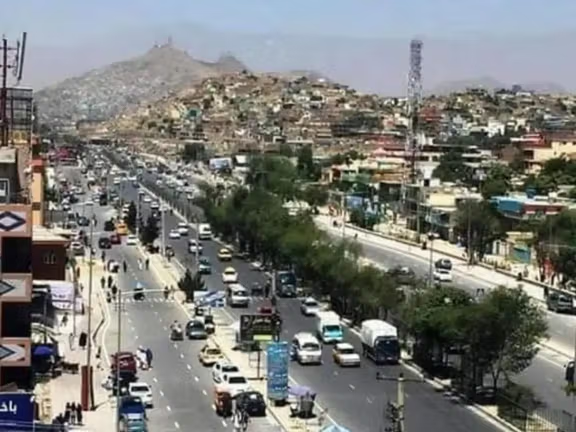
The National Resistance Front (NRF) announced on Wednesday that its forces attacked a Taliban checkpoint in the Karte Naw area of Kabul.
The National Resistance Front (NRF) announced on Wednesday that its forces attacked a Taliban checkpoint in the Karte Naw area of Kabul.
The front stated that in this attack, a Taliban member had been killed and two others got wounded.
In a statement on X social media platform, NRF wrote that the attack took place at 8:20 PM.
The Taliban has not yet reacted to the NRF’s claim.

Nikolai Patrushev, Russia’s Secretary of the National Security Council, said that the Ukrainian army and NATO are resorting to terrorist tactics due to their inability on the battlefield.
He mentioned that Ukraine and NATO are trying to tell Russia that the assault on Moscow could potentially be the work of the ISIS branch based in Afghanistan.
Following the armed assault on a concert hall on the outskirts of Moscow, resulting in numerous casualties, ISIS claimed responsibility for it. US officials attributed this attack to ISIS-Khorasan, situated in Afghanistan.
Subsequently, Vladimir Putin, the President of Russia, attributed the attack on Crocus City Hall to "radical Islamists”.
At the nineteenth meeting of National Security Advisors of the Shanghai Cooperation Organisation, the Secretary of Russia's National Security Council said that the terrorist attack on Crocus City Hall was well organised. He emphasised that the attack was accompanied by "broad and pre-organised Western media coverage”.
The Russian official added that the swift identification of the supporters of the terrorist attack in Crocus City is very important.
Regarding ISIS' claim of responsibility for the attack on Crocus City Hall, he said that both ISIS and other terrorist groups have been created by the United States
Previously, Putin had attributed the attack to "radical Islamists," whom he described as adversaries of the Islamic world for centuries due to their ideology.
He further remarked that the United States is employing various channels to persuade that Ukraine played no part in this "bloody terrorist" attack, insisting instead that the perpetrators were "followers of Islam" and members of the proscribed ISIS organisation in Russia.
Kassym-Jomart Tokayev, the President of Kazakhstan, emphasised on the importance of focusing on Afghanistan's development to prevent international terrorist groups from exploiting its territory.
He also stressed on the need for ongoing assistance to prevent the humanitarian crisis in Afghanistan.
Tokayev raised this issue on Wednesday at the nineteenth meeting of National Security Advisors of the Shanghai Cooperation Organisation (SCO). This two-day meeting began on Tuesday in Astana, the capital of Kazakhstan.
The Ministry of Foreign Affairs of Kazakhstan has stated that important international issues within the scope of the Shanghai Cooperation Organisation's responsibilities, such as collaborative counterterrorism measures, addressing separatism, extremism, and combating illegal drug trafficking, will be addressed during this meeting.
Additionally, a spokesperson for the Ministry of Foreign Affairs of Kazakhstan emphasised that combating organised crimes and fostering cooperation in international information security are key agenda items for this meeting.
Zabihullah Mujahid, the Taliban spokesperson, said that ISIS cannot pose a threat in Afghanistan. He dismissed concerns about the ISIS threat and called it "propaganda and exaggeration”.
Recently, Frank McKenzie, former CENTCOM commander stated that with the US forces’ withdrawal from Afghanistan, ISIS has strengthened in Afghanistan.
Mujahid told Radio and Television Afghanistan, under Taliban control, on Wednesday that ISIS is not a phenomenon that can cause trouble in Afghanistan. He labeled foreign concerns about the ISIS threat as an exaggeration.
Earlier, Abdul Salam Hanafi, the Taliban’s deputy prime minister, had stated that ISIS does not have a presence in Afghanistan.
Earlier, McKenzie warned of ISIS' strong desire to attack the United States and other foreign powers. He stated that the withdrawal of US forces from Afghanistan paved the way for the growth of ISIS' Khorasan branch in the country.
Mark Milley, former US Joint Chief of Staff, also recently warned of ISIS' intention to attack the United States, stating that the country remains ISIS' number one target.
While Taliban officials deny the presence of ISIS in Afghanistan, ISIS Khorasan recently claimed responsibility for a suicide bombing in Kandahar. Over 40 people, mostly Taliban members, had been killed in this attack.
Footage obtained by Afghanistan International shows that Dr Bashir, the former head of Taliban’s intelligence in Nangarhar province, accused the Taliban's purification commission of unjustly dismissing Taliban members from their positions.
Bashir, a prominent Taliban commander in the eastern zone, during the inaugural ceremony of the investigation of the Taliban purification commission, criticised the commission for dismissing a significant number of Taliban members. He stated that this issue has caused dissatisfaction among the Taliban in the province.
This Taliban commander mentioned that in the current system, not only does the Taliban have rights, but also the families who have fallen victim to the ISIS and lost their family members, should be accommodated within the ranks of the Taliban.
Many Salafis were killed or detained during Bashir's tenure as head of intelligence in Nangarhar, allegedly on suspicion of affiliating with ISIS, and he was the main accused.
Following the Taliban's defence minister Yaqoob Mujahid's directive, the purification of the group’s ranks has begun with new conditions, and after Maidan Wardak province, now it is being implemented in Nangarhar.
Reports emerged that on Tuesday afternoon, unmanned drones hovered for several hours over the office of Mullah Hibatullah, the Taliban's leader in Kandahar, setting off alarms within the group.
This aerial surveillance led to the decision to move their leader to a safer location in the Panjwai district.
According to sources of Afghanistan International, the prolonged drone presence over Mullah Hibatullah's Kandahar office was interpreted by Mawlawi Abdul Ahad Taleb, the commander of the Taliban leader's special security forces, as a direct and immediate threat to Hibatullah Akhundzada's safety, prompting a swift relocation.
The Taliban subsequently transferred their leader to the "Tolakan military base," located in Kandahar's Panjwai district.
Drone patrols have not been uncommon in the region, with Kandahar residents previously noting similar occurrences. Additionally, in recent days, individuals from Badakhshan, Panjshir, Kunar, and Laghman provinces reported drone sightings to Afghanistan International, pointing to a broader pattern of aerial surveillance.
In reaction to these incidents, the Taliban's spokesperson has pointed fingers at the United States, accusing it of infringing upon Afghanistan's sovereignty by violating its airspace.
Zabihullah Mujahid, in statements to the local press, has made it clear that these aircraft are unmistakably American, accusing them of entering Afghan airspace from neighbouring countries. He called for all involved parties to acknowledge their roles in this breach and to cease their invasive actions immediately.
Following their departure from Afghanistan, US officials have affirmed their commitment to keeping a watchful eye on terrorist activities within the country.
The assertion of Afghanistan's airspace still being under "occupation" by the United States has been a point of contention, voiced by several members of the Taliban leadership, including the group’s Defence Minister and the army's chief of staff.