Afghanistan Freedom Front Resumes Operations Against Taliban

The Afghanistan Freedom Front (AFF) has announced the resumption of its operations against the Taliban.

The Afghanistan Freedom Front (AFF) has announced the resumption of its operations against the Taliban.
According to the group, an attack was carried out on Friday at approximately 8PM in the Pul-e-Artal area of Kabul, resulting in the death of one Taliban member and injuries to three others.
Previously, during the month of Ramadan, the AFF had declared a temporary suspension of its attacks against the Taliban, which lasted for one month.
In this recent operation, the AFF targeted two patrol vehicles associated with the intelligence division of the Taliban's Ministry of Defence. A video released by the group captured the sound of the explosion.
As of now, Taliban officials have not issued any statements regarding the incident.
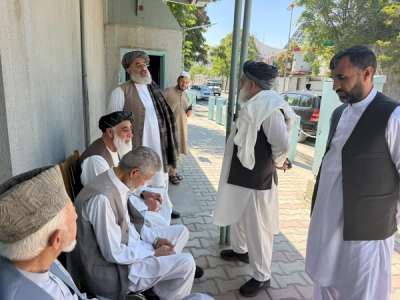

Led by former Afghan Vice-President Amrullah Saleh, Afghanistan's Green Trend (AGT), has reported that the Taliban's Ministry of Defence has requested a budget for 2024 that is double in value than that of the one sanctioned for 2023.
Taliban’s last year's defence budget was nearly 40 billion Afghanis, while this year's request exceeds 80 billion Afghanis.
On Friday, Afghanistan's Green Trend disclosed that it has accessed confidential documents from the Taliban’s Defence Ministry. They highlighted that although the Taliban keeps their security sector's budget highly confidential, they lack the expertise necessary to adequately safeguard their confidential documents.
The detailed data provided by Afghanistan's Green Trend shows that in 2023, the Ministry of Defence’s budget was over 39 billion Afghanis. For 2024, the requested budget is over 80 billion Afghanis.
This increase reflects a doubling from the previous year, attributed to escalating threats and internal rivalries within the Taliban. According to AGT, internal conflicts among Taliban leaders have so far prevented the approval of this year's proposed budget.
The breakdown of the Taliban’s defence ministry budget reveals that the majority of the budget is allocated to the directorates of weapons and tactics, strategic supplies, and administrative sectors. Notably, the budget for the weapons and tactics directorate has surged from 625 million Afghanis last year to 21 billion Afghanis this year.
Furthermore, while the strategic supplies directorate received over 12 billion Afghanis last year, it has requested more than 22 billion Afghanis for this year. The Ministry of Defence has also sought increased funding for the human resources sector in 2024.

Joseph Votel, former US Central Command Commander, said that with the Taliban's takeover of power, ISIS-Khorasan has found space for development.
Votel stated that the absence of US military forces and the Taliban's inability to provide security have allowed ISIS to become a significant threat.
According to Business Insider, prior to the Taliban's takeover of Kabul, ISIS’ activities were limited to Afghanistan. However, thereafter, it found more opportunities for expansion and took responsibility for attacks beyond Afghan soil, including a suicide attack on Qasem Soleimani's death anniversary ceremony in Iran and an attack on a concert hall in Moscow.
Votel, who oversaw military operations in the Middle East in 2010, told Business Insider, "It doesn't take very long for these organisations to rise up and become more capable."
Michael Kugelman, director of the South Asia Institute at the Wilson Center, also considered the US withdrawal and the Taliban's control over Afghanistan as key factors contributing to the strengthening of ISIS-Khorasan.
Business Insider reported that without US military presence in Afghanistan, options for combating ISIS are fairly limited. The report added that while the White House has previously emphasised a strategy for targeting terrorists with drones, there seems to be little evidence of the effectiveness of such a strategy.
This media outlet wrote that before the collapse of the previous Afghan government, the US had significant intelligence capabilities in Afghanistan and could conduct military strikes against terrorist groups, as well as provide advice and assistance to Afghan forces in key operations.
According to Business Insider, Votel stated that this "mowing-the-grass" approach to counterterrorism ultimately led to further strengthening and flexibility of ISIS, and the group is now focusing on expanding its influence in other regions.

Mohammad Kharwin, a member of the Hezb-e-Islami party of Afghanistan, listed on the US terrorist watchlist, was arrested following media reports of his free presence in the United States.
According to NBC News, Kharwin, 48, was arrested in March 2023 in San Ysidro, California.
US media outlets reported that Kharwin, despite being on the FBI’s terrorist watchlist, was freely roaming in the country.
According to the reports, Kharwin was detained in California in 2023 after illegally crossing the border from Mexico into the United States. However, because the information about him did not fully match the person on the watchlist, he was released on bail and under police supervision.
At the time of entering the United States, US Immigration and Customs Enforcement (ICE) agents apprehended Kharwin as one piece of his information matched an individual on the watchlist.
However, agents took his biometric data, and released him like any other asylum seeker. He was, then, allowed to apply for asylum and work permits and live and travel freely in the US for a year.
Nonetheless, the FBI provided information to ICE in February indicating that Kharwin had potential terrorist connections and could pose a national security threat to the country.
NBC News reported, citing sources familiar with the case, that almost a year after his release near the border, US police arrested him in San Antonio on February 28.
He was held in detention and on March 28, he appeared in the court. NBC News reported that prosecutors did not have classified information showing Kharwin’s tie the Hezb-e-Islami of Afghanistan, but they demanded his detention due to possibility of running away.
However, the judge released this member of the Hezb-e-Islami on bail.
FBI’s terrorist watchlist includes about 1.8 million people considered potential security threats.
The database shows that this individual is a member of the Hezb-e-Islami under the leadership of Gulbuddin Hekmatyar. According to the US, this party is a political and paramilitary organisation, designated as a terrorist organisation.
According to the US office of the director of national intelligence, Hezb-e-Islami is a "virulently anti-Western insurgent group" that sought to overthrow the West-backed government in Afghanistan before its collapse in 2021.
The party has been responsible for attacks in Afghanistan that resulted in the deaths of at least nine American soldiers and civilians from 2013 to 2015.
US does not consider this party a threat within its own borders.
Joe Biden, US president has said his priority for arresting and deporting immigrants is individuals considered a national security threat.
The US Department of Homeland Security responded to media criticism of Kharwin's release, saying that he was not released "knowingly".
The department told NBC News that initially the information did not fully match the person's information, but as soon as the information indicated that this person was of concern, he was arrested.

Fox News reported on Thursday, citing experts, that the differing Eid messages from two influential Taliban leaders indicate tensions within the group.
This media outlet wrote that unlike the strict stance of Hibatullah Akhundzada, Taliban’s leader, Sirajuddin Haqqani, the group’s interior minister, is looking to draw trust support from the outside.
According to Fox News, Akhundzada defended the implementation of Islamic laws in his Eid message and criticised the international community for objecting it. This American media outlet stated that Haqqani urged the Taliban to be humble and avoid behaviours that displease Afghans.
The Taliban leader pledged to publicly stone women in a direct message aimed at Western democracies.
In recent weeks, the Taliban have released two Eid messages attributing to Mullah Hibatullah.
The first Eid message was a written statement issued on Saturday in seven languages, including Arabic, English, Turkmen, and Uzbek. In this message, he issued recommendations to the officials of the group in the group’s administration.
The second Eid message was an audio file that the Taliban broadcasted after the Eid prayers held at the Eidgah Mosque in Kandahar. This half an hour audio file is in Pashto and has a fiery tone similar to the previous statements of Hibatullah.
In this speech, he said that he would never compromise with anyone over the implementation of Islamic law. “I won’t even take a step away from Shariah (Islamic law)”, he said.
Fox News wrote that the analysis of Haqqani's Eid message indicates that he is was looking to show a softer side and “to draw trust and support from a broader Afghan public aware of the Taliban’s brutal form of governance”.
Ahmed Rashid, a Pakistani journalist and author who has written books about Afghanistan and the Taliban, said that both leaders send a strong message to Taliban members that nothing has changed despite pressure from the West.
Rashid said that there is clearly a difference within the Taliban, but they stand together. “There are moderate elements that want to see women educated, but they’re not in a strong position so they’re biding their time,” said Rashid.

On Thursday, Human Rights Watch (HRW) released its report documenting violence against Afghan women in sports.
The organisation provided the documented report to the United Nations Special Rapporteur on violence against women and girls, who is expected to present a report to the UN General Assembly.
In addition to Afghanistan, the report also addresses violence against women in Mali and Haiti, as well as the exploitation of children in sports in Japan and gender testing of women athletes.
HRW’s report focuses on the deprivation of women's access to sports. The report highlights that the situation in Afghanistan has pushed some female athletes into hiding, compelling them to destroy evidence regarding their sporting activities, including medals and sports attire, due to fear of the Taliban.
Some female athletes in exile are seeking to compete in international competitions as representatives of Afghanistan. This initiative arises in protest against the prohibition on women's sports participation in Afghanistan's international competitions.
The Taliban, which oversees the Afghanistan Olympic Committee, prohibits women athletes from representing the country.
Human Rights Watch is calling for sanctions against the Afghanistan Olympic Committee, backed by funding from the International Olympic Committee, for its refusal to allow women's sports participation.
The Afghanistan Olympic Committee faced sanctions between 1999 and 2003 for its ban on women's sports, resulting in Afghan teams being excluded from international Olympic events.
Additionally, HRW’s report highlights a serious incident of violence against Afghan women in sports during the previous administration.
In 2019, The Guardian reported on sexual harassment of female athletes by Keramuddin Karim, the former head of the Afghanistan Football Federation. Subsequently, the Attorney General of Afghanistan issued an arrest warrant for him, but he was never arrested.
FIFA also found Karim guilty of sexual harassment and mistreatment of Afghan women footballers. The organisation imposed a USD 1,000,000 fine on Karim and permanently barred him from any involvement in football-related activities.
So far, the Taliban has not taken any legal action to address the sexual harassment allegations against the former head of the Afghanistan Football Federation. Instead, a Taliban official in Kabul met him in 2022.