Iran Halts Afghanistan's First Transit Train En Route To Turkey
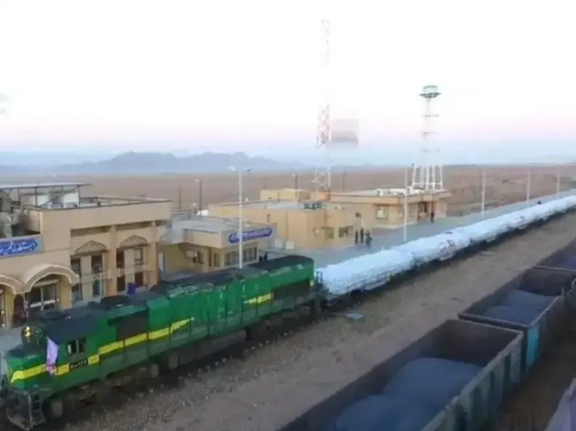
Afghanistan's inaugural transit train to Turkey was halted in Iran, as reported by ILNA news agency, citing sources.

Afghanistan's inaugural transit train to Turkey was halted in Iran, as reported by ILNA news agency, citing sources.
The train, loaded with 110 metric tonnes of mineral ore, was stopped at Rozanak railway station in Iran and was not allowed to proceed.
Neither Taliban officials nor the Islamic Republic of Iran have officially commented on the incident.
ILNA's report on Sunday highlighted the ambiguity surrounding Iran's decision to stop the train. Miad Salehi, CEO of Iran's Railway Company, stated that enhancing rail transit remains a priority. However, he noted that, for unspecified reasons, the first transit train and its official passage through the Khaf-Herat railway were halted at Rozanak station, and no locomotive was provided for the train's continuation.
An informed source suggested to ILNA that "financial issues" might be the reason for denying the train's passage.
Recently, the Taliban's railway authority announced the first-ever export of 1,100 metric tonnes of mineral ore to Mersin, Turkey, via rail. The shipment included talc, as specified by the authority.
The Taliban also noted that Afghanistan currently has railway connections to Iran and Turkmenistan, facilitating the daily export and import of hundreds of tonnes of commercial goods.


Khalid Zadran, the spokesperson for the Taliban police command in Kabul, confirmed an explosion in the western part of the city, resulting in one death and three injuries.
Zadran reported that the incident was triggered by an IED explosion in a passenger vehicle. He told the media that the explosion occurred in the Kote Sangi area, within police district 3 of Kabul, and that the magnetic bomb had been planted in a passenger vehicle.
Residents of Western Kabul had earlier reported a significant explosion in the area. Eyewitnesses shared videos on social media showing that Taliban members assaulted individuals who were filming the incident.
As of now, no group has claimed responsibility for the incident. Additional sources reported that at least three people might have been killed in the explosion. The Taliban police spokesperson stated that the vehicle's driver died, and three civilians were injured. He noted that Taliban members were present at the site and an investigation into the explosion is ongoing.
Previously, residents of West Kabul told Afghanistan International that an explosion occurred around 7 PM local time near the Gulayee Dawakhana area.

The Tehreek-e-Taliban Pakistan (TTP), in a statement, has accused Pakistan's Inter-Services Intelligence (ISI) for the assassination of Mohammad Omarjan Akhundzada, a prominent member of the Taliban in Afghanistan.
In their statement, the TTP said that the ISI "eliminates scholars and clerics to please their Western masters”.
Expressing sorrow, the TTP referred to the killing of Mohammad Omarjan Akhundzada as "extremely saddening news" and extended condolences to his family.
According to the Pakistan’s Balochistan State Police, Mohammad Omarjan Akhundzada possessed a Pakistani identity card.
Following the assassination of Omarjan Akhundzada, an advisor to Hibatullah Akhundzada, the leader of the Taliban, BBC Urdu, citing the Quetta city police in Pakistan, reported that he held a Pakistani identity card.
Quetta police confirmed that Akhundzada was a long-serving Imam at a local mosque and resided at his own house in the city, highlighting that non-citizens typically cannot own property in Pakistan.
The police authorities told BBC Urdu that investigations into the perpetrators and motives behind the murder of this cleric are ongoing.
A police official said that Akhundzada was shot and killed by unidentified armed individuals on Thursday night.
For 15 years, Akhundzada served as the imam of a mosque in Quetta's Kali area, according to police records.
Taliban’s spokesperson Zabihullah Mujahid issued a statement on the social media platform X, expressing condolences over Akhundzada's death, on Friday.
However, Taliban spokespersons and officials have not provided details on the exact circumstances or identities of those involved in Akhundzada's killing.
When BBC Urdu inquired about Akhundzada's connections to the Afghan Taliban, Abdul Hai Baluch, a spokesperson for Quetta police, claimed ignorance on the subject.
So far, no individual or group has claimed responsibility for the assassination of this Taliban figure.
Who was Mohammad Omarjan?
Radio Television Afghanistan (RTA), under Taliban control described Akhundzada as a member of the Taliban’s Supervisory Commission and a teacher at a jihadist school in Kandahar, although sources reported to Afghanistan International that he was a trusted advisor to the Taliban leader.
He had been a senior member of the Quetta Shura and was involved in establishing religious schools in Pakistan.
After the Taliban regained control of Afghanistan in August 2021, they transformed the Kandahar Mechanical Institute into a jihadist school, placing Mullah Mohammad Omar Akhundzada in charge. This school is located next to the Mandigak Palace, reportedly used by the Taliban leader as his office.
Sources noted that Hibatullah Akhundzada typically started his meetings with recitations from the Quran by Akhundzada, underscoring his significant role within the group.

The Taliban's Ministry of Refugees and Repatriation announced the forced repatriation of 837 Afghan immigrants from Pakistan to Afghanistan on Thursday and Friday.
According to the ministry, these immigrants entered Afghanistan through the Turghundi and Spin Boldak borders.
The Taliban stated that these individuals were directed to seek assistance from the United Nations High Commissioner for Refugees (UNHCR) and the International Organisation for Migration (IOM).
Simultaneously, as the second phase of forced expulsion of Afghans from Pakistan begins, this Taliban ministry reported that thousands of migrants are being expelled from Iran and Pakistan to Afghanistan every day.

The Taliban's Supreme Court announced that an individual in Zabul province has been sentenced to 39 lashes on charges of extramarital relations.
In a statement on Saturday, the court said that this individual had been punished in the presence of local Taliban officials in Shahjoy district.
Since taking power in Afghanistan, the Taliban has resumed physical punishments such as flogging, amputation, and execution, publicly punishing many citizens in various provinces.
Human rights defenders and the international community have repeatedly urged the Taliban to halt physical punishments of the accused. However, the group’s officials have stated that they will continue with punishments according to "Islamic Sharia law”.

Two days after the assassination of Mohammad Omarjan Akhundzada, an advisor to Taliban leader Hibatullah Akhundzada, BBC Urdu reported, citing Quetta police, that he held a Pakistani identity card.
Quetta police confirmed that Akhundzada was a long-serving Imam at a local mosque and resided at his own house in the city, highlighting that non-citizens typically cannot own property in Pakistan.
Authorities are still investigating the motives and identifying the perpetrators behind the cleric’s assassination, as per Quetta police.
A police official noted that Akhundzada was shot dead by unidentified gunmen on Thursday night.
The incident occurred as Akhundzada was returning home from the mosque when several individuals on motorcycles opened fire and then fled the scene, leading to his death from a chest gunshot wound.
For 15 years, Akhundzada served as the imam of a mosque in Quetta's Kali area, according to police records.
Taliban’s spokesperson Zabihullah Mujahid issued a statement on the social media platform X, expressing condolences over Akhundzada's death, on Friday.
However, Taliban spokespersons and officials have not provided details on the exact circumstances or identities of those involved in Akhundzada's killing.
When BBC Urdu inquired about Akhundzada's connections to the Afghan Taliban, Abdul Hai Baluch, a spokesperson for Quetta police, claimed ignorance on the subject.
Afghanistan National Television, controlled by the Taliban, broadcast a statement condemning the assassination as a "major crime," but no group or individual has yet claimed responsibility for this act.
State television described Akhundzada as a member of the Taliban’s Supervisory Commission and a teacher at a jihadist school in Kandahar, although sources reported to Afghanistan International that he was a trusted advisor to the Taliban leader. He had been a senior member of the Quetta Shura and was involved in establishing religious schools in Pakistan.
After the Taliban regained control of Afghanistan in August 2021, they transformed the Kandahar Mechanical Institute into a jihadist school, placing Mullah Mohammad Omar Akhundzada in charge. This school is located next to the Mandigak Palace, reportedly used by the Taliban leader as his office.
Sources noted that Hibatullah Akhundzada typically started his meetings with recitations from the Quran by Akhundzada, underscoring his significant role within the group.