Taliban Releases Detained Iranian Border Guards, Reports Iranian Media
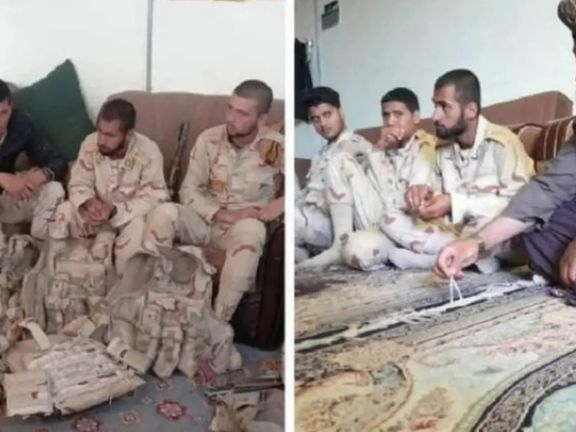
Iranian state news agencies reported on Thursday that the Taliban has released six Iranian border guards.
Iranian state news agencies reported on Thursday that the Taliban has released six Iranian border guards.
These guards had been detained earlier on Thursday after entering Afghan territory in Farah province.
Mehr and ISNA news agencies wrote that six Iranian border guards who were detained by the Taliban at the Afghanistan border had been released a few hours ago.
Earlier, sources told Afghanistan International that Taliban border forces had arrested six Iranian soldiers who had crossed the border in Farah province.
Iran had stated that these forces had "mistakenly entered Afghan territory."
The Taliban had handed over the detained border guards to the intelligence department for further investigation.

The Committee to Protect Journalists (CPJ) called for the immediate release of three journalists - Ismail Saadat, Wahidullah Masum, and Ehsanullah Tasal - detained in Khost province.
The committee urged the Taliban to refrain from harassing and mistreating journalists.
Saadat, a journalist of Radio Naz; Masum, a journalist of Radio Iqra, and Tasal, a journalist of Radio Wolas Ghag, were detained on Monday, April 22, after being summoned by the provincial directorate of the Taliban’s Ministry of Propagation of Virtue and Prevention of Vice.
Sources informed CPJ that the Taliban detained these journalists for broadcasting music and talking to female callers.
According to the sources, these three journalists have been transferred to the police command of Khost province and are expected to face trial soon.
After the takeover of power in Afghanistan, the Taliban banned the broadcast of music in the media.
The Afghanistan Journalists’ Centre (AFJC) reported that Taliban authorities in Khost province last month prohibited women and girls from making phone calls to the media.
According to AFJC, female listeners in some cases used to call in for questions and answers during educational programmes.
Carlos Martinez de la Serna, CPJ’s programme director, called the detention of Khost journalists "the latest example of ruthless media suppression by the Taliban”.
The Taliban has stated that media can only operate within the framework of the values and policies approved by the group in Afghanistan.
Earlier, the Taliban banned the operation of two television networks on charges of violating "national and Islamic values”.
Furthermore, the Taliban's Minister of Communications announced plans to impose restrictions on Afghan users' access to Facebook in Afghanistan.
The Ministry of Transport of Uzbekistan announced on Thursday a plan to establish a new multi-modal transportation corridor via Afghanistan.
Tashkent aims to connect Belarus, Russia, Kazakhstan, and Pakistan through this initiative to bolster trade in Central Asia.
Transport ministers from these countries met on Tuesday, in Termez, Uzbekistan, to discuss this trade corridor.
According to a statement from Uzbekistan’s Ministry of Transport, participants in the meeting discussed connecting Central Asia and the South Asian countries through the development of a multi-modal transportation corridor to increase Uzbekistan's transit capacity.
This initiative includes plans to enhance transportation, as well as the analysis of transit shipments, digitising documents, and simplifying transit processes between countries.
In November 2023, during the Shanghai Cooperation Organisation Transport Ministers’ Meeting in Tashkent, Russia, Kazakhstan, and Uzbekistan signed a memorandum to establish this corridor.
Uzbekistan reported a significant increase in cargo transportation through Afghanistan since 2021. According to their statistics, transit cargo volume reached 675,000 tonnes in 2022 and one million tonnes in 2023.
Uzbek authorities express hope that this volume will increase in 2024.
The proposal for a new transportation corridor comes as Uzbekistan, with this ambitious initiative, seeks to diversify its trade routes, upgrade transportation infrastructure, and reduce reliance on Russia.
Informed sources have confirmed that Taliban’s intelligence agency has detained several employees of the former government’s Ministry of Foreign Affairs.
Sources said that these detentions have caused deep concern and fear among the ministry's staff.
It is said that among the detainees is Sayed Nabi Nabil, a former advisor of the Afghanistan embassy in Saudi Arabia. Some users on social networks have introduced him as a member of the Jamiat-e-Islami Party led by Salahuddin Rabbani.
Sources told Afghanistan International that some employees of the Ministry of Foreign Affairs, especially non-Pashtuns, are concerned about their detention for ethnic reasons.
So far, there are no details available about the reason for the detention of these employees.
During a recent meeting with Iran's Special Envoy, Hassan Kazemi Qomi, Abdul Ghani Baradar, the Taliban's Deputy Prime Minister for Economic Affairs, confirmed that water from the Helmand River has reached Iran's Sistan and Baluchestan Province.
Baradar described the evolving relationship between the Taliban and the Islamic Republic as "improved and positive”, noting that the water transfer could help resolve many bilateral issues.
The meeting, held on Thursday, included the presence of the Taliban's Ministers of Energy and Water, Information and Culture, Agriculture and Livestock, and their ambassador in Tehran, as reported by Mullah Baradar's press office.
The discussions centered on enhancing political, economic, trade, and transit relations, as well as broadening bilateral cooperation across various sectors.
Baradar emphasised on the need for continued collaboration between the Taliban and the Islamic Republic to foster these improvements.
He highlighted that this year's high rainfall had helped channel water from the Helmand River into Nimroz Province and onward to Iran, which he believes will alleviate some challenges faced by both nations. Baradar also urged Iran to facilitate the transit of Afghan goods to European markets more effectively.
In response, Kazemi Qomi expressed satisfaction with Helmand River water reaching Sistan and reaffirmed Iran's commitment to collaborate with Afghanistan on resolving issues related to banking for traders, environmental protection, agricultural development, and the enhancement of trade and transit routes through Iran.
Furthermore, Baradar called on the Islamic Republic to stop the forced deportation of Afghan migrants, advocating for better coordination on this matter between the two governments. Additionally, the head of Iran's Environmental Protection Organisation reported that approximately 50 to 60 million cubic metres of water have been released from the Helmand River under Iran's water rights, with expectations for this amount to increase following ongoing negotiations.
Amnesty International's recent report has highlighted the dire human rights situation in Afghanistan.
The organisation has pointed out severe repression and violations suffered by the Afghan people, with a particular emphasis on violence and discrimination against ethnic groups, notably the Hazaras.
Released on Tuesday, April 23, the report also mentioned the Taliban's policies targeting women and girls, to eradicate their presence from social spheres.
This report coincides with the release of the US State Department's report on human rights in Afghanistan and other countries. The State Department report highlighted sexual violence, the marginalisation of women from public life, and condemned the Taliban for their brutality in prisons, including killings and torture.
In its report, Amnesty International stated that people's freedoms have been severely compromised. The organisation added that if anyone criticises the Taliban, they will face forced disappearance, arbitrary detention, self-detention, torture, and various abuses.
The report by Amnesty International refers to cases of detention and torture of individuals previously highlighted by the United Nations Mission in Afghanistan.
The organisation said that the Taliban has not conducted any investigation into allegations of torture of individuals.
Ethnic and Religious Discrimination
In addition to curtailing freedom of speech, religious minorities in Afghanistan have suffered under the Taliban rule. Amnesty International's report highlights the further marginalisation and discrimination faced by ethnic groups and religious minorities.
The report underscores that Uzbeks, Hazaras, Tajiks, and Turkmen communities are experiencing heightened marginalisation, and often forcibly displaced from their homes and lands.
Furthermore, Taliban officials have consistently favoured tribal communities, predominantly Pashtuns, in disputes over land and livestock, particularly in conflicts involving Hazaras.
Hazaras have been compelled by the Taliban to compensate tribals for missing livestock dating back to 20 years ago.
Additionally, the report documents targeted attacks on Hazara individuals, including the killing of men from this ethnic group in the Uruzgan province.
Non-Afghan Casualties
Taliban officials have repeatedly claimed that security has returned to Afghanistan for the people and foreign officials. However, Amnesty International says that civilian casualties continue despite the end of armed conflict.
Quoting United Nations Assistance Mission in Afghanistan (UNAMA), after the Taliban's return to power in 2021, more than 3,500 people were killed and injured in Afghanistan. Most of the casualties were caused by ISIS attacks in Afghanistan. This is while the Taliban has repeatedly downplayed the threat of ISIS.
The Taliban has not reacted to the reports by the US State Department and Amnesty International. However, prior to this, officials and spokespersons of the group had refuted human rights violations, especially women's rights violations, in Afghanistan.