Iranian President Allocates 3 Billion Euros For Border Obstruction Project
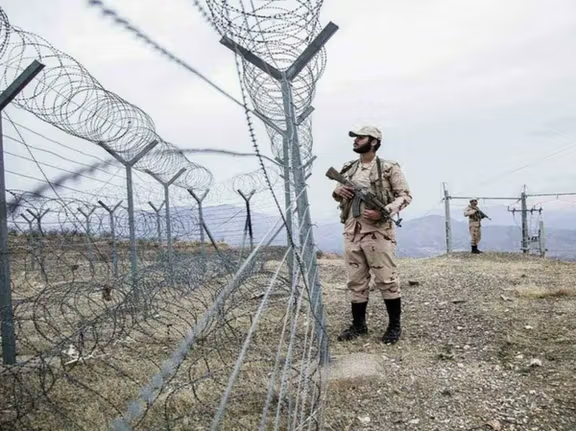
Ebrahim Raisi, the President of Iran, has allocated three billion euros to the General Staff of the Armed Forces of Iran for border obstruction.

Ebrahim Raisi, the President of Iran, has allocated three billion euros to the General Staff of the Armed Forces of Iran for border obstruction.
Majid Mirahmadi, Iran’s Deputy Minister of Interior, highlighted that routes used for human and arms trafficking, including the Afghanistan border, are a priority according to this plan.
According to Iranian media reports, Mirahmadi emphasised that border obstruction entails a comprehensive plan implemented in several layers, including fences, walls, and intelligent border control systems.
He mentioned that Raisi has endorsed the border obstruction plan and has instructed the armed forces to commence the process within five years with this budget.
This Iranian interior ministry official stated that Iran is fortifying its borders to enhance security and deter human and arms trafficking.
Mirahmadi pointed out that more than USD 20 billion worth of smuggled goods enter or leave Iran annually.
He stressed that addressing drug trafficking and insecurities in Iran can all be tackled through fundamental investment in border security measures.

The National Resistance Council for the Salvation of Afghanistan has issued a stark warning that the current situation under the Taliban’s rule presents a greater danger than the Soviet occupation.
In a statement, the council urged for an extensive and definitive resistance against the Taliban, involving all political, military, and civilian sectors of Afghan society.
Highlighting the Taliban's refusal to engage in meaningful dialogue to resolve Afghanistan's crises, the council criticised the group for its focus on a small, ethnically and ideologically homogenous faction, disregarding the broader Afghan populace.
In a statement, the National Resistance Council outlined its commitment to exploring all methods of resistance, depending solely on divine support and the resilience of the Afghan people.
Moreover, the council has called on the international community and neighbouring countries to hear the plight of the Afghan people rather than continuing their unilateral support for the Taliban regime. It strongly advised against any engagement with or support for the current rulers of Afghanistan.
The council also cautioned that any agreements made with the Taliban regarding the exploitation of Afghanistan's natural resources are both illegitimate and illegal, calling such actions as plunder.
Reflecting on the historical significance of the Mujahideen's victory over the Soviet forces, the council acknowledged this monumental triumph while also noting the painful and instructive events that followed.
The National Resistance Council for the Salvation of Afghanistan comprises veteran leaders of the anti-Soviet Jihad, former government officials, and leaders of significant Afghan political parties. Established abroad after the Taliban's takeover, its influential members, including Marshal Abdul Rashid Dostum, Atta Mohammad Noor, Mohammad Mohaqiq, Abdul Rab Rasul Sayyaf, and Sarwar Danish, continue their activities from outside Afghanistan.

The US State Department announced that John Bass, Acting Under Secretary of State for Political Affairs, will travel to Doha and Islamabad to discuss Afghanistan and regional security interests with Qatari and Pakistani officials.
The department stated that the trip will take place from April 26 to 30.
In a statement, the US State Department said that Bass will meet with senior Qatari government officials and other diplomatic missions to discuss supporting Afghanistan and shared security interests in the region.
The department added that in Islamabad, he will also discuss a range of regional and bilateral issues as part of US-Pakistan cooperation with senior government officials.
Bass has served as the US Ambassador to Afghanistan from December 2017 to January 2020.

During a meeting with Taliban officials in Kabul, Serik Zhumangarin, Deputy Prime Minister of Kazakhstan, announced his country's readiness to assist in the digitisation of the Taliban government.
Zhumangarin stated that Kazakhstan will also collaborate in connecting Afghan schools to the internet and ensure that all children have access to education.
The Taliban's Ministry of Commerce and Industry reported on Friday about a meeting between the group and officials from Turkmenistan and Kazakhstan in Kabul.
The ministry, without providing further details, mentioned that discussions in the meeting focused on connecting North Asia to South Asia and reducing transit and transportation costs.
Zhumangarin expressed during the meeting, "We are eager to share our experiences with our Afghan partners."
Both sides also discussed increasing internet speed in Afghanistan from 60 to 100 gigabits per second.
Additionally, during the official visit of the Kazakh delegation to Afghanistan, 35 Kazakh companies showcased their products and services at the Kazakhstan-Afghanistan Trade Expo in Kabul.

The Afghanistan Freedom Front (AFF) has claimed responsibility for a recent attack on a Taliban base in the Qaleh-e Najara area of Khair Khana, Kabul, which occurred on Friday evening.
The assault resulted in the deaths of three Taliban members and injuries to another. Additionally, two Taliban military vehicles were reportedly destroyed in the attack.
The AFF released a video showcasing the assault, describing it as a "targeted and precise operational attack" on a Taliban outpost located in Kabul’s 11th district. The Front alleges that this newly established outpost was actively involved in scrutinising, detaining, and harassing locals, particularly young people from North Kabul and Panjshir, and was also used for imprisoning them.
Further details provided by the AFF state that the Taliban utilised this outpost to conduct raids on homes in Khair Khana area without prior notice.
With an increase in attacks over recent months, the AFF has expressed concerns about the deteriorating human rights situation in Afghanistan. The group is calling for an international humanitarian intervention to assist the Afghan people.

On Friday, the Ministry of Commerce and Industry of the Taliban announced a meeting between the group and officials from Turkmenistan and Kazakhstan in Kabul.
The ministry stated that discussions focused on connecting North Asia to South Asia, reducing transit costs, and improving transportation.
While details of these discussions remain undisclosed, the Taliban's Ministry of Commerce has announced an agreement to establish a joint technical committee for ongoing discussions between the Taliban, Turkmenistan, and Kazakhstan.
The Taliban’s Minister of Commerce, the Deputy Prime Minister of Kazakhstan, and the Deputy Prime Minister of Turkmenistan were present at the meeting.
Prior to this gathering, Taliban officials engaged in bilateral discussions with delegations from Turkmenistan and Kazakhstan, focusing on economic relations.
The launch of a large joint logistics centre in Turghondi, the development of Afghanistan's railway infrastructure, facilitation of oil and gas transfer from Turkmenistan to Afghanistan, resolution of quarantine issues for Afghan exports and transit goods, development of banking relations, and the exportation of Afghan minerals, were among topics discussed between the Taliban Minister of Commerce and Mammetkhan Chakyyev, Deputy Prime Minister of Turkmenistan.
In another meeting, the Minister of Industry and Trade of the Taliban spoke with Serik Zhumangarin, Deputy Prime Minister, regarding mineral extraction in Afghanistan.
Despite this, no country has officially recognised the Taliban till date, although some nations in the Middle East maintain economic relations with them.
Since taking over power, the Taliban have repeatedly asked countries to invest in Afghanistan, especially in mining sector.
