UN Special Rapporteur Urges Taliban To Assist Flood Victims Immediately
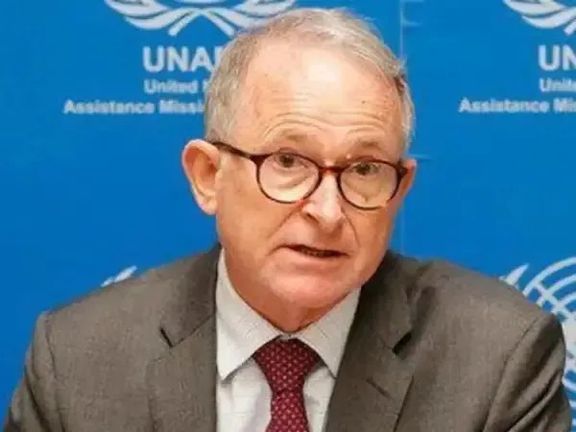
Richard Bennett, the UN Special Rapporteur on human rights in Afghanistan, has called on the Taliban and international actors to immediately assist flood victims in Afghanistan.
Richard Bennett, the UN Special Rapporteur on human rights in Afghanistan, has called on the Taliban and international actors to immediately assist flood victims in Afghanistan.
He emphasised that the recent floods serve as a reminder of Afghanistan's vulnerability to climate change.
The UN official, on Saturday, expressed condolences to the families of the flood victims, urging the Taliban and international actors to provide long-term assistance to those affected by the floods.
The Taliban is yet to provide a comprehensive tally of the overall casualties and damages caused by the floods across Afghanistan even after a week since the natural disaster occurred. However, the group has reported 50 deaths in Balkh and 20 in Takhar till now.

The Ministry of Refugees and Repatriations of the Taliban announced that in a single day, 582 Afghan migrants returned from Pakistan, both "forcibly and voluntarily”.
According to the ministry's statement, these migrants entered Afghanistan on Thursday through the Torkham border crossing.
The Ministry of Refugees of the Taliban, on Saturday citing border officials in Torkham said that 67 families totalling 336 individuals were "forcibly" expelled from Pakistan, and another 48 families, compromising 246 individuals, returned to Afghanistan "voluntarily”.
The Taliban claims to have provided 10,000 Afghanis to each family.
The statement mentioned that expelled migrants from Pakistan have been referred to international organisations for assistance.
Following Abdulhamid Khorasani's protest against "Taliban ethnocentrism," several non-Pashtun Taliban members warned that if the insults against him continue, they will split up from the Taliban.
This Tajik-origin commander, through a video, supported the protests in Badakhshan and opposed the suppression of protesters.
The people of Badakhshan, following the murder of two residents in Darayim and Argo districts, launched widespread protests against the Taliban.
The residents of Badakhshan said that non-local Taliban members entered the privacy of people's homes "under the pretext of destroying poppy fields," "harassed women," and killed two residents of these districts.
With the continuation and expansion of protests in Badakhshan, the Taliban sent a military delegation led by Fasihuddin Fitrat, the group’s Chief of Staff of Army, to Badakhshan.
Local residents informed Afghanistan International that the Taliban sent hundreds of fighters with light and heavy equipment "to suppress protests" in Darayim, Argo, and Jurm districts on Wednesday.
However, Khorasani, supporting the protests in Badakhshan, advised Fitrat to prevent the group's army from attacking the people of Badakhshan.
He also urged the Taliban to punish the perpetrators of the killings of two local residents in Badakhshan. In an audio file obtained by Afghan International, he stated, "If the [Taliban] regime is ethnic and biased, I will not serve for a moment."
However, some non-Pashtun Taliban, along with this Tajik-origin Taliban commander, have warned of separation from the Taliban if the insults against Khorasani continue. In a video file, they stated, "The Islamic Emirate [Taliban] is not anyone's personal property. We must all be united. We are one nation, including Hazaras, Tajiks, Uzbeks, and Pashtuns."
Shehbaz Sharif, the Prime Minister of Pakistan, has announced that the country is prepared to engage in "preferential" trade discussions with Afghanistan and Azerbaijan.
During an economic conference, Sharif stated that talks with Azerbaijan, Afghanistan, and other interested nations regarding preferential trade agreements are ongoing.
However, Pakistani authorities have not disclosed further details regarding preferential trade with Afghanistan and Azerbaijan.
The official also highlighted the benefits of the country's trade with Uzbekistan and Tajikistan through Afghanistan. Additionally, the Prime Minister stressed on the urgent need for measures to enhance the competitiveness of Pakistani products in order to expand export markets.
Dawn, a Pakistani newspaper, reported that the completion of a free trade agreement with Gulf states was also deliberated at this conference.
Furthermore, there was emphasis on the "close monitoring" of transit trade with Afghanistan.
The Pakistani Prime Minister has called for the development and implementation of a comprehensive strategy to assess the performance of customs officials.
This development comes while reports indicate a decline in trade relations between Afghanistan and Pakistan ever since the Taliban took over power in the country.
Arafat Muhajir, the Taliban's head of information and culture in Nangarhar province, claimed that during protests along the Torkham-Jalalabad route, one Taliban member and "some individuals who had usurped lands" had been killed.
However, protesters said that they possess legal documents and evidence.
According to some residents of Nangarhar province and Taliban officials, the protests began after the Taliban instructed residents to vacate their homes and areas, saying that these land parcels belonged to the government.
Taliban officials argued that these properties are state-owned lands seized from the people years ago. However, local residents claim that the rightful owners of these properties are Kuchis (tribals) who have legal documents.
Meanwhile, some demonstrators have alleged that the Taliban issued orders to demolish their personal homes. Protesters informed Afghanistan International that as a result of direct firing by the Taliban at the protesters, at least three people, including a woman, were killed, and four others were injured.
Now, Muhajir claims that after the group sought to reclaim state-owned lands from "land usurpers," they incited chaos, resulting in the death of one member of the group.
However, he has not provided any explanation regarding the identity of the group member who had been killed. This Taliban official confirmed that several "land usurpers" were also killed.
Nevertheless, no precise figures regarding the casualties from the protests have been provided. Earlier, the number of fatalities was reported to be three.
While the Taliban has been targeting these protesters, the group also killed at least two residents of Darayim and Argo districts in Badakhshan province last Friday and Saturday by gunfire. This led to unprecedented protests against the Taliban in Badakhshan. Taliban officials claimed that these two residents of Badakhshan were killed "for defending the forbidden poppy cultivation”.
This is happening at a time when, following the Taliban's takeover of Afghanistan, people are less inclined to protest to assert their rights.
Over the past nearly three years in Afghanistan, Taliban members have largely resorted to violence against protesters.
Noorullah Nazari, the Taliban’s spokesperson for the group's army unit in Badakhshan, announced the commencement of the poppy eradication operation in Darayim and Argo districts.
Nazari emphasised that this operation will be conducted by army units in collaboration with local people.
The Bakhtar news agency, under Taliban control, has also released a picture of the poppy eradication operation in Badakhshan.
This news comes amidst mass anti-Taliban demonstrations in Darayim and Argo districts. Residents of Badakhshan have reported the deployment of hundreds of Taliban fighters, armed with both light and heavy weaponry, to these districts.