BRICS Foreign Ministers Calls For Peaceful Solution To Afghanistan Issue
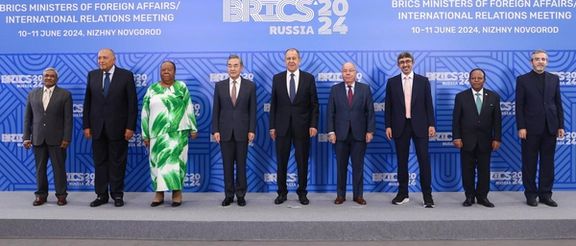
The Foreign Ministers of BRICS called for an immediate peaceful solution to the Afghanistan issue to enhance security and stability in the region.
The Foreign Ministers of BRICS called for an immediate peaceful solution to the Afghanistan issue to enhance security and stability in the region.
In a statement, the BRICS Foreign Ministers wrote that tangible actions should be taken in Afghanistan to ensure that terrorist groups do not use Afghan soil.
They emphasised on Afghanistan's independence and peace and supported an Afghanistan free from terrorism, war, and drugs.
The BRICS Foreign Ministers' meeting was held for two days (June 10 and 11) in the city of Nizhny Novgorod, Russia.
According to the statement, the BRICS Foreign Ministers stressed on the need for immediate and uninterrupted humanitarian assistance to the people of Afghanistan and the protection of the fundamental rights of all Afghans, including women, girls, and various ethnic groups.
BRICS, consisting of major emerging economies including Brazil, Russia, India, China, and South Africa, was formed in 2010 with the goal of seeking a stake in the global order. Iran joined this group last year.
The Foreign Ministers of this organisation discussed international issues, strategies to enhance global governance, conflict resolution in multilateral frameworks, and emphasized increasing the influence of developing countries.

The International Research Council For Religious Affairs (IRCRA) reported that the Kandahari Taliban adopt a stricter and more conservative stance on girls' education compared to the Haqqani Network and the Taliban from Paktika.
According to this Pakistani organisation, the Taliban, fearing the progress of Afghanistan, prevent the education of girls.
This research, titled "Taliban Profile: Views and Strategies," examines the policies and perspectives of the Taliban over the past year.
The researchers traveled to Afghanistan and interviewed dozens of Taliban officials, including Mullah Shirin, the group's governor in Kandahar and senior advisor to Hibatullah Akhundzada, Taliban leader, as well as researchers and members of Afghan civil society.
A copy of this report has been obtained by Afghanistan International.
The authors of the IRCRA believe that the Kandahari Taliban oppose girls' education because they fear that allowing women in public spaces will "lead Afghanistan towards modernisation and progress”.
The study states that the Kandahari Taliban believe that "granting rights to women will blur the boundaries between democracy and Islamic Sharia”.
Fragmentation Within Taliban
The IRCRA noted that the Taliban is a fragmented movement with noticeable regional divisions. Their approach to the Taliban's ideology also varies.
The report identifies three main divisions within the Taliban: extremist/moderate, tribal/regional (such as the contrast between Kandahari and Paktika Taliban), and the distinction between military forces and the political class.
Despite internal rumours of dissent, the Pakistani research institution believes that the Taliban leader's control over the group is "stable and unchallenged”.
Rural vs Urban Taliban
The authors suggest that Kandahari Taliban leaders have lived in rural areas, while Haqqani Network leaders have resided in Pakistani cities, influencing their views on issues like women's education and relations with the outside world.
The study indicates that Kandahari Taliban, who lived in remote areas of Pakistan such as Chaman, Qilla Abdullah, Qilla Saifullah, Kuchlak, and the outskirts of Quetta, were not familiar with modern urban phenomena like women's education.
Conversely, the Taliban from Paktika, who mostly live in Kabul, Khost, Paktia, Paktika, and parts of Logar, have relatively open views on issues like women's education due to their experiences living in Pakistani cities like Islamabad, Bannu, Peshawar, and Dera Ismail Khan.
The study also notes that the Paktika Taliban, due to their close ties with foreign militants like Al-Qaeda and Tehreek-e-Taliban Pakistan (TTP), and their urban experiences, are considered relatively moderate, pragmatic, and open to engagement with the world.
Power and Influence in Kandahar
The IRCRA states that the Kandahari Taliban comprise religious scholars and jihadist commanders residing in Kandahar, Helmand, Farah, Uruzgan, and parts of Nimroz. Kandahar is the group's power center, and the Kandahari Taliban have significant influence within the Taliban leadership.
Hibatullah's Inner Circle
This organisation provided information about members of Hibatullah’s close circle. According to the study, Khalid Hanafi, Minister for the Propagation of Virtue and Prevention of Vice; Fariduddin Mahmood, Head of the Academy of Sciences; Yousuf Wafa, Governor of Balkh; Mullah Shirin, Governor of Kandahar; Abdul Hakim Haqqani, Minister of Justice; Noor Mohammad Saqib, Minister of Hajj and Religious Affairs, and Habibullah Agha, Minister of Education, are close advisors to the Taliban leader.
These individuals advise the group’s leader on important issues, especially those related to religious matters and foreign affairs.
5,000-Strong Suicide Unit
The study revealed that Hibatullah has formed an independent 5,000-strong unit for suicide bomber forces. The IRCRA noted, "The Taliban leader holds great respect for those who voluntarily join the suicide unit."
Despite the end of the war against the US and the former Afghan government, the Taliban's suicide units remain active.
The report stated that the Taliban leader closely oversees the support to the families of deceased fighters, who are under the care of the Ministry of Martyrs and Disabled Affairs. This initiative aims not only to address these families' needs, but also to strengthen loyalty within the Taliban ranks.
Security Apparatus Monopolised by Taliban
The study highlighted that the Taliban only allow their members and relatives into the security apparatus. Taliban fighters have been promised gradual integration into the army and police.
The chances for non-Taliban individuals to join the army and police are very low.
Doha Office's Diminished Credibility
The study noted that some Taliban members view the Doha office with suspicion, causing a rift between Taliban commanders and Doha office members who have engaged in political negotiations with foreign officials over the past few years.
According to an analyst close to a Taliban commander, the Taliban commanders and fighters feel that Doha office members have a luxurious and comfortable life. Additionally, they believe the Doha office members have been given undue credit for the US withdrawal from Afghanistan, while the commanders feel they played the primary role in forcing the US to leave.
The report stated that the Taliban leader has the final say on foreign policy matters.
While it appears that regional countries are moving towards recognising the Taliban, the IRCRA noted that these countries remain cautious. The global community prefers engagement with the Taliban without official recognition, focusing mainly on humanitarian aid to Afghanistan.
Crackdown on Salafists
The study reported that the Taliban have brutally cracked down on Salafists, whom they accuse of supporting ISIS. This suppression extends to banning Salafist activities in mosques, schools, and gatherings.
The authors believe that this crackdown could drive more Salafists to join ISIS.
The study also mentioned the suppression of Uzbek militants. A Taliban commander stated that the Taliban eliminated 300 members of the Islamic Movement of Uzbekistan, including women, in Nangarhar and Kunar.
The Islamic Movement of Uzbekistan poses a threat to Uzbekistan, a country seeking to persuade the Afghan Taliban to suppress and control Uzbek militants through expanded trade and political relations.
Despite the crackdown, ISIS remains a serious threat to the Taliban's rule.
Non-Pashtuns Presence Is Symbolic
According to this Pakistani think tank's study, despite the Taliban appointing some Tajik, Hazara, and Uzbek figures to government positions, their presence is largely symbolic. The power structures in non-Pashtun provinces like Bamiyan are controlled by Pashtun Taliban.
The Long War Journal reported that ISIS-K, in collaboration with its networks in Central and South Asia, has "acquired the capacity to launch operations" in Asia and Europe.
According to the author of the article, ISIS-K has become a serious threat not only to Afghanistan but also to all Asian and European countries.
Janatan Sayeh, the author of this article published on Monday, wrote that Taliban officials have also acknowledged the increasing influence of ISIS-K in Afghanistan.
Following the US withdrawal, hundreds of ISIS-K prisoners were released from prisons and began recruiting. ISIS-K’s bases are in Nangarhar and Kunar provinces, but its activities have spread to other areas of Afghanistan.
The author quoted a Taliban official as saying that ISIS-K can easily organise attacks in Afghanistan. The ability to mobilise and move weapons and resources indicates a security vacuum in the country.
Transnational Threat of ISIS-K
With the Paris Olympics and the Euro 2024 in Germany approaching, the European Union is on high alert due to the threat posed by ISIS.
The group has conducted attacks in Russia, Iran, and Pakistan, and its members have been arrested in Europe and even the United States. In early May, a man in the US was arrested on charges of being a member of ISIS. He had entered the country illegally in 2022.
In early April 2024, Italy and Turkey arrested ISIS members who were Tajik citizens. Additionally, Germany arrested seven citizens of Tajikistan, Uzbekistan, and Kyrgyzstan on charges of planning terrorist attacks and membership in ISIS.
As the Euro 2024 approaches, concerns about an ISIS attack have increased. Recently, ISIS has encouraged its forces to target this European competition.
According to a recent report by the cybersecurity firm, Recorded Future, the Paris Olympics face a serious terrorist threat, including from ISIS.
The National newspaper reported on June 5 that ISIS has released a plan to attack the Olympics with drones.
Matt Mooney, a former official of the US Department of Homeland Security, said there is a high probability of a drone attack. He stated that ISIS is seeking to showcase its capabilities.
ISIS released a 56-minute audio file harshly criticising the Taliban for what it called dependency on Iran. The recording claimed that the Taliban protect Iran and Shia Muslims from attacks by the Islamic State.
The report indicates that Iran has cooperated with the Taliban in combating ISIS.
Nasser Kanaani, Iran's Foreign Ministry spokesperson, explained the absence of the Taliban at the Tehran meeting held on Saturday.
Kanaani stated that the Taliban had been invited to the meeting, but the group's officials decided that their representatives would not attend.
He described the Tehran meeting as a continuation of similar meetings held regionally and internationally regarding Afghanistan.
During a press conference on Monday, he said, "At the Tehran meeting, the participating delegations discussed a wide range of issues concerning Afghanistan, including counter-terrorism, aid to improve the livelihood and economy of the Afghan people, and the political developments in Afghanistan, all within the framework of contributing to Afghanistan's security through enhanced regional cooperation mechanisms."
Kanaani emphasised that developments in Afghanistan and "any disruption and deficiencies in its security and economic situation" would not remain confined within Afghanistan's borders and would "impact the overall situation of the region”.
The second meeting of the Regional Contact Group for Afghanistan was held in Tehran on Saturday, June 8. Representatives from Iran, Russia, China, and Pakistan discussed Afghanistan during this meeting.
The Taliban announced shortly before the start of the meeting that they had been invited, but would not attend.
Zakir Jalali, an official from the Taliban's Foreign Ministry, wrote on X social media platform that the group had been invited to the meeting in Tehran concerning Afghanistan, but would not attend it.
He added that the Taliban "expects that meetings concerning Afghanistan should use usual and established mechanisms instead of forming new ones”.
Jalali noted that representatives from Russia, Iran, and China have referred to this meeting by different names.
Khan Jan Alokozay, Deputy head of the Afghanistan Chamber of Commerce and Investment (ACCI), has claimed that many Afghan traders and investors have transferred their companies and a significant portion of their capital to Iran.
Alokozay stated that after the Taliban came to power in Afghanistan, people have faced numerous challenges.
Tasnim News Agency reported on Sunday, that the Deputy head of the Afghanistan Chamber of Commerce and Investment said that most traders from western Afghanistan transferred their capital to Iran following the takeover of Taliban.
Previously, Hossein Salimi, Iran's head of the Foreign Investment Association, had said that Afghan citizens hold the top rank in investment in Iran.
Meanwhile, the Taliban’s Minister of Commerce and Industry has said that the group is pursuing economic self-sufficiency and attracting foreign investment in Afghanistan.
The group emphasised that it has provided an environment for investment for both domestic and foreign investors in Afghanistan and is working to encourage Afghan merchants to transfer their capital back to Afghanistan.
Maria Zakharova, the spokesperson for the Russian Ministry of Foreign Affairs, announced that Moscow is in contact with the Taliban to combat drug trafficking, terrorism, and organised crime.
Zakharova stated that it is in Russia's interest to respond pragmatically and align with the country’s national interests.
Speaking to TASS news agency on the sidelines of the St. Petersburg Economic Forum, Zakharova said, "The presence of a delegation from the 'Taliban movement' at this forum is not accidental, as there are prospects for strengthening beneficial trade relations."
Zakharova mentioned that there are significant regional projects that include Afghanistan. Regarding the process of removing the Taliban from Russia's list of terrorist organisations, she said, "Experts in various departments are working on this."
The 27th St. Petersburg Economic Forum was held from June 5 to 8, with Abdul Manan Omari, the Taliban's Minister of Labour and Social Affairs, leading a delegation at the forum.
On Tuesday, Russian President Vladimir Putin stated that establishing relations with the Taliban is a necessity, noting that the Taliban controls Afghanistan and its territories. In a meeting with journalists in Tashkent, the capital of Uzbekistan, he said, "We take into account the views of each of our partners and friends, and we will coordinate on this issue accordingly."