Taliban To Participate In Third Doha Meet

Zabihullah Mujahid, the spokesperson for the Taliban, confirmed in an interview with the media that representatives of the group will attend the third Doha meeting.

Zabihullah Mujahid, the spokesperson for the Taliban, confirmed in an interview with the media that representatives of the group will attend the third Doha meeting.
Mujahid stated that the composition of the delegation representing the group in Doha will be announced soon.
The third Doha meeting, hosted by the United Nations and attended by special representatives of countries on Afghan affairs, is scheduled to take place on June 30 and July 1.
Mujahid mentioned that the Taliban have discussed the agenda of the meeting with the United Nations and have deemed it beneficial for Afghanistan.
Previously, the Taliban had set conditions for participating in the third Doha meeting. These conditions included setting their desired agenda, granting the group Afghanistan's seat in the United Nations, and not inviting members of civil society to the meeting.
The Taliban also requested that the United Nations refrain from appointing a new special representative for Afghanistan.
It is not yet clear to what extent the United Nations has accepted the Taliban's conditions.
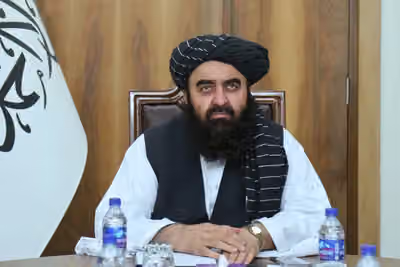

Abdul Salam Zaeef, the former Taliban ambassador in Islamabad, states that the tyranny and absolute rule of an emir are among the main factors leading to the decline of Islamic societies.
Zaeef explained that any "emir" who gains absolute power will gradually become an "absolute tyrant”.
According to Abdul Salam Zaeef, after an emir becomes a tyrant, he surrounds himself with flatterers and distances himself from knowledgeable and wise individuals.
This well-known diplomat of the Taliban, during the first rule of the group, wrote on X social media platform on Saturday, that over time, the decisions and orders of the emir are shaped by flattery.
Zaeef has suggested that a "powerful leadership council" could fill the void of an emir.
Zaeef, who held significant government positions during Mullah Omar's era, was arrested in Pakistan after the fall of the Taliban in 2001 and then, transferred to Guantanamo Bay prison.
After spending three years there, he was released from Guantanamo in 2005. Subsequently, during Hamid Karzai's presidency, he established a religious foundation named "Afghan Foundation" in Kabul.
In his note on X, Zaeef cited the neglect and abuse of responsibilities, as well as the mixing of personal desires with Sharia by the emir and his close associates, as other factors leading to the decline of Islamic societies.
This prominent Taliban figure emphasised that it is crucial for anyone taking on a responsibility not to neglect their duties. He insisted that if a person is not competent for the assigned responsibility, they should resign to allow someone else to take their place.
Zaeef also stated that it is important for law and Sharia to be implemented without "personal whims”. According to him, if decisions are made based on personal desires, it will cause division and disobedience.

According to numbers from the Taliban's Ministry of Refugees and Repatriations, 10,273 Afghan refugees have been returned to Afghanistan from Iran and Pakistan over the past week.
Of them, 7,422 refugees returned from Iran and 2,851 from Pakistan.
Based on daily reports released by the Taliban's Ministry of Refugees and Repatriations, these refugees had been expelled from the two neighbouring countries between June 8 and June 15.
Taliban’s Ministry of Refugees stated that children and women are among those refugees who returned from these two countries.
The ministry added that Afghan refugees returned to Afghanistan through the Torkham, Spin Boldak, Islam Qala, and Pul-e-Abrisham border crossings.
In recent months, the Pakistani and Iranian governments have significantly increased the expulsion of Afghan refugees from these countries. Some of the returned refugees from Iran and Pakistan reported that the police in these countries detained and imprisoned them before their expulsion.
According to some refugees, the Pakistani government usually imprisons Afghan refugees without legal residency documents for three months before returning them to Afghanistan.
Meanwhile, some Afghan refugees in Iran, in contact with Afghanistan International and through videos sent to the team, have claimed that the Iranian police mistreated them.
Pakistani and Iranian officials, following the expulsion of Afghan refugees, stated that the expulsion process only applies to those who do not have legal residency documents in these countries. However, some of the returned refugees from these two countries said that despite having legal visas, they were still arrested by the police and returned to Afghanistan.

Following the arrest of six individuals on charges of membership in ISIS-Khorasan in the United States, some US officials have told CNN that a "dangerous" ISIS-linked cell could carry out an attack on US soil.
CNN reported that multiple US security officials believe that the withdrawal from Afghanistan has reduced the country's ability to gather intelligence on terrorism threats in Afghanistan.
Earlier, the New York Post, citing informed sources, reported that six Tajik citizens were arrested in three US cities on charges of membership in ISIS-K.
US intelligence officials are keenly aware of the intelligence-gathering gaps in Afghanistan, where ISIS-Khorasan is said to be based.
According to CNN, US officials believe that instead of training and field operations, ISIS-K is trying to radicalise and inspire attackers.
CNN did not name these US officials.
The US officials and analysts closely monitoring Islamist terrorist groups say that ISIS-K has significantly increased its online propaganda capabilities.
According to terrorism experts, citizens of Tajikistan, one of the poorest countries in the world with a population facing severe religious repression, are more vulnerable to recruitment by ISIS.
Colin Clarke, a researcher who specialises in terrorism, said that ISIS is strengthening its propaganda to reach "diasporas currently in Europe, North America, and the region and Central Asia, and is trying to encourage people to carry out attacks”.
Two US officials also said that immigration and intelligence officials are appropriately monitoring anyone traveling from Tajikistan, Uzbekistan, and Kazakhstan to the United States.

Ahmad Vahidi, Iran's Interior Minister, once again emphasised on the expulsion of "unauthorised foreigners," stating that his country cannot accept these individuals.
Vahidi stated that "all unauthorised foreigners must be returned to their countries," and those who do not create obstacles by their presence should be organised and monitored.
Iranian media reported on Friday, that Vahidi, on the sidelines of a meeting in Fars province, said, "We cannot accept unauthorised foreigners, and the acceptance cap for foreigners is a specific number based on labour market needs and the job atlas."
Iranian media and officials of the Islamic Republic primarily use the term "unauthorised foreigners" to refer to Afghan migrants in Iran.
This is not the first time Iran's Interior Minister has warned about the expulsion of Afghan migrants.
Last month, he had stated that in the past year, 1.3 million "illegal" migrants were expelled from Iran.
He added that Iran will not accept new foreigners, and all "unauthorised" foreigners must leave the country.
Following the Taliban's takeover of Afghanistan in August 2021, a significant number of people fled to other countries, including Iran.
The Islamic Republic of Iran detains thousands of Afghan migrants every week and deports them back to Afghanistan.

Sources told Afghanistan International that Taliban intelligence in Parwan province has arrested Abdullah Danish, a former journalist for Maarif TV.
According to sources, Danish was arrested on Thursday evening, in the Bagrami district.
Sources said that after the arrest, Taliban intelligence members transferred this journalist to an unknown location.
Taliban officials have not yet commented in this regard.
According to sources, this local journalist previously worked for the private Mitra TV and the state-run Maarif TV network.
The Taliban had previously arrested several journalists in Parwan province.