• العربية
  • پښتو
  • فارسی
Brand
  • Afghanistan
  • Sport
  • Markets
  • Afghanistan
  • Sport
  • Markets
  • Theme
  • Language
    • العربية
    • پښتو
    • فارسی
  • Afghanistan
  • Sport
  • Markets
All rights reserved for Volant Media UK Limited
volant media logo

NRF Attacked Kabul Airport, 28 Other Targets Last Quarter, Confirms UN Secretary General

Jun 21, 2024, 12:37 GMT+1Updated: 13:42 GMT+1

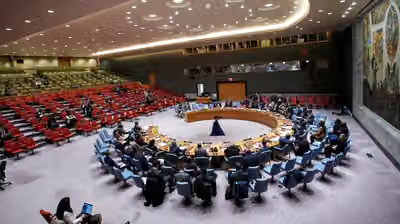
UN Secretary-General António Guterres announced that the National Resistance Front (NRF) has carried out a total of 29 attacks on Taliban forces in the past three months.
Among these, 20 attacks were in Kabul, six in Takhar, two in Baghlan, and one in Parwan.

According to the report, the NRF managed to attack the military facilities at Kabul Airport during this period. The UN revealed that "three rockets were fired at a helicopter upon entry, but there were no casualties or damage”.

Guterres also confirmed that the Afghanistan Freedom Front launched 14 attacks on the Taliban in Kabul over the past three months.

He noted that the attacks by the Afghanistan Freedom Front have decreased compared to the previous three months, during which 24 attacks were carried out.

The UN report indicates that both military fronts opposing the Taliban have used "hit-and-run" tactics against Taliban forces. They employed grenades in 22 instances and improvised explosive devices in seven cases to target the Taliban.

Most Viewed

Taliban Ignore Afghanistan’s Interests By Backing Militants, Says Pakistan Army Chief
1

Taliban Ignore Afghanistan’s Interests By Backing Militants, Says Pakistan Army Chief

2

United Nations Delivers Education Kits To Four Million Afghan Children

3

Taliban Renews Call For China To Launch Aynak Copper Mine

4

Taliban Leaders In South-West Hold Security Meet In Kandahar

5

Afghan Deportations Is Strategic Mistake, Says European Parliament Member

•
•
•

More Stories

Taliban Signs Mining Contracts Worth 10 Billion Afghani

Jun 21, 2024, 12:03 GMT+1

Homayoun Afghan, spokesperson for the Taliban's Ministry of Mines and Petroleum, stated that over the past three years, the ministry has signed contracts worth 10 billion Afghanis with various local companies for the extraction of small mines.

On Thursday, Afghan mentioned that these contracts were signed with Afghan investors across different sectors.

In an interview with Taliban-controlled National TV, he said that the ministry has also signed contracts for about 30 large mines worth at least $7 billion with domestic and foreign companies.

According to him, in 2023, contracts for 14 large mines extracting gold, ruby, coal, cement, lead, and zinc were signed. These mines are located in the provinces of Herat, Ghor, Baghlan, Takhar, Kabul, and several other provinces.

In April, the spokesperson for the Taliban's Ministry of Mines and Petroleum noted that since the group’s takeover of Afghanistan, countries such as China, Turkey, Qatar, Iran, and the United Kingdom have invested over $7 billion in the country.

The Taliban have not yet provided comprehensive information to the public about these contracts and the extracting companies. Critics have repeatedly criticised the Taliban for their lack of transparency in the collection and expenditure of Afghanistan's mining revenues.

Instability in Afghanistan Increases by 55% in Last Quarter, Says UN Secretary-General

Jun 21, 2024, 11:09 GMT+1

The UN Secretary-General, António Guterres, reported a significant rise in instability in Afghanistan, with over 2,500 security incidents recorded in the past three months.

Guterres highlighted that insecurity in February, March, and April of this year increased by 55% compared to the previous three months.

Notably, drug-related incidents surged by 97%, from 212 to 418 cases. The majority of these incidents occurred in the central, northeastern, southeastern, and southern regions of Afghanistan.

According to the UN report, the primary cause of this instability is the "ruling authorities' decision" to enforce a ban on poppy cultivation.

Additionally, land disputes have risen from 20 to 51 cases in the past three months, predominantly in the southern and eastern parts of Afghanistan. During this period, armed clashes increased from 75 to 106 cases, although the number of explosions has decreased.

The report underscores the growing challenges faced by Afghanistan as it continues to grapple with security issues amidst ongoing efforts to enforce new policies.

Build Wall on Afghan Border to Address Iran's Security Issues, Says Ghalibaf

Jun 21, 2024, 10:32 GMT+1

Iranian presidential candidate Mohammad Baqer Ghalibaf stated that all of Iran's serious social issues originate from the eastern part of the country.

He added, "We must build a wall on the eastern border with Pakistan and Afghanistan to ensure its security."

Ghalibaf attributed some of the crimes and social issues in Iran to the presence of undocumented migrants.

In a debate broadcast on Thursday by Iran's state TV, Ghalibaf said, "Today, undocumented foreigners cause serious social issues in the areas of drugs, employment, and divorce."

As the Speaker of the Parliament and one of the main presidential candidates, Ghalibaf has made expulsion of illegal migrants, mostly Afghan, a part of his election campaign.

Doha Meeting to Focus on Private Sector, Finance, Banking & Drug Menace

Jun 21, 2024, 09:45 GMT+1

Zakir Jalali, a Taliban Foreign Ministry official, stated that the United Nations has shared the agenda for the third Doha meeting with the group, focusing on the private sector, finance, banking, and drug menace.

Jalali did not mention human rights, especially women's rights. On Friday, Jalali posted on the social media platform X that the conditions for the Taliban's participation in the Doha meeting had been met.

Previously, it had been indicated that women's rights would be the primary focus of this meeting. However, recent criticisms suggest that the UN might have agreed to the Taliban's request to exclude women's rights from the agenda of this international meeting on Afghanistan.

The Women's Forum for Afghanistan, a women's rights advocacy group, criticised that any UN-led meeting on Afghanistan without comprehensive women's representation would lack legitimacy.

Recently, Ziauddin Yousafzai, father of Nobel Prize winner Malala Yousafzai, wrote in a note shared by Heather Barr, a Human Rights Watch official, that if the UN yields to the Taliban's conditions, including the exclusion of women, it would be a blatant violation of the UN Charter and would legitimise a "gender apartheid regime”.

Previously, Barr also wrote on X that the UN had removed the issue of Afghan women from the Doha meeting's agenda.

The UN, the organiser of the third Doha meeting, is yet to officially announce the meeting's agenda. This meeting is expected to be held in Qatar's capital, with the participation of special representatives from several countries under the supervision of senior UN officials.

The Taliban announced that a delegation from the group would attend the meeting, but details about this delegation are still unclear. The Taliban also warned that any changes in the composition or agenda of the Doha meeting would affect their decision to participate.

The group did not attend the previous Doha meeting, although some civil society representatives, including several women, were present.

Earlier, AFP reported, citing diplomatic sources, that civil society representatives would not be invited to the third Doha meeting.

The Taliban have been under international pressure for excluding women from public life and banning their employment and education, yet they have not lifted these restrictions. Recently, there have been growing calls to recognise the Taliban's systematic policies against women and girls as "gender apartheid”. However, the UN has so far refrained from accepting this designation.

Former Taliban Ambassador Insists on Acknowledging Mistakes

Jun 20, 2024, 15:45 GMT+1

Abdul Salam Zaeef, the former Taliban ambassador to Pakistan, has emphasised that without understanding the world, meaningful interaction is impossible.

On Thursday, without specifying his audience, Zaeef wrote on the social media platform X that if someone does not acknowledge their mistakes, they cannot implement reforms.

These remarks follow Zaeef's recent posts highlighting that tyranny leads to the decline of Islamic societies and that an "Amir" who holds absolute power gradually becomes an "absolute despot”.

It appears that his comments have prompted reactions from Taliban officials. On Thursday, Zaeef, a well-known diplomat from the first Taliban regime, clarified that his remarks were intended to strengthen the Islamic system and should not be misinterpreted. He emphasised that Afghans have fought and sacrificed for years to establish an Islamic system.

The former prominent Taliban figure stated, "If one does not closely examine the past, the future cannot be built. If one does not acknowledge their mistakes, they cannot correct them."

He added, "If one does not recognise the negative, they cannot think positively. If one cannot bear the truth, they will not reach reality, and finally, if one does not understand the world, they cannot interact with it."

Zaeef, who heads the "Afghan Foundation" in Kabul, stressed that "military strength, political skill, a strong economy, and national support are the guarantors of the survival of the Islamic system and must be given serious attention”.

Previously, Zaeef had stated that after an Amir becomes a despot, he surrounds himself with sycophants and distances himself from people of knowledge and opinion.