Nicaragua Appoints Non-Resident Ambassador for Afghanistan
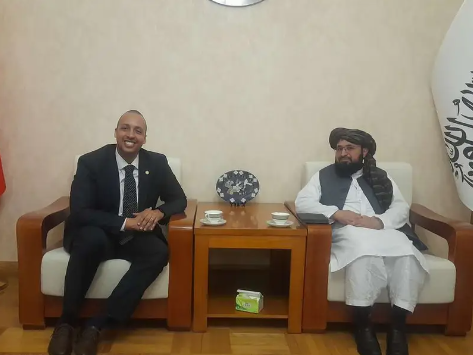
In an unprecedented move to establish diplomatic relations with the Taliban, Nicaragua has appointed a non-resident ambassador for Afghanistan.

In an unprecedented move to establish diplomatic relations with the Taliban, Nicaragua has appointed a non-resident ambassador for Afghanistan.
Nicaraguan officials stated that Michael Campbell, the country's ambassador to China, will manage the affairs of Nicaragua's embassy in Kabul from Beijing. This is the first time Nicaragua has appointed a non-resident ambassador for Afghanistan. Located in Central America, Nicaragua previously had no diplomatic relations with Afghanistan.
Rosario Murillo, the Vice President of Nicaragua, said, "We appreciate the Islamic Emirate (the Taliban) and the people of Afghanistan for the opportunity given to our comrade Michael Campbell."
Nearly three years after the Taliban's return to power, no country has yet recognised the Taliban. The Nicaraguan government has also made no reference to recognising the Taliban government.
In recent months, Nicaragua's ambassador to China had met with Taliban diplomats in Beijing. The Taliban stated that the Nicaraguan ambassador conveyed the president's condolences to the Taliban for the flood casualties in Afghanistan.


A group of women and civil rights activists have issued a statement criticising the remarks of Roza Otunbayeva, the UN Secretary-General’s Special Representative for Afghanistan.
They accused Otunbayeva of considering Afghan women as "second-class" and "whitewashing" the Taliban during a United Nations Security Council meeting.
In the statement, a number of Afghan women, civil rights, and political activists claimed that Otunbayeva, under "the direction of the United States," invited the Taliban to an international meeting and ignored the situation of the Afghan people, especially women.
The statement reads: "With complete shamelessness and in violation of all existing international and legal norms, Otunbayeva stated that Afghan culture places women in a second-class position, and they will not be present at the third meeting, while whitewashing the Taliban."
On Friday, Otunbayeva reiterated during the Security Council meeting that the Taliban's presence at the third Doha meeting does not equate to normalising or legitimising the group. She emphasized her efforts to establish a consultative process.
Women’s rights activists and international human rights organisations argue that the UN excluded women from the third Doha meeting due to the Taliban’s preconditions.
The Associated Press also reported that the UN representative defended the absence of Afghan women from the Doha meeting.
The third Doha meeting, with the participation of representatives of various countries including the Taliban, will be held over two days. The UN Secretary-General’s representative said at a press conference in New York yesterday that Afghan women will be present on the second day of the meeting.

Radio Pakistan reported that 13,815 Afghan migrants have been deported from Pakistan in the past 10 days.
The state-run media stated that since the initiation of the deportation plan for Afghan migrants, over 620,000 Afghans have been returned to their country.
According to a report by Radio Pakistan, from Tuesday, 11 June, to Friday, 21 June, 5,014 men, 4,087 women, and 4,714 Afghan children have been deported from Pakistan.
The media outlet reported that a total of 620,981 Afghan migrants, including women and children, have been deported from Pakistan over the past nine months.
Pakistan began the deportation programme for Afghan migrants in October 2023. Islamabad has announced its intention to deport all undocumented migrants from the country.
Earlier, Pakistan's Interior Minister stated that all possible efforts have been made to secure the country's borders and prevent illegal border crossings and human trafficking.

Security and diplomatic sources have informed Afghanistan International that the Taliban are planning to relocate members of Tehreek-e-Taliban Pakistan (TTP) from border areas to other provinces in Afghanistan.
This decision comes after months of negotiations between the Taliban, Pakistan, and China.
According to the sources, the Taliban in Afghanistan are attempting to move TTP fighters from areas along the Pakistan-Afghanistan border, particularly in Khost province, to other provinces in Afghanistan.
However, the TTP has expressed concerns about the Taliban's decision to relocate their fighters, and discussions on this matter are still ongoing.
This decision follows recent attacks in Pakistan and an attack on Chinese citizens in Besham, Khyber Pakhtunkhwa in Pakistan.
In the nearly three years since the Taliban took over the power in Afghanistan, the Pakistani government has repeatedly accused them of harbouring Pakistani Taliban fighters. Reports also indicate that senior TTP members and many of their fighters are present in Afghanistan. However, the Taliban have repeatedly denied these accusations.
It now appears that the Afghan Taliban are willing to relocate Pakistani Taliban fighters from border provinces to other provinces within Afghanistan. Although it is not clear to which provinces these fighters will be moved, earlier reports suggested that the Taliban plan to resettle them in northern and western provinces of Afghanistan.
In May 2023, a senior Pakistani official, speaking on condition of anonymity, told Turkey's Anadolu news agency that Islamabad had reached an agreement with the Taliban's Ministry of Interior to relocate Pakistani Taliban fighters from the border to western Afghanistan.
At that time, Anadolu Agency reported that Pakistan would fund this relocation.
The spokesperson for the Hezb-e Junbish Milli Party also previously stated that the relocation of TTP to northern provinces would turn these areas into another Gaza.

Yerzhan Kistafin, the Ambassador of Kazakhstan to Pakistan, said that the Shanghai Cooperation Organisation (SCO) should engage with Afghanistan to solve problems.
Kistafin said that the SCO's engagement with countries like Afghanistan is important for expanding the organisation’s influence and resolving geopolitical issues.
TASS news agency reported on Friday that Kistafin spoke about the activities of the SCO during a meeting at the Institute of Strategic Studies in Islamabad.
The Kazakh Ambassador to Pakistan said that his country supports the participation of SCO observer countries in its activities.
The SCO summit is scheduled to be held on July 3-4 in Astana, Kazakhstan.
Afghanistan has been an observer member of the SCO since 2012, but after the Taliban came to power, no one has been allowed to enter SCO meetings to represent Afghanistan.
Last week, Zamir Kabulov, the Russian President's Special Representative for Afghanistan, said that Tajikistan opposes the Taliban's presence in the SCO.
Russia, China, India, Pakistan, Kazakhstan, Kyrgyzstan, Tajikistan, and Uzbekistan are members of the SCO. Although some of these countries have economic and diplomatic relations with the Taliban, none of them recognise the Taliban government.
Earlier, Kassym-Jomart Tokayev, the President of Kazakhstan, announced that he had removed the Taliban from the list of terrorist groups of the country.

Russian Foreign Minister Sergey Lavrov stated that fully prepared militant groups, including ISIS, Al-Qaeda, and their affiliates, remain active in Afghanistan.
Following a meeting with the Foreign Ministers of the Collective Security Treaty Organisation (CSTO), Lavrov warned that threats continue to emanate from Afghan territory.
According to Lavrov, there needs to be a more substantial dialogue with the Taliban regarding the fight against terrorism.
On Friday, the state news agencies TASS and RIA Novosti reported that Lavrov, after the CSTO Council of Foreign Ministers’ meeting in Almaty, told reporters, "We consider supporting the fight against terrorism to be crucial."
The CSTO Council of Foreign Ministers’ meeting was held on Friday in Almaty, Kazakhstan.
The Foreign Ministers of Russia, Tajikistan, Kyrgyzstan, Kazakhstan, and Belarus attended the meeting.
Warning that threats from Afghanistan persist, Lavrov said, "We support the establishment of a more sustainable, permanent, and substantive dialogue aimed at implementing specific projects with the Taliban, who control Afghanistan."
Imangali Tasmagambetov, the Secretary-General of the CSTO, also presented a report at this meeting on the regional security situation and its impact on the security of CSTO member countries.
While the Russian Foreign Minister highlighted the threats posed by ISIS and Al-Qaeda in Afghanistan, Georgy Grigorievich Machitidze, a researcher at an institute affiliated with the Russian Foreign Ministry, warned about the relations between the Taliban and Al-Qaeda in an article.
Georgy Grigorievich stated that alongside ISIS-Khorasan, Al-Qaeda, which operates under the aegis of the Taliban, is gaining increasing attention, providing its members with passports, housing, and, in some cases, employment.