Darayim Residents In Badakhshan Protest Against Taliban Over Poppy Field Destruction

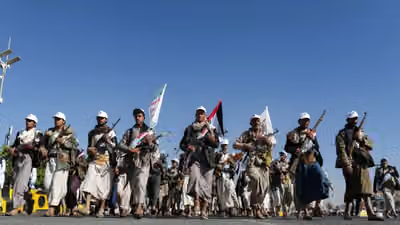
Residents of Darayim district in Badakhshan province protested against the Taliban again on Wednesday, due to the destruction of poppy fields by the group.

Residents of Darayim district in Badakhshan province protested against the Taliban again on Wednesday, due to the destruction of poppy fields by the group.
Local residents told Afghanistan International that Taliban fighters fired at the protestors, injuring four people.
So far, Taliban officials have not commented on the incident.
Videos sent by locals to Afghanistan International show protestors chanting slogans against the Taliban leader.
Protestors claimed that the Taliban responded to local protests with gunfire. In the videos received, gunfire can be heard.
They said that the Taliban entered the area with considerable force.
This is not the first time residents of Darayim have protested. Previously, clashes between the Taliban and farmers in Darayim and Argo district of Badakhshan, resulted in several protestors being killed.
The protests by these residents prompted the Taliban to send a delegation led by Fasihuddin Fitrat, the group's Chief of Staff of army, to Badakhshan to prevent the protests from spreading.
However, locals stated they would not stop protesting until non-native Taliban members left Badakhshan.
Previously, local residents had accused the Taliban of entering people's homes and harassing them.

Rosemary DiCarlo, the UN Under-Secretary-General, has emphasised that human rights and girls' education in Afghanistan are not merely domestic issues, given the country's international obligations.
Previously, Taliban spokesperson Zabihullah Mujahid had said that girls' education is a domestic matter.
On Tuesday, at a press conference concluding the third Doha meeting on Afghanistan, DiCarlo clarified this in response to a question.
She explained that the issue is not solely domestic, as Afghanistan has signed several international treaties, conventions, and agreements focusing on human and civil rights.
She noted that it does not matter if the government changes, as the country has committed to these agreements as a nation. DiCarlo emphasised that the matter is not internal, and the UN has made this clear.
She also highlighted that the ban on women's employment under Taliban control is detrimental to the country's economy, as it sidelines 50 percent of the population.
She added that discussions on the private sector cannot proceed without the inclusion of women. Furthermore, in matters of drug production and consumption, women's issues must be addressed since they are involved in both areas.
DiCarlo underscored these points at the end of the Doha meeting, noting that due to Taliban opposition, she could not invite women's rights advocates and civil activists to the main talks.
Although the UN invited several women to participate in the meeting's side discussions, some, including former Afghan Women's Affairs Minister Habiba Sarabi, declined the invitation.
Afghan civil and women's rights activists boycotted the meeting altogether. However, DiCarlo mentioned that she spoke with eight civil and women's rights activists on the sidelines, though their names were not disclosed.
The Taliban have banned women's employment and girls' education beyond the sixth grade, ignoring both domestic and international protests on this issue.
Taliban officials have repeatedly emphasised that girls' education and women's employment are domestic matters and that the group will address these issues in their own way and within the framework of their interpretation of Sharia.

Vasily Nebenzya, the Russian ambassador to the United Nations, has said that the Taliban justifies its policies towards Afghan women and girls with Islamic principles, but they are "not Islamic”.
On Monday, the Russian ambassador stated at the United Nations that Moscow discussed issues concerning Afghan women and girls with the Taliban, but the group has its own views about women and girls, which he does not agree with.
Nebenzya said that the reality is that they are dealing with the Taliban in Afghanistan, and that the group justifies its policies towards women and girls based on Islamic norms that are actually not Islamic.
The Russian ambassador said that the Taliban do not listen to the leaders and heads of Islamic countries who want to explain to them the rights of women and girls in Islam. He said, "That is the point. That is the problem."
The Taliban have asked world countries to refrain from commenting on women's education and employment in Afghanistan, as they consider it interference in Afghanistan's internal affairs.
Zabihullah Mujahid, Taliban’s spokesperson, warned countries at the third Doha meeting that reopening girls' schools would create a crisis in the country again. However, he did not explain his point.
According to statistics from the previous government's Ministry of Education, before the government's collapse, at least 36 percent of the millions of students in Afghanistan were girls.

Rosemary DiCarlo, head of the United Nations delegation at the third Doha meeting, has refuted the Taliban spokesperson's claim about lifting of some of the banking restrictions.
DiCarlo told Afghanistan International that while this topic was discussed at the Doha meeting, no decision was made.
In an interview with Maryam Rahmati, Afghanistan International's reporter in Qatar, the UN Under-Secretary-General for Political and Peacebuilding Affairs stated that there was no agreement to lift sanctions against the Taliban.
She explained that lifting sanctions is not within the UN's authority but is a decision made by individual countries.
Zabihullah Mujahid, the Taliban spokesperson and head of the group's delegation at the Doha meeting, had written on the X social media platform that there was a "commitment to remove economic and banking restrictions”. However, DiCarlo clarified, "We only discussed sanctions. The Taliban expressed their concerns about the impact of sanctions on the private sector and the issue of narcotics."
Status of Women "Not a Domestic Issue"
The Taliban refuse to discuss women's rights and freedoms, including the right to education and work, and the inclusivity of the government, claiming these are internal issues and part of "Afghan culture”.
DiCarlo stressed that "these are not domestic issues. Afghanistan has signed international conventions over the years and must adhere to them”.
Regarding the inclusion of women in future meetings, DiCarlo noted that the decision is not within her authority. She urged the Taliban to go beyond the issue of drug control and address women's and girls' participation and ethnic group equality.
DiCarlo refrained from commenting on "gender apartheid," stating that the topic was not discussed at the Doha meeting as it is a legal issue. However, various other issues, including girls' education and Afghanistan's social diversity, were raised.
Narcotics and Alternative Cultivation
DiCarlo described the Taliban's statements at the session as "convincing," noting that the group has made significant progress in fighting drug trafficking. Yet, she acknowledged that there are challenges in providing alternative crops and treating addiction.
The Taliban expects help from the international community and the UN to introduce alternatives to poppy cultivation in Afghanistan.
The Doha meeting took place on June 30 and July 1, with representatives from regional and global countries, as well as a Taliban delegation, in attendance.
The UN has faced significant criticism for excluding women and civil society activists from the meeting and ignoring Afghanistan's political factions.

An organisation supporting LGBTQ+ individuals in Afghanistan has condemned the flogging of four members of this community by the Taliban.
Rainbow Afghanistan said that the UN and countries "involved in the Afghanistan disaster" are ignoring the plight of the country's LGBTQ+ community.
In a statement released on Tuesday, the organisation expressed concern over the situation of the community in Afghanistan and their punishment by the Taliban.
On Monday, the Taliban flogged four people in the Sayed Khel district of Parwan province on charges of having a sexual relationship.
Rainbow Afghanistan in Germany emphasised in the statement that members of their community have faced increasing risks and threats under the Taliban rule over the past three years.
The statement reads, "We witness the punishment of LGBTQ+ individuals in public by the Taliban every day, and unfortunately, the UN, its mission in Afghanistan, and the countries involved in the Afghanistan disaster pay little attention to the dire situation of LGBTQ+ individuals in Afghanistan."
They also expressed concern about the lack of guarantees for LGBTQ+ rights at the third Doha meeting.
This organisation, which supports gay, bisexual, and transgender individuals, stresses that the UN, by ignoring the demands of Afghanistan's LGBTQ community, has contributed to the "repetition of a dark history”.
Rainbow Afghanistan stated, "The UN has always surrendered to the demands of anti-LGBTQ+ religious groups and extremists, including the Taliban."
Homosexuality is illegal in Afghanistan and Islam. Since the Taliban's return to power, dozens of individuals across the country have been punished on charges of having sexual relations.

Vasily Nebenzya, Russia's ambassador to the United Nations, on Monday hinted at the possibility of lifting Russia's sanctions against the Taliban.
He mentioned that although there is no precise timeline for removing the Taliban from the sanctions list, he has "heard discussions about it”.
Representatives of the Taliban and special envoys from 25 countries and five international organisations participated in the third Doha meeting on Sunday.
At this meeting, the Taliban called for the lifting of sanctions and for countries to assist Afghanistan's private sector and combat drug trafficking.
Like many other countries, including the United States and the European Union, Russia has maintained sanctions against the Taliban. Despite its close relations with the Taliban, Moscow has not removed the group from its list of terrorist organisations, though it has promised to consider doing so.
According to Agence France-Presse, Nebenzya stated that he cannot provide a definitive answer on how close they are to lift sanctions against Taliban, but mentioned that he has heard discussions about it.
He reiterated the statements of senior Russian officials that the Taliban are the main power in Afghanistan and control the country.
Earlier, Russia's Ministry of Foreign Affairs told the state news agency TASS that the removal of the Taliban from Russia's list of terrorist organisations is under review.
Since take over of power in August 2021, the Taliban has not been recognised by any government.
Russia has not recognised the Taliban as the legitimate government of Afghanistan but has defended their positions in international meetings, including at the Security Council.