Nearly 20,000 Afghan Migrants Expelled From Iran & Pakistan

According to the Taliban's Ministry of Refugees and Repatriation, 19,120 migrants have been deported from Pakistan and Iran to Afghanistan in the past week.

According to the Taliban's Ministry of Refugees and Repatriation, 19,120 migrants have been deported from Pakistan and Iran to Afghanistan in the past week.
The ministry reported that 4,710 people were deported from Pakistan, while 14,410 migrants were deported from Iran.
The Taliban's Ministry of Refugees and Repatriation said that among those deported from Iran and Pakistan, women and children were also included.
The ministry added that Afghan migrants returned to Afghanistan through Torkham, Spin Boldak, Islam Qala, and Pul-e-Abrisham border crossings.
In recent months, the governments of Iran and Pakistan have significantly increased the deportation of Afghan migrants, expelling hundreds of undocumented migrants from these countries daily.
Additionally, some migrants deported from Pakistan and Iran in recent months have claimed that despite having legal documents, they were first detained by the police and then repatriated to Afghanistan.
These Afghan migrants have sent videos to Afghanistan International, complaining about mistreatment by Iranian police in the refugee camps.
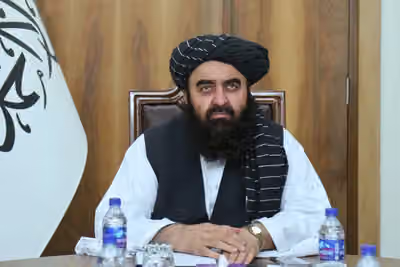

The Shia Ulema Council of Afghanistan, in a statement, urged the Taliban to take necessary measures to ensure security during the month of Muharram and to prevent any disruption and insecurity.
According to the statement, despite various challenges, this year's Muharram mourning ceremonies will be held.
Last year, the Taliban asked Afghan Shias to refrain from erecting scaffolding and large religious flags in the city. The Taliban also banned refreshment stands and the distribution of drinks during Muharram.
In the statement issued by Shia Ulema Council of Afghanistan on Saturday, religious committees in mosques and Hussainiyas, who are primarily responsible for the ceremonies, were asked to pay attention to security issues.
The council also urged the leaders of religious committees to be vigilant about suspicious matters.
Shia leaders in Afghanistan have repeatedly asked the Taliban to officially recognise the Jafari jurisprudence, but the group has not made any official statement on this matter.
The Taliban have based their policies and governance on their particular interpretation of Sunni Hanafi Islam.
The Council also requested religious scholars to avoid discussing contentious issues during the month of Muharram.

Kyrgyzstan media reported that the sale of carbonated pomegranate drinks produced in Afghanistan has been banned in all stores across the country.
According to these reports, the Kyrgyz government is withdrawing this beverage from the market due to its harmful substances for children.
Kyrgyzstan's Department of Disease Prevention and State Sanitary and Epidemiological Surveillance, under the Ministry of Health, has deemed the carbonated pomegranate drink, marketed as "Golden Life" from Afghanistan, to be harmful.
Reports state that the confiscation of this non-alcoholic carbonated pomegranate drink began on July 3.
Kyrgyzstan said that this Afghan beverage contains a colourant that could negatively impact children's health.
Also, Uzbekistan has announced that it is currently sampling and re-testing pomegranate-flavoured products produced in Afghanistan.

The Presidents of China and Tajikistan emphasised on the formation of an inclusive government in Afghanistan in a joint statement.
In their statement, Xi Jinping and Emomali Rahmon, presidents of China & Tajikistan, expressed support for a government in Afghanistan that includes representatives from all ethnic, religious, and political groups.
They highlighted that an independent, neutral, and united Afghanistan is in the interest of the region.
The Chinese President had traveled to Dushanbe, the capital of Tajikistan, to meet the Tajik President following the Shanghai Cooperation Organisation (SCO) summit.
In their joint statement, the two leaders expressed their desire for a peaceful Afghanistan free from terrorism, war, and drugs, capable of coexisting harmoniously with its neighbouring countries.
Previously, SCO leaders had declared at a meeting in Astana that the formation of an inclusive government is the only path for Afghanistan to achieve peace.
They emphasised that lasting peace in Afghanistan can only be achieved through the establishment of a government that includes representatives from all ethnic and political groups.
Meanwhile, some Russian state media reported following the SCO leaders' meeting that these countries supported the plan to create a "security belt" around Afghanistan. The media noted that this security belt plan was proposed by the President of Tajikistan.

Three Afghan candidates were unable to secure seats in the recent UK Parliamentary elections.
Labour Party candidate Rohullah Yakobi with over 15,000 votes; Liberal Democrats candidate Eraj Rostaqi with over 4,000 votes; and Workers' Party candidate Sirajul Haq Parwani with 723 votes, were all defeated in the latest elections.
According to the election results, Yakobi lost to his Conservative rival by a margin of 880 votes, securing 15,437 votes in his constituency and finishing second. Yakobi, who arrived in the UK as a refugee in 2004, is the first Hazara candidate for the UK Parliament.
In this election, Rostaqi lost to his Labour rival by a margin of over 20,000 votes, securing 4,292 votes in his constituency and finishing fourth.
Meanwhile, Parwani lost to his Conservative rival by a margin of nearly 25,000 votes, securing 723 votes in his constituency and finishing seventh. Parwani stated on his X account that he previously served as the Deputy Spokesperson for the Afghan Ministry of Foreign Affairs and the Charge d'Affaires at the Afghan Embassy in Greece.
While these three Afghan candidates were not elected, nearly 90 representatives from racial minorities residing in the UK were elected to Parliament in this round.

Sources in western Kabul have told Afghanistan International that Taliban fighters once again conducted house-to-house searches in several areas on Friday.
According to the sources, a large number of Taliban forces participated in the searches but did not explain their reasons for doing so.
The sources mentioned that in the Naqqash area of Dasht-e Barchi alone, the Taliban deployed at least 30 vehicles with forces.
So far, several areas in western Kabul have been searched.
Some sources stated that the Taliban have been conducting house-to-house search operations ahead of the month of Muharram and Ashura mourning.
One source told Afghanistan International that the Taliban, upon entering homes, forced residents out and inspected all rooms, cupboards, and boxes without any consideration.
This source added that despite the Taliban conducting the house-to-house search operations with dozens of vehicles, they did not bring any female police officers with them.
Some sources reported that the Taliban checked residents' electronic ID cards, while others said that the Taliban carried out these searches without verifying the residents' identities.
The Taliban have not officially commented on the house search operations in western Kabul.
Over the past three years, the Taliban have repeatedly searched citizens' homes in the capital. Taliban officials have stated that the purpose of these searches is to collect weapons.
Previously, there were reports that Taliban fighters mistreated people and assaulted citizens during house searches.