Pakistan To Build New Border Terminal Near Afghanistan
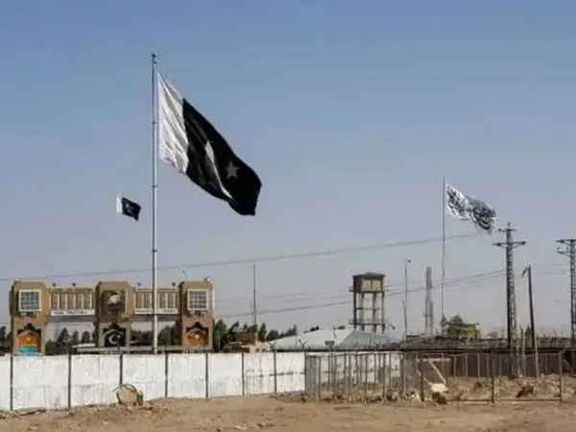
Pakistan is constructing a new border terminal in the Killa Saifullah area of Balochistan, near the Afghanistan border.
Pakistan is constructing a new border terminal in the Killa Saifullah area of Balochistan, near the Afghanistan border.
The purpose of this terminal is to monitor terrorist activities, control illegal trade, and prevent the illegal movement of people.
The Nation newspaper reported on Tuesday, July 9, that this terminal will be used as an alternative route for trade with Afghanistan and Central Asia.
Pakistani officials have not officially commented on the construction of this terminal.
The terminal will be built on 35 hectares of land at a cost of over 24 billion Pakistani rupees, and it will take 60 months to complete at the border point within Pakistan.
The Nation wrote that once completed, the terminal will facilitate services in all official and operational offices, including customs, the Federal Investigation Agency, the National Database and Registration Authority, the Anti-Narcotics Force, and intelligence and security agencies.

The UN Assistance Mission in Afghanistan (UNAMA) has released a detailed report accusing the Taliban's Ministry for the Propagation of Virtue and the Prevention of Vice of violating human rights and fundamental freedoms.
According to UNAMA, ombudsmen of the ministry have engaged in at least 1,033 acts of arbitrary punishment, including 205 cases of mistreatment of women and 828 cases of men.
On Tuesday, July 9, UNAMA expressed concern over the increasing power of this Taliban ministry, stating that its actions negatively impact fundamental rights and freedoms, especially for women.
The report highlights the ministry's use of verbal threats, arrests, detentions, mistreatment, and public flogging to enforce its directives.
UNAMA reported that the ministry's authority extends to overseeing media, participating in the media violations commission, eradicating addiction, banning the sale of poor-quality gold, regulating private businesses, mediating disputes, and monitoring prisons.
From August 2021 to March 2024, the ministry imposed numerous restrictions, including bans on music, hookah smoking, displaying images of humans and animals, public statues, artistic sculptures, black magic, and celebrations of Nowruz and Valentine's Day.
These restrictions contradict individuals' right to participate in cultural life, with women being the most adversely affected. The ministry also violates the right to privacy through phone searches, mosque inspections, and questioning couples about their marriage certificates in public, the report added.
UNAMA documented 1,033 cases where this Taliban ministry used force to implement its directives.
Media Restrictions
The Taliban's virtue ministry has imposed severe restrictions on the media, preventing the broadcast of music, comedy programmes, and foreign cultural contents.
In provinces like Kunar, media networks have been instructed not to broadcast the voices of female callers or use female presenters. Women in the media must appear with masks and full hijab as mandated by the Taliban.
Women's Travel Restrictions
The ministry mandates that women need a male guardian for journeys longer than 78 kilometres. In November 2022, the Taliban in Nangarhar instructed women not to visit health clinics without a male guardian, although this restriction was lifted after a month.
Similar restrictions were reported in Kandahar, Balkh, and Khost, where women were not allowed to work, take taxis, or shop without a male guardian.
In December and January, several women in Kabul were arrested for not wearing "appropriate hijab”.
Restrictions On Women's Business
Despite the Taliban's commitment to women's work in the private sector, UNAMA documented that the ministry ordered the closure of women-run bakeries in Kabul, some women's shops in Kandahar and Balkh, and demanded shop owners to replace female shopkeepers with men. Tailors were also instructed not to take women’s clothing measurements.
The United Nations called on the Taliban to respect citizens' fundamental rights and adhere to the seven international conventions to which Afghanistan is still a member.
Reliable sources have told Afghanistan International that Ali Mojani, a diplomat and advisor to the special representative of Iran for Afghanistan, is on the verge of being expelled.
According to these sources, Taliban officials have stated that this Iranian diplomat is an "undesirable element" and has "overstepped his boundaries”.
Sources said that the Taliban have given Mojani, who holds a diplomatic passport, a few hours to leave the country.
The sources indicated that the Taliban are expelling this Iranian diplomat in response to the recent expulsion of one of their diplomats from Mashhad and his undiplomatic actions.
Ali Mojani Barred from Eidgah Mosque in Kandahar
Ali Mojani recently stated that Taliban members did not allow him to perform Eid al-Adha prayers led by Mullah Hibatullah, the Taliban leader, at Eidgah mosque in Kandahar.
Mojani mentioned that he had previously sent an official letter to the Taliban's Ministry of Foreign Affairs to participate in the Eid prayers, but the Ministry did not adhere to diplomatic protocols and did not respond to his official request.
This Iranian diplomat wrote on X social media platform that after an hour and a half of waiting, the Taliban did not allow him to enter the mosque.
Ali Mojani posted on his X account that Taliban members told him that the office of Hibatullah Akhundzada, the Taliban leader, did not grant him permission to enter Eidgah.
Torture of Iranian Photographer and Taliban Diplomat Expulsion
On December 16, 2023, Salim, a Taliban diplomat, beat up and tortured an Iranian photographer at the Afghan consulate in Mashhad. Following this incident, the Iranian government expelled this Taliban diplomat.
Salim, was serving as the first secretary at the Afghan consulate in Mashhad.
Kazemi Qomi, Iran's special representative for Afghanistan, recently confirmed that this Taliban diplomat was expelled for beating an Iranian female photographer.
Qomi stated that the offender was "severely dealt with, such that it was decided he must leave, and this action was carried out”.
Following the destruction of the statue of Abdul Ali Mazari, the former leader of the Hezb-e Wahdat-e Islami Party, reports indicate that the Taliban plan to demolish his memorial as well.
Local sources said that the Taliban had begun construction work around this memorial, dedicated to the prominent Hazara leader, in Mazari Square recently.
According to these reports, the group intends to extend the reconstruction of the road between Pul-e-Sorkh and Pul-e-Sokhta to Mazari Square and completely remove his memorial.
Taliban members destroyed Mazari's statue in this square on Saturday night but did not provide an explanation for their actions.
After demolishing Abdul Ali Mazari's statue, the Taliban banned photography and filming of the destroyed statue and his memorial.
Following the destruction of the statue, several political leaders and many social media users reacted, calling it "hostile”.
Muhammad Mohaqiq, leader of People's Islamic Unity Party of Afghanistan, called the Taliban's action "adventurism and a challenge" for an "early armed confrontation”.
Additionally, Sarwar Danish, former vice-president, called the Taliban's action "hostile," "childish," and "a sign of the Taliban's fear" of "the intellectual and historical symbols of the Afghan people”.
Danish added that currently, the "intellectual and cultural war is far more important and decisive than political wars and the conflict for power and wealth”.
He explained that this intellectual and cultural war continues along two lines: "the pursuit of justice and freedom" and "tyranny and monopoly”.
Some political leaders have remained silent about the Taliban's actions.
In the past two days, many social media users have also reacted to the Taliban's actions. While Taliban supporters endorsed the group's actions, opponents condemned them.
Also, the Taliban removed and tore flags and banners that Shia Muslims had put up for the month of Muharram. They told residents in some neighbourhoods that they were not allowed to display such flags on rooftops and streets.
The group also defaced the image of Amanullah Khan in Torkham, eastern Afghanistan, which sparked widespread reactions.
On Monday, Bilawal Bhutto Zardari, the leader of Pakistan People's Party (PPP), emphasised on the need to address the complex issues between Pakistan and Taliban-controlled Afghanistan.
However, Bhutto Zardari remarked that these problems "cannot be solved by simply visiting Afghanistan or having a cup of tea there”.
Bhutto's comment subtly referred to the visit of General Faiz Hameed, the former ISI chief, during Imran Khan's government in the early days of Kabul's fall, where he was seen drinking tea at the Serena Hotel. When asked by reporters at Kabul Serena hotel in Kabul about Afghanistan's future, Hameed had said, "Everything will be fine."
During a press conference on Monday, July 8, Bhutto Zardari stated that the problems between Afghanistan and Pakistan need to be resolved, and it must be acknowledged that not all issues are under Afghanistan's control.
Bhutto's recent comments about the Afghan Taliban seem to be in response to statements made by former Prime Minister Imran Khan.
On Friday, July 5, Imran Khan, in a message from prison, addressed the government and military of Pakistan, stating that Islamabad would not succeed in the war on terror without the support of the Afghan Taliban.
Imran Khan also criticised Bilawal Bhutto and Pakistan's current Foreign Minister Ishaq Dar for not visiting Taliban-controlled Kabul.
In response to the growing instability in Khyber Pakhtunkhwa province, Pakistan has launched the "Operation Resolve" to prevent escalating violence and terrorist attacks.
Previously, Pakistan's Defence Minister had stated that as part of "Operation Resolve”, Pakistan would target locations in Afghanistan in the future. According to him, Pakistani Taliban are organising their attacks from Afghan soil.
John Bolton, former US National Security Advisor, told Afghanistan International that the Taliban must be sidelined to resolve the crisis in Afghanistan.
He expressed support for strengthening anti-Taliban forces and called for sending US military aid to resistance groups in Afghanistan.
On Monday, July 8, Bolton stated that meetings between US officials and the Taliban, especially intelligence officials from both sides, benefit the Taliban more than the US, as they grant legitimacy to the group.
Bolton's comments refer to the meeting between CIA Deputy Director David Cohen and a Taliban delegation, including Abdul Haq Wasiq, the Taliban's intelligence chief, on October 8, 2022, in Qatar.
Bolton emphasised that the US should not pay the Taliban for intelligence information.
Earlier, NBC News reported, citing informed sources, that the US is seeking increased intelligence cooperation with the Taliban to combat terrorism.
Two informed sources and a former US official told NBC that Biden administration officials are discussing expanding cooperation with the Taliban government in Kabul to counter ISIS.
Western officials have warned about ISIS-Khorasan terrorist attacks in Europe and the US. This group primarily operates in Afghanistan and has carried out three deadly attacks in Iran and Russia.
Bolton, a senior official in the Trump administration, suggested that Washington should aid in the downfall of the Taliban instead.