Will Soon Decide Afghans’ Deportation, Says German Chancellor

Olaf Scholz, German Chancellor, announced on Wednesday that his government will soon decide on the deportation of Afghan refugees to their country.

Olaf Scholz, German Chancellor, announced on Wednesday that his government will soon decide on the deportation of Afghan refugees to their country.
Scholz said that deportations, especially of criminals, to Afghanistan and other countries will be carried out and that preparations are underway for this process.
According to the German Chancellor, deportation cases have increased by up to 30 percent.
He added that Germany wants to limit irregular and illegal migration and that the country will decide who comes to Germany.
However, Scholz mentioned that to remain prosperous and wealthy, Germany needs a sufficient influx of labour, including from non-European countries.
Scholz also said that Germany intends to speed up the process of reviewing asylum applications.
Following the killing of a German police officer by an Afghan migrant in June in the city of Mannheim, pressure to deport refugees to Afghanistan has increased.
Sulaiman Ataee, an Afghan national, attacked a far-right anti-Islam rally on June 1, during which a police officer was initially injured and later died in the hospital.
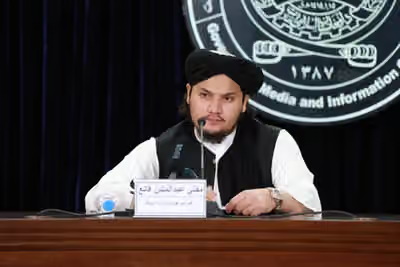

The Taliban's Ministry of Refugees and Repatriation announced that more than 2,000 migrants have returned to Afghanistan from Iran and Pakistan.
In a statement on its website, the ministry said that 1,664 of these individuals returned from Iran, while the rest came back from Pakistan.
The Taliban did not clarify whether these migrants returned voluntarily or were expelled.
In recent days, reports have emerged about the poor conditions faced by Afghan migrants in Iran. According to these reports, some migrants have been subjected to attacks and harassment by Iranian police and citizens on the streets.
A former Afghan security forces member, who sought refuge in Iran out of fear of Taliban retaliation, told Afghanistan International that Afghan migrants, especially former military personnel, are under pressure.
He added that Iranian police are arresting migrants with legal documents and taking them to camps. He said that Afghan military personnel are under pressure both in Afghanistan and in Iran.
Another Afghan migrant in Iran sent a video to Afghanistan International saying, "We came to Iran to escape the misery in Afghanistan. Now, Iranian police are searching for us street by street."
In a voice message, an Afghan migrant said that migrants in Iran face "insult, humiliation, and the threat of deportation" every moment.
In recent days, following reports of the death of an Iranian citizen after a confrontation with three Afghan workers, there have been reports of attacks on Afghan migrants in District 15 of Tehran.
Some Afghan migrants who contacted Afghanistan International said that they are scared to leave their homes for work or shopping. Additionally, distressing images received by us reportedly show severe injuries resulting from attacks on the migrants.

Sergey Vershinin, Russia's Deputy Foreign Minister, has expressed concerns about "terrorism in Afghanistan”.
On Tuesday, at a BRICS counter-terrorism working group meeting in Moscow, he stated that terrorism in Afghanistan and the Middle East is a global concern.
In his speech, published on Tuesday on the Russian Foreign Ministry's website, Vershinin emphasised on the need to suppress terrorist groups.
The Deputy Foreign Minister of Russia highlighted that terrorism in Afghanistan, the Middle East, and northern Syria requires close monitoring to effectively address emerging challenges.
He referred to a report by the UN Security Council's Sanctions Monitoring Team about "ISIS, Al-Qaeda, and the Taliban" to justify his remarks.
The Monitoring Team reported in July that terrorist groups still consider Afghanistan a safe haven and that the Taliban's leniency towards these groups creates conditions for terrorism to spread to neighbouring countries.
The report stated that the Taliban's inability to act decisively has revitalised Al-Qaeda and ISIS. According to the report, Al-Qaeda has quietly reestablished its bases and offices in five provinces, including Kabul and Nangarhar.
The report indicated that Al-Qaeda has utilised Afghanistan to reorganise, recruit, and set up a network of training camps and safe houses in at least five provinces. It also noted that this expansion has resulted in a growing influx of Al-Qaeda fighters from abroad into Afghanistan.
At the BRICS counter-terrorism working group meeting in Moscow, Vershinin warned that terrorist groups are not only seeking to strengthen their influence in conflict areas, but are also aiming to establish a solid base for controlling other regions.

Sirajuddin Haqqani, the Taliban's Interior Minister, has expressed concern over the dismissal of former government employees by the group.
Haqqani said, "We should not dismiss others and replace them with ourselves." He added that removing former employees indicates the Taliban's weakness.
Over the past three years, the Taliban have dismissed a significant number of professional employees from the previous government and appointed their own group members in state organisations.
On Wednesday, July 24, at the National Labour Conference, Haqqani said that the purpose of holding this conference is to reassure the people and create job opportunities.
He added, "We must hire deserving and experienced individuals, not dismiss them and replace them with ourselves."
Reports indicate that the Taliban have dismissed specialists from government offices and appointed their own people, who lack academic education and administrative experience, in public institutions.
Haqqani said that dismissing individuals may lead to their unemployment and migration and emphasised that the Taliban should not allow them to go abroad. Without referring to the Taliban's quest for power, Haqqani said that the group has "fought for the sake of God”.
The Taliban's Interior Minister said that if there are problems and shortcomings, they should be addressed with advice and guidance, not by dismissing people from their jobs.
He added that if the Taliban dismiss former government employees from their positions, they will be deprived of their salaries.
Addressing the Taliban ministers, this senior Taliban official said that since the group has saved them from war and bloodshed, they should also be patient with their work.
In the past three years, the Taliban have dismissed thousands of former Afghan government employees, and many former government cadres have sought refuge in other countries.
Women have been completely removed from government institutions and confined to their homes. Thousands of former soldiers and officers have also migrated to Iran and Pakistan due to fear of Taliban retaliation.

Amir Khan Muttaqi, the Taliban’s Foreign Minister, and Ismail Haniyeh, the head of Hamas's Political Bureau, discussed Gaza.
Zia Ahmad Takal, the Deputy Spokesperson for the Taliban’s Ministry of Foreign Affairs, wrote that Muttaqi welcomed the agreement of Palestinian groups in Beijing and stated that the Taliban supports the Palestinian resistance.
According to Zia Ahmad Takal, Muttaqi, in this telephone call on Wednesday, appreciated the “efforts and sacrifices of the Jihadi Hamas movement,” and emphasised on “unity and steadfastness in Jihadi struggles”.
Senior representatives of Palestinian political factions reached an agreement in China on Wednesday.
Mousa Abu Marzook, a member of Hamas's Political Bureau, announced on Tuesday that after a meeting in China, Hamas had signed an agreement with other Palestinian factions, including its rival, Fatah.
The Deputy Spokesperson for the Taliban’s Ministry of Foreign Affairs stated that Ismail Haniyeh, in his call with Amir Khan Muttaqi, discussed Palestine and recent developments in Gaza. Details of this conversation were not disclosed.
The Taliban have consistently expressed support for Hamas in recent months.
Husam Badran, a member of Hamas’s Political Bureau, in March 2024, appreciated the “strong” stance of the Taliban leader regarding the Gaza conflict and mentioned that Hamas is working to strengthen its “good relations” with the Taliban.
In June this year, Israeli army radio, quoting the Al-Akhbar newspaper, reported that the Taliban assured Iran that in the event of an intense war between Israel and Hezbollah, they would send thousands of fighters to Lebanon.
Earlier, Hassan Kazemi Qomi, Iran's Special Representative for Afghanistan stated that Afghanistan is the “axis of resistance” and that if needed, “martyrdom” forces from Afghanistan would go to Gaza.
The Taliban and the Islamic Republic of Iran have close relations, and officials from Iran and the Taliban have frequently visited Kabul and Tehran over the past three years.

UNAMA has republished a survey from April highlighting that only four percent of Afghans want the Taliban government to be recognised.
According to the survey, 45 percent of respondents said that to improve the situation for women in the country, the international community should facilitate direct dialogue between them and the Taliban.
The United Nations Assistance Mission in Afghanistan (UNAMA) conducted the survey by interviewing 888 women in 33 provinces and 64 men in 14 provinces. This report was republished on Wednesday, July 24, on UNAMA's X account.
Based on this survey, 80 percent of women said that they had no interaction with Taliban officials in the past three months, while 16 percent said they had.
At least 53 percent of men, however, reported meeting with local Taliban officials at least once during the three-month period.
Only two percent of women reported having "good" or "full" influence over decision-making processes in the community, compared to 18 percent of men. Women emphasised that they are excluded from public meetings and are unable to directly discuss their issues with local Taliban officials.
The UNAMA survey also indicated that only three to seven percent of women have access to formal and informal dispute resolution mechanisms, whereas 50 percent of men benefit from these mechanisms.
Sixty-four percent of women surveyed said that they "never" feel safe when left alone at home. For men, this figure is two percent. Men stated that they feel less secure when they leave home with a female family member.
In the UNAMA survey, both women and men called on the international community to establish formal mechanisms to ensure women's participation in international meetings related to Afghanistan's future.
Respondents believe that this can be achieved by allocating 50 percent of quota of Afghan delegations to women, ensuring women's presence at any discussion tables related to Afghanistan, or forming an advisory body of women for the international community.