World Bank’s New Country Director For Afghanistan To Focus On Support For Critical Sectors

The World Bank announced on Thursday appointment of Faris Hadad-Zervos as the new Country Director for Afghanistan.

The World Bank announced on Thursday appointment of Faris Hadad-Zervos as the new Country Director for Afghanistan.
In the announcement, Hadad-Zervos outlined his priorities, which include the provision of essential services and the strengthening of small and medium-sized enterprises.
These initiatives are central to his strategy for Afghanistan's economic and social development.
Hadad-Zervos succeeds Melinda Good, who previously held the position. Since the Taliban takeover in 2021, the World Bank has committed over $1.7 billion in aid to Afghanistan, aimed at stabilising the country's economy and supporting its people.
The new director emphasised that one of his primary focuses will be to support critical sectors such as healthcare, food security, livelihoods, and education, with a particular emphasis on ensuring that women and girls benefit from these programs.
Hadad-Zervos, a US citizen, has been with the World Bank since 1996. He has previously served as Country Director for the Maldives, Nepal, and Sri Lanka, bringing extensive experience to his new role in Afghanistan.
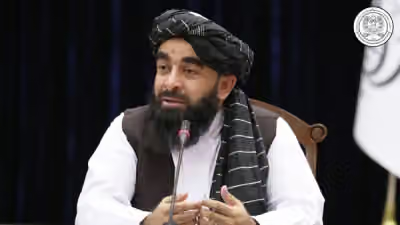

Afghanistan International has obtained the names of Taliban officials involved in transporting and sheltering Ayman al-Zawahiri, the former leader of al-Qaeda, in Kabul.
According to the information, Ayman al-Zawahiri was brought to Kabul by Qari Khalid Hikmat, a native of Kandahar and the head of the 08 department of the Directorate General of Intelligence (GDI), the main Taliban intelligence agency
Following the publication of a report by the Emirati news outlet Al Akhbar, Afghanistan International continued investigating the case of the al-Qaeda leader's death. Sources told Afghanistan International that Khalid had travelled from Kabul to Quetta city in Baluchistan province of Pakistan to relocate his family to Afghanistan. In Quetta, he was informed that al-Zawahiri was ill and required urgent medical attention. Khalid left Quetta without his family and went to the remote district of Baghran in Helmand province.
Before the fall of Kabul in 2021, Khalid had been in charge of al-Qaeda and Taliban communications in the southwestern region from Quetta city in Pakistan. According to reports, Agha Mohammad Hakim, the current Taliban governor of Panjshir, and Qari Dawood Afghani, a member of the group, were among the few Taliban officials aware of al-Zawahiri's presence in Kabul. Qari Dawood, a close associate of the prominent Taliban figure Mullah Mohammad Yasser, along with these officials, secretly met al-Zawahiri and his host, Qari Hikmat, immediately after the al-Qaeda leader was brought to Kabul.
Who Hosted Ayman al-Zawahiri in Kabul?
It has been reported that al-Zawahiri was transferred to Kabul to access medical care, as he suffered from heart and kidney diseases. The al-Qaeda leader was moved from Pakistan to southern Afghanistan and then to Kabul. According to information, Qari Hikmat kept al-Zawahiri in two different locations in Kabul.
Initially, he was housed in a safe house belonging to the Taliban intelligence agency. However, after drones were spotted in the area, Hikmat decided to move the al-Qaeda leader to a house near Alauddin Junction in Darulaman road in western Kabul, close to the former parliament and the Russian embassy.
During al-Zawahiri's stay near Alauddin Junction, Taliban’s Interior Ministry intelligence officers became aware of his presence in the capital. This discovery was prompted when Qari Hikmat, installed surveillance cameras at the al-Zawahiri's residence, arousing the suspicion of an intelligence official from the Taliban's Interior Ministry.
Late at night, these officers informed Sirajuddin Haqqani, the Taliban's Interior Minister, about al-Zawahiri's presence in Kabul. Haqqani, who was awakened from sleep, was shocked. He contacted his brothers, Aziz Haqqani and Qari Hamza Haqqani, to inquire if they had played any role in bringing al-Zawahiri to Kabul. When both brothers denied any knowledge of the transfer, Haqqani decided to move the ailing al-Qaeda leader to a third location in the diplomatic district of Wazir Akbar Khan in Kabul.
Ultimately, the United States discovered al-Zawahiri's hideout and killed him in an airstrike on July 31, 2022. Sources involved in the al-Zawahiri case report that several hidden cameras were found in the bedroom and kitchen of the house where he was staying.
What Happened After al-Zawahiri's Death?
Following al-Zawahiri's death, Agha Mohammad Hakim was transferred from Nuristan province to Panjshir province. Qari Dawood Afghani, another Taliban member, was appointed as the Attaché for Refugee affairs at the Afghan Embassy in Tehran by Khalil-ur-Rahman Haqqani, Sirajuddin Haqqani's uncle. Previously, he had travelled to Iran to maintain contact with Saif al-Adel. Iranian authorities, however, refused to approve his appointment and did not allow him to relocate to Tehran.
Taliban sources said that after al-Zawahiri's killing, 200 members of the group were arrested, but most were later released. Qari Hikmat was among those detained; he spent two years in prison before being recently released and moved to Pakistan.
Additionally, Mahmud Shah Habibi, an Afghan-American citizen, was arrested on August 10, 2022. Habibi worked as a consultant for a telecommunications company in Kabul. The Taliban did not disclose the reason for his arrest, but it is speculated that it may be connected to al-Zawahiri’s case.
The Taliban is currently seeking a prisoner exchange with the United States. Representatives from both sides have discussed this matter in a third Doha meeting. Three American citizens are in Taliban custody. The Taliban seek the release of Rahim Afghani, an aide to former al-Qaeda leader Osama bin Laden, currently held at Guantanamo.
Where Was al-Zawahiri Buried?
After al-Zawahiri's death, his body was taken to the 300-bed hospital in Kabul, where Hamza, the Taliban's police chief in Kabul, and Zainullah, Sirajuddin Haqqani’s chief of staff, guarded the al-Qaeda leader's body for three days. It is reported that one of Sirajuddin Haqqani's young sons was also killed in the airstrike on al-Zawahiri's house.
Following al-Zawahiri's death, most Taliban officials went into hiding. Sirajuddin Haqqani disappeared from public view for two weeks. Later, the Taliban claimed he had gone to Panjwai district in Kandahar, to attend the funeral of a Taliban commander. Sources now suggest that Haqqani attended the burial and funeral of his son and Ayman al-Zawahiri in Paktia province.
Sources indicate that the Taliban leader was buried in the Zadran Shwak area in Paktia province. Sirajuddin Haqqani, the son of former jihadist leader Jalaluddin Haqqani, hails from Paktia province. The Haqqanis belong to the Zadran tribe, primarily residing in eastern Afghanistan.
Al-Qaeda Officials Accompanying al-Zawahiri
During al-Zawahiri's secret journey from Pakistan to southern Afghanistan and then Kabul, he was accompanied by Hamza al-Ghamdi, a senior al-Qaeda member. Al-Ghamdi oversaw al-Qaeda operations in southern and eastern Afghanistan and Pakistan's tribal areas. He was last seen in North Waziristan, Pakistan.
Al-Ghamdi speaks Pashto fluently and was added to the US terrorism blacklist in June of this year, with a $5 million reward for information leading to his capture.
Denial of al-Zawahiri's Presence and Death in Kabul
Al-Zawahiri's killing in Kabul was a painful and embarrassing moment for the Taliban, as the group had pledged in the Doha Agreement on February 29, 2020, not to harbour al-Qaeda or other terrorist groups in Afghanistan. However, less than a year after the Taliban regained power, the suspect behind the September 11 attacks and a top US wanted terrorist was found in the heart of Kabul.
The Taliban were alarmed by al-Zawahiri's death, fearing that the US might retaliate with further airstrikes. As a result, Taliban officials denied al-Zawahiri's presence and death in Kabul.
The Taliban were also concerned that al-Qaeda might confirm al-Zawahiri's death and announce a new leader. Therefore, they sent a message to Saif al-Adel in Iran, requesting him not to confirm al-Zawahiri's death or announce his successor. In their message, the Taliban referred to the historical relationship between the two organisations and praised al-Qaeda's military and financial support during the war. However, the Taliban made it clear that Osama bin Laden's presence in Afghanistan led to their regime's collapse in 2001, and they were not ready to risk the fall of the Taliban again due to al-Zawahiri's presence.
Saif al-Adel reportedly responded that he understood the Taliban's position and said, "It was al-Zawahiri's wish to be martyred in this way." Till now, the Taliban has remained silent about al-Zawahiri's death.

The Taliban has disclosed that its leader, Mullah Hibatullah Akhundzada, conducted a significant meeting with 600 senior military and political officials at the 205th Al-Badr Corps in Kandahar.
This gathering was described as a reformative session focused on addressing internal challenges.
Mullah Hibatullah addressed the military and political leaders, along with members of the Taliban's cabinet, warning that "disagreements and distrust will lead to your defeat”. He underscored the critical importance of unity and cohesion within the group.
The Taliban's Ministry of Defence announced that the meeting, which lasted for three days, concluded on August 1. During this time, Mullah Hibatullah stressed to the officials that their foremost duty is the protection and consolidation of the Islamic regime. He cautioned them against becoming "arrogant" with the power they wield, emphasising on the need for humility and vigilance.
In his directives, Mullah Hibatullah urged Taliban members to exhibit unwavering obedience, metaphorically describing their compliance as being "as obedient as a lifeless body”.
He advised against questioning the orders of their superiors, framing such adherence as a form of jihad, or spiritual struggle.
The Ministry of Defence noted that the meeting included participation from high-ranking officials, including the Deputy Prime Ministers for Economic and Administrative Affairs, the Ministers of Interior, Foreign Affairs, Promotion of Virtue, and Hajj and Religious Affairs, among other cabinet members. Also in attendance were commanders of battalions, central commanders, and various military unit officials.
Mullah Hibatullah also emphasised on the necessity for Taliban members to acquire knowledge pertinent to their respective roles. He called for the elimination of regional discrimination within the group and insisted that members should strive to gain the skills necessary for their responsibilities.

Hamidullah Fitrat, the deputy spokesperson for the Taliban, has criticised the latest report by the United Nations Assistance Mission in Afghanistan (UNAMA), describing it as "biased".
The Taliban also accused the organisation of "disrespecting Islamic Sharia”.
Fitrat dismissed the findings of the UNAMA report, insisting that Afghanistan is governed by Islamic laws and that safeguarding citizens' rights is a "religious obligation”.
He voiced his objections on the social media platform X, stating, "The recent UNAMA report suggests that the enforcement of Islamic Sharia constitutes a violation of human rights. Such assertions are a clear disrespect to the principles of Islamic Sharia."
The Taliban representative further contended that the report disrespects the sentiments of Muslims and urged UNAMA to show respect for the beliefs of the Islamic community.
UNAMA's recent quarterly report highlighted ongoing human rights concerns in Afghanistan, including the Taliban's continued detention and torture of former government officials and military personnel. The report documented that at least 60 individuals had been arbitrarily detained over the past three months, predominantly former officials and military members.
Additionally, the report noted the continuation of corporal punishment under the Taliban rule, with at least 147 individuals, including 28 women, publicly flogged in the past three months.

Vladimir Dzhabarov, Deputy Chairman of the Russian Federation Council's Committee on International Affairs, announced the unanimous support from Collective Security Treaty Organisation (CSTO) member states to safeguard the Tajik-Afghan border.
He underscored CSTO's critical role in maintaining stability in Central Asia, highlighting the strategic importance of Russia's 201st military base in Tajikistan.
This base, among Russia's largest overseas, has been fortified with modern equipment following the Taliban's takeover of Afghanistan in August 2021.
Dzhabarov emphasised that the CSTO is instrumental in safeguarding the region, with the 201st base providing significant security to Tajikistan.
The senator criticised the United States for attempting to regain influence in the region post-withdrawal from Afghanistan, alleging that the US is trying to establish "a second front against Russia in Central Asia" through joint military exercises and exacerbating conflicts, particularly along the Kyrgyzstan-Tajikistan border.
In July, Tajik Foreign Minister Sirojiddin Muhriddin urged the CSTO Council of Foreign Ministers to expedite the signing of a programme aimed at bolstering the Tajik-Afghan border. Originally slated for 2023, this initiative has been rescheduled for 2024.
The CSTO, a regional security alliance, comprises Russia, Belarus, Armenia, Kazakhstan, Kyrgyzstan, and Tajikistan.

Pakistan's National Counter Terrorism Authority (NACTA) has officially designated the Hafiz Gul Bahadur Group and the Majid Brigade as terrorist organisations, thereby prohibiting their activities.
These groups had previously been linked to the Tehreek-e-Taliban Pakistan (TTP) and Baloch insurgents, respectively.
As reported by the Pakistani newspaper Dawn on Thursday, the inclusion of these groups has increased the total number of banned organisations on NACTA's terrorist list to 81. This year alone, three new groups have been added to this list.
The Hafiz Gul Bahadur Group, identified as a significant anti-Pakistan faction, was once considered a militant wing of the TTP. The group has been responsible for numerous deadly assaults against Pakistani security forces. Pakistani authorities assert that this group, along with the TTP, operates bases and training camps within Afghanistan.
The Majid Brigade, now recognised as an independent entity on NACTA's terrorist list, was formerly known as a formidable military wing of the Baloch Liberation Army. Since 2011, the group has been involved in numerous lethal attacks targeting the Pakistani military.
Earlier in March, NACTA also classified the Zainebiyoun Brigade—affiliated with Iran's Islamic Revolutionary Guard Corps (IRGC)—as a terrorist organisation.