• العربية
  • پښتو
  • فارسی
Brand
  • Afghanistan
  • Sport
  • Markets
  • Afghanistan
  • Sport
  • Markets
  • Theme
  • Language
    • العربية
    • پښتو
    • فارسی
  • Afghanistan
  • Sport
  • Markets
All rights reserved for Volant Media UK Limited
volant media logo

Haqqani Calls For Unity Among Taliban Amid Concerns Regarding Power Distribution

Aug 3, 2024, 09:02 GMT+1

Sirajuddin Haqqani, the Taliban's Interior Minister, has emphasised on the importance of maintaining unity within the group, warning that the distribution of power should not create divisions.

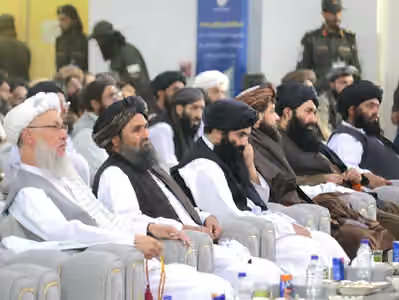
At a three-day meeting in Kandahar, Haqqani highlighted that unity had been a key factor in preventing internal issues among the Taliban prior to their recent takeover of Afghanistan.

Haqqani expressed his concern over the emergence of factionalism within the Taliban, which he found more troubling than the loss of life among their members.

He lamented the identification of Taliban factions under various names, including the Haqqani network, and urged for cohesion.

During the meeting, which included 600 senior military and political officials at the 205 Al-Badr Army Corps, Haqqani stated, "We are united as before, under the leadership of one Amir. We did not fight for power. Before the conquest, there were no issues among the Taliban across Afghanistan, and this was due to the blessings of unity and solidarity."

This gathering also saw other senior Taliban figures addressing the attendees. Abdul Haq Wasiq, the Taliban's Intelligence Chief, warned of an ongoing "cold and ideological war" against the group. He dismissed rumours of internal divisions as unfounded, asserting that the primary objective of such rumours was to create a perception of disunity within the Taliban.

Khalid Hanafi, the Taliban's Minister for the Promotion of Virtue and Prevention of Vice, cautioned against the labels assigned to Taliban officials by external observers, such as "hardliner”, "moderate”, and "intellectual”. He stressed on the importance of maintaining "unity and obedience”.

Noor Mohammad Saqib, the Taliban's Minister of Guidance, Hajj, and Endowments, praised the Taliban government as an exemplary Islamic system, noting that its success depended on strict obedience to the Amir. He remarked, "There were many movements composed of scholars, but they perished because they lacked obedience."

Additionally, Amir Khan Muttaqi, the Taliban's Foreign Minister, emphasised on the need for the Taliban army to garner public support. He urged military personnel to avoid actions that might provoke public resentment. Taliban spokesperson Zabihullah Mujahid echoed this sentiment, stating, "The army is the main pillar of a country. The collapse of regimes stems from the collapse of the army." Fasihuddin Fitrat, the Taliban's Chief of Staff, attributed the group's victory to their unwavering belief.

The meeting concluded with Mullah Hibatullah addressing the military and political leaders, as well as the Taliban cabinet members, cautioning that internal disagreements and distrust could lead to the group's downfall.

Most Viewed

Pakistani PM Accuses Taliban Of Helping India Undermine Pakistan
1

Pakistani PM Accuses Taliban Of Helping India Undermine Pakistan

2

Obedience To An Emir Is A Religious Obligation, Says Taliban Leader

3

UN Raises Alarm Over Taliban Child Marriage Regulations

4

Afghan Territory & Borders Pose No Threat To Iran, Says Taliban Defence Minister

5

Moscow Ready To Mediate Between Pakistan & Taliban

•
•
•

More Stories

8 Million Afghans Have Left Their Homeland Since Doha Agreement

Aug 2, 2024, 14:32 GMT+1

The International Organisation for Migration (IOM) has reported that nearly eight million Afghan citizens have fled their homeland since 2020.

According to the IOM, approximately one million of these Afghans have sought asylum in European countries, while 85% have migrated to neighbouring nations.

On February 29, 2020, the United States signed a peace agreement with the Taliban in Doha, Qatar. Critics argue that this agreement paved the way for the collapse of the Islamic Republic of Afghanistan and the Taliban's subsequent takeover of Kabul.

In a recent report, the IOM highlighted that since the Taliban assumed power in August 2021, Afghanistan has experienced significant economic inflation, with over half the population living in poverty.

The report indicates that around 70% of Afghans migrating to Iran cite a lack of job opportunities as their primary reason for leaving. The IOM also noted a substantial number of returnees from Iran, with nearly one million Afghans returning to their homeland in 2023, 70% of whom lacked residency documents.

The IOM stressed that many Afghan citizens, facing challenges in obtaining passports and visas, resort to illegal means of migration, often paying human traffickers to cross borders.

The report emphasises the increased risk of human rights violations for Afghans without travel documents, both at border crossings and in neighbouring countries. The IOM noted that these individuals frequently endure "cruel, inhuman, and degrading" treatment.

In light of these issues, the IOM has called on countries to suspend the deportation of Afghan migrants until conditions for a "safe, dignified, and voluntary" return are established.

This appeal comes as Pakistan and Iran have intensified the deportation of undocumented Afghan migrants in recent months. According to data from the Taliban's Ministry of Refugees and Repatriation, over a thousand Afghan migrants are expelled daily from these two countries.

Iranian Diplomat Describes Relations With Taliban As Most Complex Diplomatic Task

Aug 2, 2024, 12:59 GMT+1

Rasoul Mousavi, an aide to Iran's Foreign Ministry, described managing relations with Taliban as "the most difficult and complex type of political management in diplomatic relations".

He expressed this after meeting with Abdul Kabir, the Taliban's deputy prime minister.

Mousavi highlighted the presence of numerous "internal and external challenging factors" in both Iran and Afghanistan.

Despite these complexities, Mousavi emphasised in a post on the social media platform X that both the Taliban and the Islamic Republic of Iran view their relationship as having "strategic importance" at the "highest levels."

The Iranian diplomat pointed out various challenging factors that could have a "destructive impact" on the relations between Iran and the Taliban.

Although the Islamic Republic, like other nations, does not officially recognise the Taliban government, it continues to maintain close ties with the group.

The meeting between the Taliban's deputy prime minister and the Iranian Foreign Ministry aide took place on the sidelines of the inauguration ceremony for Iran's new president, Masoud Pezeshkian.

On Thursday, Abdul Kabir travelled from Iran to Qatar to attend the funeral of Ismail Haniyeh, the head of Hamas's political bureau, who was assassinated in Tehran.

Afghan Social Researcher Deported From Iran Over Hijab Compliance

Aug 2, 2024, 12:13 GMT+1

Iranian authorities have expelled Kobra Gholami, an Afghan social researcher, for allegedly failing to comply with the country's hijab requirements.

Despite possessing valid residency documents, Gholami was summoned to the passport office and subsequently deported to Afghanistan on Thursday.

Her friends and supporters claim the expulsion was without legal basis.

Reports indicate that Gholami received several text messages warning her about her hijab before being called to the passport office. Upon arrival, she was detained by the Iranian police and deported within hours, without the opportunity to communicate with her family.

The incident has sparked an outcry on social media, where users launched a campaign with the hashtag "#BringKobraBack," expressing concern for her well-being and urging her return to Iran.

Shima Va’ezi, an Iranian social media user, highlighted Gholami's sudden deportation on social media platform X, noting, "Kobra is now on the bus and hasn't been able to speak or say goodbye to her family and loved ones. She had all the necessary residency documents and was pursuing a master's degree at Al-Zahra University."

Gholami has previously been an outspoken critic of the treatment of Afghan migrant women in Iran. She addressed these issues at the sixth Social-Cultural Research Conference in Iran last year, where she presented on "Afghan Migrant Women in the Cycle of Oppression" during a panel on "Femininity and Social-Cultural Transformation."

US, Allies to Counter Emerging Terror Threats in Afghanistan

Aug 2, 2024, 11:15 GMT+1

On Thursday, Vedant Patel, spokesperson for the US State Department, announced that the United States, in partnership with its global allies, is actively working to prevent the resurgence of terrorist threats in Afghanistan.

Patel characterised ISIS as an "international terrorist network" capable of executing attacks worldwide.

He emphasised on the consistent efforts of the US to ensure that Afghanistan does not become a base for terrorist activities against the United States and its allies.

Responding to a question from a Pakistani journalist regarding a United Nations report on the resurgence of terrorist groups in Afghanistan, Patel underscored the ongoing collaboration between the US and its international and regional partners to combat terrorism.

The United Nations Security Council had previously reported a notable increase in terrorist attacks in Pakistan, raising concerns among member states about the threat posed by terrorist groups originating from Afghanistan. The council noted enhanced cooperation between the Afghan Taliban and Pakistani Taliban, including the sharing of manpower and training facilities.

In a report from late July, the UN monitoring team on ISIS, al-Qaeda, and the Taliban identified the Tehreek-e-Taliban Pakistan (TTP) as the "largest terrorist group in Afghanistan”.

World Bank’s New Country Director For Afghanistan To Focus On Support For Critical Sectors

Aug 2, 2024, 10:04 GMT+1

The World Bank announced on Thursday appointment of Faris Hadad-Zervos as the new Country Director for Afghanistan.

In the announcement, Hadad-Zervos outlined his priorities, which include the provision of essential services and the strengthening of small and medium-sized enterprises.

These initiatives are central to his strategy for Afghanistan's economic and social development.

Hadad-Zervos succeeds Melinda Good, who previously held the position. Since the Taliban takeover in 2021, the World Bank has committed over $1.7 billion in aid to Afghanistan, aimed at stabilising the country's economy and supporting its people.

The new director emphasised that one of his primary focuses will be to support critical sectors such as healthcare, food security, livelihoods, and education, with a particular emphasis on ensuring that women and girls benefit from these programs.
Hadad-Zervos, a US citizen, has been with the World Bank since 1996. He has previously served as Country Director for the Maldives, Nepal, and Sri Lanka, bringing extensive experience to his new role in Afghanistan.