Pakistan State Bank Reports 4 Percent Increase in Exports To Afghanistan
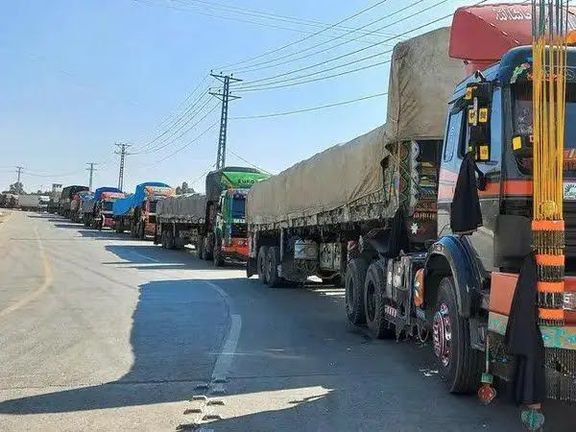
The State Bank of Pakistan announced that the country's exports to Afghanistan increased by 4.12 percent in the current fiscal year, rising from $522 million to $544 million.
The State Bank of Pakistan announced that the country's exports to Afghanistan increased by 4.12 percent in the current fiscal year, rising from $522 million to $544 million.
Additionally, Pakistan's imports from Afghanistan decreased by 21.95 percent, dropping from $15 million to over $11 million.
The Pakistani newspaper, The Nation, reported on Tuesday, that according to the monthly statistics of the State Bank of Pakistan, the total exports of the country to Afghanistan in June exceeded $46 million. In contrast, this figure was $43.657 million last year.
Pakistan's exports in June of this year increased by 5.53 percent compared to the same period last year.
This newspaper wrote that Pakistan's exports to other countries overall increased by 11.53 percent in one year, reaching more than $31 billion.

In a recent report, Save the Children announced that at least 38,488 people were displaced due to extreme weather events across Afghanistan in the first half of this year.
The organisation stated that half of these displaced individuals are children.
According to the organisation, the six-month displacement figure in Afghanistan this year exceeds the total number for last year.
On Tuesday, August 6, Save the Children wrote in its latest report that these individuals were forced to leave their homes due to drought, high temperatures, floods, landslides, avalanches, and storms in Afghanistan.
This child protection organisation mentioned that last year, Afghanistan had the highest number of displaced children in the world.
Save the Children, quoting the United Nations, reported that in 2022, one out of every seven children in Afghanistan faced long-term displacement. The organisation said that this is the highest rate in South Asia and second globally.
Save the Children stated that Afghanistan is among the countries least capable of adapting to and coping with climate crises and is the sixth most vulnerable country to climate change globally.
Arshad Malik, Save The Children Country Director in Afghanistan, said, “The climate crisis is fuelling the humanitarian crisis in Afghanistan. It is forcing people from their homes, destroying water sources, and preventing children from going to school."
He added that compared to people over 60 years old, newborns in Afghanistan are 5.3 times more likely to face drought during their lifetimes, and this crisis alters the lives of children.
The organisation, quoting the United Nations, reported that more than one in three people in Afghanistan faces critical hunger due to climate-induced crises and high food prices.
According to the United Nations, 25 out of 34 provinces in Afghanistan are experiencing drought conditions, affecting more than half of the country's population.
Save the Children added that research repeatedly shows that girls and women are disproportionately affected by natural disasters compared to men.
The organisation noted that since the Taliban's takeover, Afghanistan has seen a significant reduction in aid over the past three years, and thus humanitarian organisations alone cannot be expected to bridge this gap.
Save the Children has called for increased international assistance to meet current needs and for long-term planning to address the climate crisis.
Special Inspector General for Afghanistan Reconstruction (SIGAR) reported that Washington has provided approximately $21 billion in aid to Afghanistan since 2021.
According to SIGAR, this funding has been allocated for humanitarian aid, the relocation and resettlement of refugees, and the repayment of Afghanistan’s foreign assets.
Humanitarian Aid
The report detailed that of the $20.71 billion provided since August 2021, $2.97 billion was spent on humanitarian and development aid. SIGAR specified that this aid was used in four areas: humanitarian assistance ($2.029 billion), development ($458 million), agency operations ($316 million), and security ($100 million).
However, SIGAR did not explain the nature of the "agency operations" and "security" expenditures in Afghanistan.
According to the report, these funds were disbursed from October 2021 till the end of June 2024 through the US Agency for International Development (USAID) and affiliated United Nations agencies.
Repayment of Afghanistan’s Foreign Assets
The report noted that an additional $3.5 billion was transferred to Afghanistan’s trust fund for the repayment of the country's foreign assets, which were to be managed on behalf of the Afghan people.
These assets, frozen in the US following the Taliban's takeover, were moved to a Swiss trust fund to be held under its oversight for the Afghan people.
By June 28, 2024, the total value of these assets, including accrued interest, had reached $3.84 billion.
Aid for Refugee Relocation and Resettlement
SIGAR added that $8.7 billion was allocated for the relocation and resettlement operations of Afghan evacuees in United States. The report did not provide detailed expenditures for this amount.
According to SIGAR, $5.36 billion was spent by the US Department of Defence on an overseas programme including civilian aid, humanitarian issues, and disaster response, though specific details of this programme were not included.
SIGAR's report also highlighted that the US Department of Health and Human Services committed $3 billion, and the Department of Homeland Security committed $284 million for assistance to Afghans.
Counter-Narcotics Efforts
The report noted a significant reduction in poppy cultivation in Afghanistan following an order issued by Taliban leader Mullah Hibatullah Akhundzada on April 3, 2022. Despite this, SIGAR questioned how the Taliban managed to reduce poppy cultivation so quickly, given that the US and its allies had spent $9 billion over two decades with limited success.
SIGAR believes that the decrease in poppy cultivation and the rise in drug prices have complicated the drug situation in Afghanistan. Despite the reduction in poppy cultivation, Afghanistan's economy remains heavily dependent on drug production.
The report mentioned that before Akhundzada’s order, landowners were allowed to store large quantities of drugs. Additionally, certain areas continued poppy cultivation despite the ban. As a result, the high-value drug trade persisted after the decree. In 2023, the price of a kilogram of opium in Kandahar was $263, compared to $160 the previous year. In Nangarhar, the price per kilogram was $362 in 2023, up from $220 the previous year.
International Community’s Engagement with the Taliban
SIGAR reported that the international community’s engagement with the Taliban continued in the first quarter of 2024, both at the international and regional levels. The report cited the third Doha meeting and the participation of a Taliban delegation as an example of ongoing engagement. The report also mentioned ongoing relations between regional countries and the Taliban, including trade exchanges.
Despite this, SIGAR noted that during the reporting period (ending June 30), Sirajuddin Haqqani, the Taliban’s interior minister and a US-designated "terrorist," left Afghanistan for the first time since the Taliban’s rise to power, visiting the United Arab Emirates and Saudi Arabia.
Both countries are US allies and host US military forces. SIGAR, referencing the Long War Journal, suggested that Haqqani’s travel undermines the global fight against terrorism.
Haqqani, the leader of the Haqqani network, has been implicated in organizing deadly attacks on civilians, international coalition forces, and foreign embassies. He is under US sanctions and has been sanctioned by the United Nations since 2007 due to his collaboration with Al-Qaeda.
Terrorist Groups in Afghanistan
SIGAR reported that terrorist activity continues in Afghanistan, raising concerns in the US and UN that Afghanistan may once again become a haven for terrorists due to the Taliban’s failure to adhere to the Doha agreement. While the Taliban have made progress against ISIS-Khorasan, they remain tolerant of other groups like Al-Qaeda and Tehreek-e-Taliban Pakistan (TTP).
SIGAR also noted that Saif al-Adel, the leader of Al-Qaeda, has called on foreign militants to migrate to Afghanistan for training to attack Western interests and view the Taliban as a model for future Islamic states.
The report stated that under Sirajuddin Haqqani's command, residential and training facilities are provided for Al-Qaeda and Pakistani Taliban members in Ghazni, although the Taliban denied this, claiming they are building a settlement for Pakistan-deported migrants.
According to SIGAR, TTP has between 6,000 and 6,500 fighters in Afghanistan, primarily in the eastern regions.
Regarding ISIS-Khorasan, SIGAR, citing the UN sanctions monitoring team, described the group as "the greatest threat to Afghanistan and the region," though not a threat to Taliban control. ISIS-Khorasan has an estimated 2,000 to 3,500 fighters in Afghanistan, potentially reaching 6,000 with affiliated members.
Michael Kurilla, the commander of US Central Command (CENTCOM), warned that ISIS has the capability and intent to attack Western interests within six months.
Taliban Forces
SIGAR compared the number of Taliban forces with those of the previous Afghan government’s security and defence forces. As of June 24, 2024, the Taliban’s defence forces numbered 177,890, compared to 182,071 in the previous government as of April 29, 2021. However, the Taliban police force totalled 211,024, significantly higher than the 118,628 police officers in the previous government, giving the Taliban approximately 88,000 more personnel overall.
Opposition Forces
Armed opposition forces have increased their attacks against the Taliban. Over the past three months, they claimed responsibility for 68 attacks, up from 43 in the preceding three months. SIGAR identified the National Resistance Front and the Afghanistan Freedom Front as key opposition groups, noting their joint attacks in April. The report also mentioned several other opposition groups focused primarily on political and intelligence activities.
The Hill news website reported that the issue of the United States’ catastrophic withdrawal from Afghanistan holds significant importance for segments of voters in key states such as Pennsylvania and Wisconsin.
According to the publication, the manner in which the US exited Afghanistan has adversely affected support for Joe Biden.
In an article authored by Joseph Azam and published on Monday, it has been highlighted that the withdrawal and the subsequent fate of the Afghan people under the Taliban rule resonate with a large population of US veterans and Afghan-Americans in critical states like Pennsylvania, Michigan, Arizona, Virginia, Wisconsin, and North Carolina.
Azam contends that Biden harboured a "deep and personal antipathy towards the war in Afghanistan" and adopted "Trump's ill-conceived agreement with the Taliban” without ensuring the survival of the young democracy and the safety of the Afghan people.
The writer of the article argues that both Trump and Biden jointly orchestrated the disastrous withdrawal from Afghanistan. By failing on US promises to protect the Afghan government and its people, Washington has inflicted “moral injury on hundreds of thousands of US veterans and left nearly 40 million people living under one of the most regressive and dangerous regimes in the world”.
The author calls on Kamala Harris, the Democratic Party's presidential candidate, to distance herself from Biden's Afghanistan policy and uphold United States’ commitments to the Afghan people. One such commitment is to assist former Afghan collaborators of US forces who remain in Afghanistan and expect the US to relocate them to a safe country.
Furthermore, Azam emphasises that Washington should expedite the granting of permanent residency to evacuated Afghans in the US, a proposal that has been hindered by Republican opposition in the Congress. He urges Harris to adopt a principled stance toward the Taliban and, in light of the gender apartheid in Afghanistan, to avoid normalising relations with the Taliban.
The Taliban's Ministry of Foreign Affairs announced on Monday that foreign nationals currently in Afghanistan may remain if they have visas issued by the embassies of the former Afghan government.
However, moving forward, entry into Afghanistan will only be permitted for foreign citizens holding visas obtained from embassies that are recognised and cooperate with the Taliban administration.
The ministry clarified that consular services provided by Afghanistan's diplomatic missions in countries including the United Kingdom, Belgium, Switzerland, Austria, France, Italy, Greece, Poland, Sweden, Norway, Canada, Australia, and in the cities of Bonn and Berlin, are now deemed "invalid."
The Taliban attributed this decision to "administrative corruption," "lack of transparency," and "lack of coordination" with their Ministry of Foreign Affairs in Kabul.
Currently, only the consular services from Afghanistan's embassies in Spain, Bulgaria, and the Czech Republic are considered valid, as these missions coordinate with the Taliban.
This measure is a part of the Taliban's broader effort to gain control over Afghanistan's international diplomatic missions. As a result, many Afghan migrants may now face the inconvenience of traveling long distances, potentially hundreds or thousands of kilometers, to obtain, renew, or verify consular documents.
The Coordination Council of Afghan Embassies and Consulates criticised the Taliban's new policy as "short-sighted," noting the additional hardships it imposes on Afghan migrants.
Over the past three years, the Taliban had accepted consular documents from all Afghan diplomatic missions but had also encouraged these missions to collaborate with their Ministry of Foreign Affairs.
Fariba Abbasi, a former employee of Afghanistan's Ministry of Interior, has raised concerns about her husband, Baqir Abbasi, who went missing 20 days ago following his deportation from Iran.
Abbasi reported that she has not received any information regarding his whereabouts since then.
According to Abbasi, other deportees informed her that Baqir Abbasi was identified and subsequently detained by the Taliban. She noted that her husband had previously served as a member of the security forces under the former Afghan government.
The Taliban has not provided any official comment on Baqir Abbasi's detention yet.
Fariba Abbasi recounted that on July 16, several migrants deported from Iran along with her husband had been recognised and apprehended by the Taliban at Islam Qala in Herat. She has had no further news about her husband's status since that incident.
In a video message sent to Afghanistan International, Fariba Abbasi appealed to the United Nations for assistance in securing her husband's release from Taliban’s custody.
This development comes amid Iran's recent intensification of deportations targeting undocumented migrants. Sources previously informed Afghanistan International that the Taliban had detained two other former government soldiers, Gul Nabi and Pacha Gul, in the Dawlat Shah district of Laghman province, following their deportation from Iran. These sources indicated that the individuals had served as local police officers under the previous Afghan administration.
Furthermore, Ehsan Niro, a spokesperson for the National Movement Party of Afghanistan, confirmed on July 22 that Ezzatullah, a former commander within the party, was killed by unknown assailants in Sar-e Pul shortly after being deported from Iran.