Killed Three Taliban Members in Kabul, Claims AFF

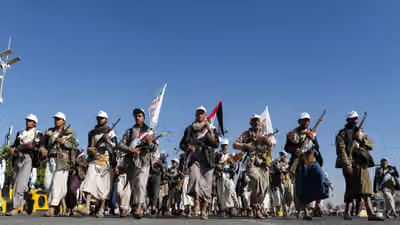
The Afghanistan Freedom Front (AFF) announced on Wednesday that it had conducted an attack on a Taliban checkpoint near Baraki Square in Kabul.

The Afghanistan Freedom Front (AFF) announced on Wednesday that it had conducted an attack on a Taliban checkpoint near Baraki Square in Kabul.
According to the group's statement, three Taliban fighters were killed in the incident.
AFF has shared a video of the attack on its social media platform.
The group also mentioned in their statement that one Taliban member was injured during the attack.
Afghanistan International has not independently confirmed the occurrence of this attack or the reported casualties.
In recent months, this anti-Taliban armed group has frequently claimed responsibility for guerrilla attacks on Taliban checkpoints and posts in Kabul and other provinces.

Zia-Ul-Haq Haqmal, the Taliban’s Deputy Minister of Broadcasting of the Ministry of Information and Culture, has met with Patricia McPhillips, the head of UNESCO in Afghanistan.
Haqmal told McPhillips that media projects should be provided to the media in coordination with the Taliban's Ministry of Information and Culture.
On Wednesday, Haqmal said that the media outlets have complaints about the projects, and to address these complaints, the projects should be made available to these organisations in coordination with the Ministry of Information and Culture.
The Bakhtar News Agency, under Taliban control, reported that McPhillips assured she would increase coordination with the group's Ministry in this regard. Bakhtar wrote that "the head of UNESCO welcomed the progress made in various sectors in Afghanistan”.
The Afghanistan Journalists Centre says that since the Taliban's return to power, freedom of expression and the media have been deteriorating alarmingly. Widespread censorship, a financial crisis, and the flight of hundreds of journalists has led to the shutdown of media outlets.
Private media are not allowed to broadcast music, films, and foreign series. Some sources say that "the newsrooms of some private media outlets are managed by the Taliban’s Intelligence, the Ministry of Propagation of Virtue and Prevention of Vice, and the Taliban's Ministry of Culture”.
The Afghanistan Journalists Centre has also expressed concern about violence and the arbitrary detention of journalists.

Sources from Panjab district in Bamiyan province told Afghanistan International that Kuchis (nomads) have attacked the pastures of several villages in the district in recent days.
According to the sources, although the Kuchis have left these villages, the efforts of Hazara villagers to drive them out resulted in a clash.
Based on information from local sources, the Kuchis attacked the pastures and advanced to several villages. However, Hazara villagers from neighbouring villages gathered and prevented the Kuchis from proceeding further.
Sources said that in response to the Hazara villagers' attempts to stop the Kuchis from entering the pastures, the Kuchis "opened fire using rifles”. In the videos received by Afghanistan International, gunfire can be heard. It is reported that no one was injured in this clash.
However, sources said that the nomads have left the Posht-e Ghor Ghori area and are currently in the Mehr and Tarpas areas.
Since the Taliban’s takeover of power in Afghanistan, nomads have repeatedly clashed with Hazara villagers in the Panjab district.
The conflict between the Kuchis and Hazara villagers in Panjab centres around claims of ownership of pastures and land.
Abdul Kabir, the deputy prime minister of the Taliban, said last year that a solution would be found "for the problem between the Kuchis and Hazaras in the light of Sharia and law”.
Following the statements of Taliban leaders last year, several members of the group signed and published a document as the "Commission for Resolving Disputes between Kuchis and Local Residents”.
This document included six articles that allowed the nomads to go to places where they claimed land ownership. If the villagers had any claims, they were to refer to the Taliban authorities.
The document also emphasised that until the disputes over pastures and land are resolved by the Taliban's Dispute Resolution Commission, neither side has the right to occupy the disputed pastures and land.

Amrullah Saleh, the former Vice-President of Afghanistan, has claimed that Mullah Hibatullah, the leader of the Taliban, is fearful of Kabul.
In an interview with the Russian newspaper Nezavisimaya Gazeta, Saleh stated, “Mullah Hibatullah fears Kabul, where the majority of the population is not Pashtun, and the residents are highly critical of the Taliban regime.” He noted that Kabul has ceased to be the true capital of Afghanistan, with this role now being assumed by Kandahar.
Saleh explained, “It is evident that Hibatullah fears that if he were in Kabul, he would face constant protests. Consequently, the Taliban Emir resides in Kandahar, 500 kilometres from Kabul, to avoid demonstrations and potential threats of rebellion.”
He further remarked that the Taliban has largely maintained its control in Afghanistan due to regular financial support from the United States, emphasising, “The United States is the only country the Taliban respects.”
Saleh also claimed that the Taliban now poses a threat to Russian interests. He noted that Iran, Russia, and other countries have attempted to establish regional relations with the Taliban but have not succeeded.
While the US has withdrawn from Afghanistan, Saleh said that it continues to exert influence, alleging that the US pays the Taliban between $40 to $80 million weekly, with funds sent from Sulaymaniyah, Iraq. He suggested that without the US support, the Taliban would collapse within a week.
Saleh emphasised that the Taliban respects only the Doha Agreement with the US, underscoring that it is an agreement solely between the Taliban and the United States, with no other country involved. He urged regional countries to understand this clearly.
He questioned why regional nations continue to honour the US-Taliban agreement after the US withdrawal, arguing that it does not serve their interests.
Additionally, Saleh accused China of failing to respect Afghanistan's diverse society, stating, “Beijing does not understand that Afghanistan is not just Pashtunistan or Talibanistan; other people also live there, but China does not acknowledge them.”
Saleh described the Taliban's regime as unprecedentedly authoritarian, saying, “In our history, even a tyrant like Abdul Rahman Khan was not as deranged as Mullah Hibatullah.”

To commemorate the 26th anniversary of the killing of eight Iranian diplomats and one journalist in Mazar-e-Sharif, the Iranian Ministry of Foreign Affairs has called on the Taliban to hold those responsible for this "crime" accountable.
Tehran has reiterated its right to pursue all aspects of this "terrorist" act.
In a statement released on Wednesday, the Ministry highlighted that on August 8, 1998, eight Iranian diplomats and one journalist were murdered at the Iranian Consulate in Mazar-e-Sharif, in clear violation of diplomatic norms, international laws, and ethical standards.
The Ministry cited UN Security Council Resolution 1267, which condemned the attack on the Iranian Consulate and the subsequent murders as a blatant breach of international law.
Iran has demanded that the Taliban reveal the findings of their investigation into the perpetrators of the attack and "impose the appropriate punishment”.
In August 1998, following the fall of Mazar-e-Sharif to the Taliban, the Iranian consulate in the city was attacked, resulting in the deaths of eight diplomats and one journalist. The Taliban did not claim responsibility for the massacre.
Currently, the Taliban and the Islamic Republic of Iran maintain close relations, with Iran handing over Afghanistan's diplomatic and consular missions to the Taliban.

Alireza Fatehinejad, the governor of Shahriar County in Tehran Province, Iran, has announced the commencement of a "plan to apprehend illegal immigrants" in the county.
During a meeting with Iranian officials in Tehran, Fatehinejad emphasised that under this plan, undocumented Afghans will be deported to their home country.
Tasnim News Agency reported that officials from Tehran's Bureau for Aliens and Foreign Immigrants Affairs also attended the meeting.
Fatehinejad called this process of apprehending illegal Afghans as a significant challenge.
He stated, "People who reside illegally in a country may cause legal problems and put pressure on public resources."
He outlined that this plan for returning of illegal immigrants in Shahriar County is being implemented with the cooperation of various agencies, including Bureau for Aliens and Foreign Immigrants Affairs of Tehran Province, Faraja and the west Tehran province immigration police. The immigrants will be collected and handed over to the relevant authorities for repatriation.
In recent weeks, pressure from Iran's security forces and some Iranian citizens on immigrants has increased, with numerous reports of attacks on immigrants. In one of the latest incidents, sources in Iran reported that a 15-year-old Afghan boy was injured and his neck was broken due to police torture.