
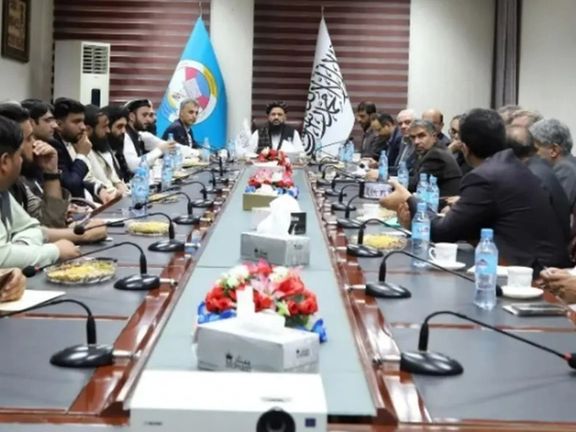
The Taliban's Ministry of Energy and Water has announced that Iranian investors have shown interest in developing water supply and electricity generation projects in Afghanistan.
As per the Taliban-controlled Bakhtar News Agency, the interested investors are affiliated with Mobarakeh Steel Company and its subsidiaries. The news agency, citing the Ministry's media office, detailed that officials from these companies discussed their investment interests during a meeting with Abdul Latif Mansoor, the Taliban's Minister of Energy and Water.
While specific projects were not disclosed, the Taliban's media office conveyed that Mansur welcomed the Iranian investors' interest, highlighting that the investment environment in Afghanistan is currently favourable.
Bakhtar also reported that Abdul Latif Mansur emphasised on the need for "coordination and the swift initiation of practical work" by these investors in the sectors of water supply and electricity generation.
Afghanistan has long been dependent on imported electricity, with the majority of its power currently sourced from Iran and Central Asian countries.

Ramazan Zirak, the former police chief of Qarabagh district in Ghazni province, has informed Afghanistan International that the Taliban officials have once again detained his 15-year-old son.
Zirak revealed that his son had been arrested last week and had been "severely tortured" while in Taliban custody.
In an interview with Afghanistan International's Pashto service, Zirak stated that his younger son, Abdul Aziz, had been imprisoned multiple times previously, but was released through the intervention of local tribal elders.
The former police chief claims that the Taliban officials are pressuring his son to hand over weapons and a vehicle allegedly belonging to him.
Zirak emphasised that he does not possess any weapons and was forced to flee the country following the Taliban's return to power.
Having fought against the Taliban during the previous government, Zirak asserted that the group's claims of a general amnesty are false and that its members are disregarding this declaration.
The Taliban officials have not yet responded to Zirak's allegations.
Abdul Salam Zaeef, the former Taliban ambassador to Pakistan, has labelled the three American citizens currently held by the Taliban as "spies."
Zaeef, who was once imprisoned at Guantanamo Bay, criticised the United States, accusing it of detaining "innocent people in its brutal prisons without trial for decades."
In response to recent comments made by Thomas West, the U.S. Special Representative for Afghanistan, Zaeef posted on the social media platform X on Sunday, stating, "Those who are concerned about their three imprisoned spies should know that they are not humanitarians but rather the greatest criminals in the history of mankind."
Previously, West had stressed the importance of securing the release of the three Americans detained by the Taliban, asserting that they had been "unjustly" imprisoned and that the U.S. is actively working towards their release.
Zaeef served as the Taliban's ambassador to Pakistan during the latter years of the group’s first regime until its collapse. Following the U.S. invasion of Afghanistan in late 2001, Zaeef was captured and transferred to Guantanamo Bay. He was released in the autumn of 2005 and subsequently returned to Afghanistan, where he settled in Kabul. A prominent Taliban figure, Zaeef documented his experiences in Guantanamo in a memoir titled My Life with the Taliban.
Reports indicate that the Taliban arrested three American citizens—Ryan Corbett, George Glazman, and Afghan-American Mahmood Habibi—in separate incidents in 2022.
On 4 July, Zabihullah Mujahid, the Taliban’s spokesperson, announced that discussions regarding a potential prisoner exchange had occurred during a meeting with U.S. representatives in Doha. Mujahid stated that the Taliban would release the American citizens in exchange for the release of their fighters from Guantanamo Bay. He further emphasised that the U.S. must comply with the Taliban's conditions to secure the release of its citizens.
Local sources in Kunar and Nangarhar provinces have reported to Afghanistan International that unidentified fighter jets were observed flying over these regions late on Saturday.
Earlier, the Taliban's police command in Nangarhar announced that it had detonated explosive materials in the Mohmand Dara district of the province.
The origin of the fighter jets remains unclear. Some sources indicated that the jets flew towards Kunar after conducting bombings in the Mohmand Dara district of Nangarhar. Afghanistan International has not yet been able to independently verify the occurrence of an airstrike in Nangarhar.
A few hours prior, the Taliban's police in Nangarhar stated that explosive devices, which had been planted by their fighters during previous conflicts with the former government's security forces, were detonated in the Mohmand Dara district.
Images released by the Taliban from the scene show flames and thick smoke rising in a residential area.
Last year, Pakistan's air force carried out strikes on targets in the Khost and Paktika provinces. A Taliban spokesperson confirmed that six people, including three women and three children, were killed in these Pakistani airstrikes. Pakistan asserted that it was targeting militants from Tehreek-e-Taliban Pakistan (TTP).
In a recent development, Pakistan's Defence Minister issued a warning last month that as part of the military operation "Zarb-e-Azm" against militants, Pakistan may conduct strikes on targets within Afghanistan in the future.
Over the past three years, U.S. drones have also regularly conducted surveillance in various parts of Afghanistan.
Following attacks by Treek-e-Taliban Pakistan on Pakistani military and security bases, Islamabad has threatened to use all available measures to suppress its adversaries. The Pakistani military has accused the Afghan Taliban of harbouring TTP militants, particularly the faction led by Hafiz Gul Bahadur, a senior TTP commander, in eastern Afghanistan. However, the Taliban have denied these accusations, stating that Afghan territory poses no threat to neighbouring countries or the region.
Sources within the Taliban have disclosed that Mullah Hibatullah, the group’s leader, has dismissed Mohammad Bara, the director of the Taliban's intelligence agency in Nangarhar province, due to significant financial corruption.
On Saturday, sources informed Afghanistan International that an aide to Mohammad Bara had embezzled 30 million Afghanis. The sources indicated that Shahin, a close associate of Bara, was arrested on charges of embezzling this amount.
During interrogations, Shahin reportedly confessed that he had collected the bribe under the orders of Mohammad Bara. After the corruption was exposed, Bara’s case was transferred to Kandahar, where Mullah Hibatullah subsequently ordered his removal from the intelligence directorate in Nangarhar province.
The Taliban have not officially announced the dismissal of this local official.
Mohammad Bara had previously lost two brothers in the conflict against the former Afghan security forces and spent five years in Bagram prison. Sources also alleged that during his tenure in Nangarhar, Bara was involved in the deaths of two prisoners who succumbed to severe torture during interrogations. These prisoners had been detained on charges of membership in ISIS.
The sources further revealed that Bara, who once led a modest life, became considerably wealthy after obtaining official positions in Kapisa and Nangarhar. He reportedly had three wives and recently married a 15-year-old girl.
The former Taliban intelligence chief in Nangarhar is said to have built a luxurious house in Logar and lived an opulent lifestyle in Kabul.
Dismissal of Another Intelligence Official
Additionally, a source reported that Abdul Basir, known as Mashal Afghan, who served as a representative of the Taliban's intelligence agency at the group’s Supreme Court, has also been dismissed over financial corruption allegations.
Although an investigation "proven" the corruption charges against Abdul Basir, he has not been arrested. The source claimed that he had acquired a house in Turkey as a result of his corrupt activities. Prior to the fall of the former government, Mashal Afghan was a member of the Taliban's media office in Qatar.
Since taking control of Afghanistan, the Taliban had pledged to combat administrative and financial corruption. The group’s leaders have repeatedly urged their members to avoid luxurious lifestyles and financial misconduct.
Nevertheless, many Taliban members at various levels are reported to be leading lavish lives. In addition to seizing private properties of former government officials, they have purchased expensive homes and vehicles, living in luxury. Some Taliban members have also ventured into business using their government authority.
Over the past three years, there have been numerous reports of financial corruption among Taliban officials, with citizens increasingly concerned about the rise in corruption and the spread of a culture of bribery within Taliban-controlled institutions.
Michael Semple, a former Deputy Special Envoy of the European Union for Afghanistan, has claimed that Taliban leaders are "materialistic" and have sought second and third marriages since coming to power.
Semple asserted that the Taliban, after their return to power in Afghanistan, have not only failed to reform but have also become increasingly corrupt. In the interview conducted on Saturday, 10 August, with Afghanistan International, he highlighted the group’s monopolistic tendencies, corruption, and lack of internal cohesion.
Discussing the similarities and differences between the Taliban's first and second regimes, Semple noted that the group has not changed significantly, particularly in terms of its political and cultural policies. He explained that the concentration of power, which was evident during the leadership of Mullah Omar, the Taliban’s first leader, continues under the current leader, Mullah Hibatullah.
According to Semple, the practice of "obedience to the Amir" was prevalent during the first Taliban regime and remains in place today, with Hibatullah wielding absolute authority. He observed that the only significant difference between the two periods is the age of the Taliban leaders. "The first Taliban regime was led by young men, but now, 20 years later, power is in the hands of 'grey-bearded' elders," Semple remarked.
Semple believes that over the past two decades, the Taliban have not reformed but have instead become more corrupt. Commenting on the group’s internal unity, he said that the Taliban try hard to present themselves as united, but looking at the group closely, a very different picture emerges.
He further alleged, "Since coming to power, Taliban leaders have taken second and third wives, seized land, acquired multiple luxurious homes, engaged in salary-related corruption, and extorted money."
Semple also questioned the Taliban's claims of religious legitimacy, stating that no one believes that the current regime is based on Islamic principles and Sharia.