Woman Flogged in Kabul for Alleged Extramarital Affairs

The Taliban's Supreme Court announced that a woman was flogged in Kabul on Wednesday on charges of having an extramarital affair.

The Taliban's Supreme Court announced that a woman was flogged in Kabul on Wednesday on charges of having an extramarital affair.
The court said in a statement that the woman was sentenced to two years in prison and 35 lashes.
The Taliban court did not give any details about the woman's identity or how the flogging sentence was carried out.
The Taliban’s statement said that the woman's sentence was carried out after approval by the Supreme Court and the group's primary court in the fourth district of Kabul city.
The Taliban recently publicly flogged a man in Mazar-e-Sharif for allegedly "selling alcohol and psychotropic pills".
Corporal punishment, stoning, and the death penalty resumed in Afghanistan after the Taliban's return to power in August 2021.
The international community and human rights defenders have repeatedly called for an end to the Taliban's corporal punishment of defendants, but the group has continued to implement "Islamic law" at will.
The United Nations has repeatedly stated that the Taliban violates the laws and human dignity by flogging Afghan citizens.
Heshmatollah Soleimani, Deputy Director of Tehran Management and Planning Organisation, announced that there are officially 2.4 million "foreign nationals" in this province.
Soleimani added, "The number of illegal immigrants in Tehran is about 2.8 million.”
The Iranian official stressed, during a press conference on Tuesday (August 21), that these figures "definitely necessitate policy-making and taking necessary decisions regarding the presence of nationals in the province,” ISNA news agency reported.
He did not specify which countries these foreign nationals belong to.
According to the statistics of the Khorasan Razavi Nationals Office, Tehran has the highest number of foreign immigrants.
The Ministry of Interior of the Islamic Republic of Iran has said that about five million Afghans live in Iran. So far, no international organisation has confirmed the statistics of the Islamic Republic of Iran regarding the presence of foreign nationals in Iran.

Norway-based Iran Human Rights reported that the Islamic Republic has executed 85 political prisoners, including eight Afghan citizens, in various prisons over the past 20 days.
On Tuesday, August 21, the human rights organisation presented the statistics of those executed, calling on people to join the "No Executions Tuesdays" campaign and protest against the execution by the Islamic Republic.
The findings of Iran Human Rights researchers show that since the beginning of August, the Islamic Republic has "hanged" these prisoners in Ghezel Hesar, Karaj Central Prison, Yasuj, Minab, Zahedan, Mashhad, Gorgan, Kerman, Bam, and Rafsanjan prisons.
Mahmood Amiry-Moghaddam, the organisation's director, said that the Islamic Republic is the world's largest executioner per capita. "We call on people and civil society organisations opposed to the death penalty around the world to support the brave activists by showing solidarity to the “No Death Penalty Tuesday” strikes,” he stated.
The human rights organisation has not commented on the crimes of the executed prisoners.
Earlier, the Hengaw Human Rights Organisation announced the execution of eight prisoners, including two Afghan prisoners, in Yazd and Shiraz Central Prisons.
Recently, Iran Human Rights published a report stating that at least 300 people, including 20 Afghans, have been executed in the Islamic Republic's prisons in the first seven months of this year.
Officials of the Islamic Republic of Iran and the Taliban have not yet commented on the execution of Afghan citizens and their charges in Iran.

The Taliban announced that Amir Khan Muttaqi, the group's foreign minister, traveled to Herat to meet Turkmenistan's foreign minister.
The press office of the Taliban governor in Herat said that Turkmenistan's foreign minister Raşit Meredow will travel to Herat and hold talks with Amir Khan Muttaqi regarding the TAPI project.
Earlier, the Taliban's Foreign Ministry quoted Murat Amanov, director of Turkmenistan's TAPI Project, as saying that the practical work of the TAPI project will begin soon in Afghanistan.
The Taliban have repeatedly called for the start of the TAPI project over the past three years.
The TAPI project starts in western Turkmenistan and continues through Herat and Kandahar in Afghanistan to Quetta and Multan in Pakistan, and then reaches western India.
The project was inaugurated in December 2015 in Ashgabat, the capital of Turkmenistan, by the former leaders of Afghanistan, Pakistan, India and Turkmenistan.
The 1,800-kilometre project worth $10 billion was expected to be completed in 2019, but due to insurgency in Afghanistan, it has so far remained only on paper.

Nineteen female Afghan students arrived in Edinburgh, the capital of Scotland, to continue their medical studies with the help of the Linda Norgrove Charitable Foundation.
These students had been deprived of the chance to continue their education in Afghanistan after the Taliban’s return to power in August 2021.
The Linda Norgrove Charitable Foundation wrote in a statement that the students were transferred to the UK from Kabul, Maidan Wardak, Daikundi and Bamiyan provinces via Pakistan.
The foundation said that it had moved the girls to Scotland after three years of work.
Zahra Hussaini, 19, who completed her first year of medical school after the Taliban’s return to power, said that she hopes her home will be safe until she returns to Afghanistan.
The Linda Norgrove Charitable Foundation was established by the parents of an aid worker named Linda Norgrove, who was kidnapped and then killed in Kunar province in 2010, to help Afghan girls.
The Taliban have closed girls' schools above the sixth grade and have banned girls from going to university.

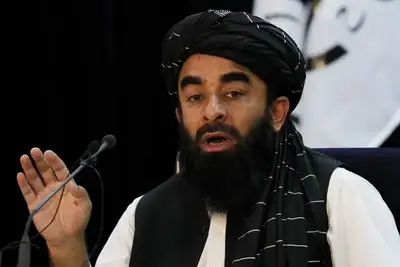
Zabihullah Mujahid, the Taliban spokesperson, criticised Richard Bennett, the United Nations Special Rapporteur on Human Rights for Afghanistan, for his reports on severe human rights violations in the country.
Mujahid stated that Bennett is no longer allowed to enter Afghanistan.
Mujahid accused Bennett of spreading "propaganda" against the Taliban and claimed that he exaggerated minor issues and provided incorrect information to other organisations.
He added, "Bennett has been banned from coming to Afghanistan. He was assigned to spread propaganda against Afghanistan. He is not someone we believe in."
In several of his reports to the UN Human Rights Council, Bennett has accused the Taliban of widespread human rights abuses in Afghanistan, including violence against women, civil society members, the media, former military personnel, and ethnic and religious minorities.
In his most recent report, Bennett described the violations of women's rights as "gender apartheid," citing human rights activists. He also called for the prosecution of Taliban officials involved in human rights violations at the International Criminal Court in The Hague.
This week, the Taliban spokesperson, in an interview with Deutsche Welle, accused international organisations, including UNAMA, of engaging in "propaganda against Afghanistan”. He claimed that these organisations overlook the positive aspects of the Taliban regime and only report on its weaknesses, alleging that they have been "hired for propaganda”.
When asked why the Taliban have not fulfilled their initial commitment to include all groups in Afghanistan's political system, Mujahid stated, "Figures who have been tested in the past and faced public hatred will never return to the regime." He explained that the Taliban are avoiding "public hatred" by excluding politicians and officials of the previous government from their regime.
Mujahid also argued that the cabinet of any government is inherently political, saying that in the West, the winning party takes all leadership positions in the government. He rejected elections and the idea of the people choosing the country's leader, asserting that the Taliban are deserving of leading Afghanistan and representing its people. He stated, "Those who fought and sacrificed for 20 years are better suited to manage the ideals of jihad and the struggle of the Afghan people."
In Western countries, elections allow different parties to govern for a period, with new political figures assuming leadership roles when a new government comes to power. However, the Taliban have rejected elections, effectively ruling out any possibility of a change in government.
Afghan political groups in exile since the fall of the previous government have warned against the Taliban's monopolisation of power. Despite this, the Taliban have dismissed these groups' requests, as well as calls from powerful foreign countries, to form an inclusive government.
