Taliban Publicly Flogs 2 Individuals in Ghazni Province
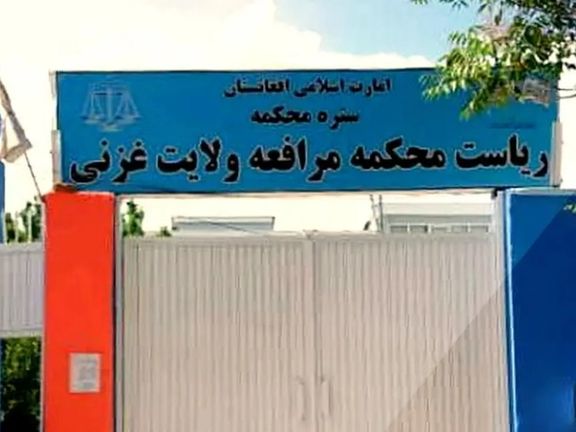
The Taliban's Supreme Court announced that two individuals were publicly flogged in Ghazni province on charges of theft.
The Taliban's Supreme Court announced that two individuals were publicly flogged in Ghazni province on charges of theft.
The court stated that the individuals received 35 and 39 lashes, with one of them sentenced to two years in prison and the other to three years.
On Wednesday, the Taliban's Supreme Court said in a statement that the group’s court in the Deh Yak district of Ghazni had punished these individuals in public.
The group did not disclose the identities of these individuals.
Over the past week, the Taliban have flogged nearly 20 people in Kabul, Zabul, Helmand, and Khost provinces on various charges.
Since their return to power, the Taliban government has resumed corporal punishments. Despite widespread international criticism, the group has continued to enforce these penalties.

The leader of the National Resistance Front (NRF) Ahmad Massoud has urged policymakers in Washington to heed the recommendations of the Hudson Institute, which has called for support for the NRF.
Massoud stated that the Taliban are exploiting the world's fatigue regarding Afghanistan to maintain their rule and continue suppressing the people, particularly women.
On Tuesday, the Hudson Institute released a report urging the US government to provide both military and non-military assistance to the NRF. The think tank also suggested that a portion of Afghanistan's frozen central bank assets be allocated to the NRF.
During his speech at the institute, Massoud expressed hope that "policymakers in Washington will welcome the points made in this research”. He criticised the policy of "appeasing the Taliban" and the "unconditional engagement of countries" with the group.
While no government has formally recognised the Taliban, several regional nations have expanded trade and political relations with the group. Western representatives, despite criticising the Taliban's policies towards women, have held meetings with Taliban officials in Qatar.
Massoud emphasised that the past three years have shattered the illusion of a "more pragmatic and moderate Taliban," asserting that "there is no reformed or good Taliban”. He added that this period has demonstrated the group remains as fanatic and oppressive as before.
Massoud presented the NRF as an alternative to the Taliban, advocating for the creation of a "democratic and pluralistic government" in Afghanistan. He also highlighted that the group is actively fighting terrorism, noting that dozens of terrorist organisations are operating in Afghanistan.
He pointed to militant attacks in Pakistan and warned that Taliban rule is destabilising the region.
Massoud cited "dozens of successful operations" carried out by the NRF against the Taliban, stating that the Front's goal is to "inspire hope among the people and prevent the normalisation of Afghanistan's current situation”.
The Hudson Institute's recent report examines the current conditions in Afghanistan under Taliban rule and states that the NRF is the only group engaged in armed resistance against the Taliban. The report also criticises the Biden administration's policy towards the NRF as lacking a strategic vision, adding that whether American policymakers accept it or not, Afghanistan will remain a crucial part of US foreign policy.
The report further recalls that in the 1990s, the US recognised the United Front, led by Ahmad Shah Massoud, and suggests that it could now also recognise the NRF as an opposition force to the Taliban regime.
Mohsin Naqvi, Pakistan's Interior Minister, said that the government possesses undeniable evidence of foreign involvement in the recent attacks in Balochistan.
Naqvi stated that the Tehreek-e-Taliban Pakistan (TTP) is involved in terrorist activities within the country and operates from Afghanistan.
He mentioned that evidence showing the TTP’s use of Afghan territory has been presented to the Taliban.
The Pakistani Interior Minister added that members of the Pakistani Taliban who were previously released from prison are also involved in terrorist activities within the country. He said that various forces and elements are working to destabilise Balochistan.
Naqvi labelled those who sympathise with "terrorists" or support terrorist actions inside or outside Pakistan as terrorists themselves, warning that the government will address them with an "iron hand”.
In recent coordinated attacks by Baloch separatists in Balochistan and retaliatory military actions, at least 73 people were killed.
In what has been described as the most extensive attacks by Baloch separatists in recent years, police stations, railway lines, and vehicles on highways in Balochistan were attacked on Sunday night.
The Pakistani military reported that 14 security personnel and 21 militants were killed in the clashes following these attacks.
Sibghatullah Mawlawizada of Herat Darul Uloom has stated that the recent remarks by Taliban's Minister of Higher Education regarding the prohibition of girls' education reflect his personal opinion.
Mawlawizada added that religious scholars in Afghanistan and the Islamic world oppose this opinion. This prominent cleric, while emphasising on the importance of education for girls, challenged Neda Mohammad Nadeem to a scholarly debate.
On Monday, August 26, Mawlawizada, a well-known cleric, said in a video that the Taliban’s Minister of Higher Education has even prohibited raising questions about girls' education.
With the Taliban flag by his side, Mawlawizada praised the Taliban's return to power in Afghanistan. He stressed on the importance of education for both men and women, urging the Taliban to provide educational opportunities for all in accordance with Islamic law.
He added that since the Taliban’s Minister of Higher Education has invited scholars to share their religious opinions on girls' education in modern sciences, he welcomes this invitation and calls on Nadeem to engage in a public discussion about girls' education.
On Sunday, the Taliban’s Minister of Higher Education, during a briefing on the ministry's activities, stated that those without religious authority should not act as religious scholars on the issue of women's education.
Nadeem warned reporters that just as women’s education is currently suspended, questioning it is also "suspended until further notice”.
The Taliban's Minister of Higher Education also asked religious scholars to prove, based on Hanafi jurisprudence, that women's education is permissible, claiming that if it can be proven, the issue will be resolved. He added that the group’s stance and policies on women’s education do not contradict "Islamic principles and Afghan traditions”.
The Taliban closed girls' schools above sixth grade and banned girls from attending university.
Sources have informed Afghanistan International of two confirmed cases of Mpox in Afghanistan.
According to these sources, the individuals infected with Mpox are two children, one from Paktia and the other from the Farza district of Kabul, and they are currently being treated at the Child Health Hospital.
Taliban officials have not yet commented on the reported cases of Mpox in Afghanistan.
This marks the first time that two cases of Mpox has been reported in Afghanistan.
Afghanistan International has also received images of the two children, showing them in hospital beds with small pox-like lesions visible on various parts of their bodies.
Mpox is a deadly disease that has been spreading in the Republic of Congo since last year. The government of Congo reported that 27,000 people have been infected, and 1,100 have lost their lives due to the disease.
Doctors describe Mpox as a viral disease that can be transmitted from animals to humans and also from human to human through sexual contact or close physical proximity. High fever, muscle aches, and large pox-like skin lesions are known symptoms of this disease.
Officials from the World Health Organisation have stated that Mpox is not similar to COVID-19.
The Taliban’s Supreme Court announced that three individuals were publicly flogged in Helmand on charges of theft and fraud.
The court stated that the accused received 30 to 39 lashes and were sentenced to prison terms ranging from eight months to two years.
On Tuesday, August 27, the Taliban’s Supreme Court said in a press release that the Babaji court of the group in Helmand province publicly flogged the accused in the presence of local judicial officials, scholars, and the public.
The court did not provide details about the identities of the accused.
Earlier, on Monday, the Taliban’s Supreme Court announced that 12 people were publicly flogged in Zabul province on various charges.