Taliban Report Installation of Nearly 1,000 Security Cameras in Parwan Province

Taliban officials in Parwan have announced that around one thousand security cameras have been installed in the province.

Taliban officials in Parwan have announced that around one thousand security cameras have been installed in the province.
On Saturday, Radio Television Afghanistan (RTA), under Taliban control, reported that these cameras have been placed in important and busy areas.
Earlier, the Taliban's Ministry of Interior had stated that the security cameras would be connected to the control room of the Taliban police command in Parwan.
This move comes amid occasional attacks on Taliban forces in Parwan province.
The National Resistance Front and the Afghanistan Freedom Front have claimed responsibility for these armed attacks.
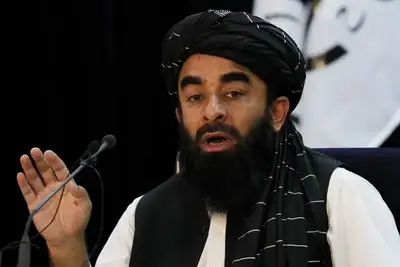

The Taliban's Ministry of Defence denied having discussions with Russian officials regarding the purchase of equipment for the country's air defence systems.
Enayatullah Khwarizmi, Taliban’s spokesperson for the Ministry of Defence, stated that comments made by a Taliban defence official about purchasing Russian anti-aircraft equipment had been "distorted”.
Previously, a Taliban official had mentioned the group's intention to acquire Russian air defence systems.
Abdul Basir Saberi, head of the logistics department of the Taliban's Ministry of Defence, had said that the group needs Russian air defence systems.
He had emphasised that whenever conditions allow, the Taliban would purchase Russian-made equipment.
Following this news, Khwarizmi, the spokesperson for the Taliban's Ministry of Defence, wrote on X social media platform that there have been no talks with Russian officials about purchasing air defence weapons, and that Saberi's comments had been "distorted”.
The Taliban does not control Afghanistan's airspace, and over the past three years, the group's officials have criticised the US for violating Afghan airspace.
The US Department of Defence has stated that the Taliban's inability to control Afghanistan's airspace is the group's own problem.

Amir Khan Muttaqi, the Taliban's Foreign Minister, met with Afnan Al-Shuaiby, Executive Director of the Women's Development Organisation, on the sidelines of the Organisation of Islamic Cooperation (OIC) meeting in Cameroon.
This meeting comes amid the enforcement of a new "Propagation of Virtue and Prevention of Vice" law that criminalises looking at and speaking to "non-mahram" women.
On Friday, August 30, the OIC reported that Muttaqi met with Tarig Ali Bakheet, OIC Secretary-General's Special Envoy for Afghanistan; Koutoub Moustapha Sano, International Islamic Fiqh Academy; and Afnan Al-Shuaiby during the 50th session of the Council of Foreign Ministers.
The OIC stated that during the meeting, discussions focused on girls' education and the participation of Afghan women in public life, in accordance with the organisation's resolutions.
This meeting took place as the new "Propagation of Virtue and Prevention of Vice" law, recently signed by Taliban leader Hibatullah Akhundzada, declared women's voices as “awrah” (intimate par to body) and criminalised looking at or speaking with non-mahram women.
According to this law, even a woman's voice during Quran recitation is considered “awrah”.
The OIC reported that the discussions with Amir Khan Muttaqi covered topics such as tolerance, moderation in Islam, women's education, and participation in public life. However, it was not specified whether the new law was addressed in these talks.

Imran Khan, former Prime Minister of Pakistan, has claimed that during his tenure, the Taliban in Afghanistan was prepared to cooperate in suppressing the Tehreek-e-Taliban Pakistan (TTP).
Khan stated that his government actively engaged with the Taliban regarding cross-border terrorism.
He rejected claims of sheltering "terrorists" during his administration and noted that after the fall of the Afghan government and the Taliban's return to Kabul in August 2021, Pakistan requested the Taliban to eliminate the TTP. He added that the Taliban was ready to cooperate with the Pakistani government.
Khan also acknowledged that General Faiz Hameed, the former head of the ISI, was in contact with the Taliban about suppressing the TTP.
The leader of Pakistan Tehreek-e-Insaf party (PTI) argued that the Pakistani Interior Minister's claims about "terrorists" operating outside Afghanistan suggest that accusations against PTI are unfounded.
He also attributed unrest in Balochistan and attacks in the Kacha region to the Pakistani military.
While Khan discusses the Taliban's cooperation in combating the TTP during his tenure, Taliban spokesperson Zabihullah Mujahid mentioned last week that the group is willing to mediate talks between the Pakistani government and the TTP. Mujahid stated that the Taliban could facilitate negotiations between the two parties.
However, Pakistan's Foreign Ministry spokesperson, Mumtaz Zahra Baloch, dismissed the notion of talks with the TTP and called on the Taliban to extradite TTP members to Pakistan.

On Thursday, Michael McCaul, the Chairman of the House Foreign Affairs Committee criticised the US President and Vice-President for the Taliban’s oppression of Afghan women.
McCaul stated that Joe Biden and Kamala Harris should be held accountable for complicity in the Taliban's abuses.
McCaul noted that during Donald Trump's presidency, the Doha Agreement conditioned the US withdrawal from Afghanistan on the Taliban's adherence to fundamental conditions, including respecting women's rights.
He said that the Biden administration ignored these conditions and chose to leave Afghan women in a vulnerable situation.
In a post on X on Friday, McCaul stated that the Taliban continues to impose some of the harshest restrictions on women globally and that Afghan women deserve better.

The Coordination Council of the Diplomatic and Consular Missions of the Islamic Republic of Afghanistan has warned of the "negative consequences" of altering the current status of these missions.
Earlier, Afghanistan International reported that some European countries are exerting pressure to close Afghan embassies.
On Wednesday, Afghanistan International, citing credible sources, reported that some European countries have discussed a recent letter from the Taliban's Ministry of Foreign Affairs with Afghan ambassadors.
Closing Afghan embassies in Europe was one of the topics of these discussions.
Sources indicate that the Taliban's Ministry of Foreign Affairs sent a letter on July 30 to all countries hat had not yet transferred control of Afghan embassies to the group.
The letter declared that the assignments of the previous government’s ambassadors had concluded, asserting that these individuals no longer represent the Taliban and that their activities no longer carry any legitimacy with the group.
On Thursday, August 29, the Coordination Council of Diplomatic and Consular Missions of the Islamic Republic of Afghanistan issued a statement highlighting their concerns that any changes to the current status of these missions could lead to negative consequences.
They warned that such changes might include the cessation of critical consular services for a large segment of the Afghan diaspora in Europe and beyond.
The council stated that the Taliban's dismissal of the consular services provided by 14 Afghan political and consular missions in European countries, Canada, and Australia as baseless and legally invalid.
This council, which consists of diplomats from the former Afghan government, said that given the Taliban's increasingly aggressive behaviour and disregard for the fundamental rights of citizens and Afghanistan's international obligations, there is an urgent need for increased pressure on the Taliban to change its repressive policies against the people.
The diplomatic missions of the Islamic Republic of Afghanistan warned host countries that any concessions in response to the Taliban's illegitimate demands would have detrimental consequences and would enable the group to further pursue its illegal objectives.
The missions stated that they are ready to cooperate with host countries to find practical solutions to the technical and consular challenges in accordance with accepted international standards and practices.
Earlier, the Taliban's Ministry of Foreign Affairs announced that the consular services of 14 Afghan political and consular missions in European countries, Canada, and Australia are invalid.
In August, the Taliban's Ministry of Foreign Affairs announced its recognised missions in Spain, the Netherlands, Bulgaria, the Czech Republic, and Munich, Germany.
The ministry also urged Afghan citizens residing in Europe to seek consular services from these missions.