Taliban Announce Expulsion Of Nearly 300 Afghan Families From Iran, Pakistan
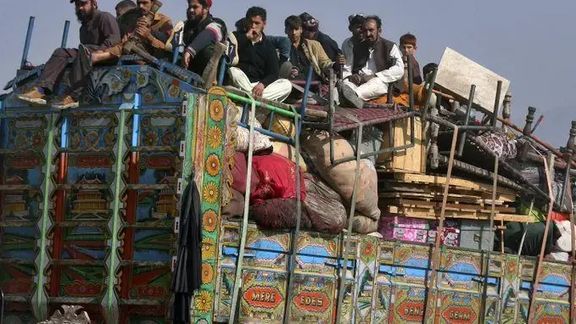
Bakhtar News Agency, the Taliban-controlled state media, reported that 299 Afghan families had returned to Afghanistan from Iran and Pakistan in a single day.
Bakhtar News Agency, the Taliban-controlled state media, reported that 299 Afghan families had returned to Afghanistan from Iran and Pakistan in a single day.
The outlet reported on Thursday, October 3, that 232 families had been deported from Iran and 67 families from Pakistan.
The Taliban-controlled Bakhtar News Agency reported that the families had returned to Afghanistan from the Torkham, Spin Boldak, Pul-e-Abrisham and Islam Qala crossings.
This comes as the deportation of Afghan refugees from Pakistan and Iran has increased sharply in recent months. Many Afghan immigrants complain about the harsh living conditions and deportation process in these two countries.

Russian Deputy Foreign Minister Andrey Rudenko announced that the Taliban's request to participate in the BRICS summit has not yet been approved.
Rudenko said that the BRICS countries have not yet reached a consensus for the presence of a Taliban representative in the meeting.
Russian state news agency TASS reported on Thursday (October 3) that Andrei Rondko had said that the invitation to the guests would be done with the consensus of the BRICS countries.
Declaring that there is still no agreement on the Taliban's participation, he added that nothing can be ruled out.
The BRICS summit is scheduled to be held from October 22 to 24 in the Russian city of Kazan.
A few days ago, Russia's state-run RIA Novosti news agency reported that the Taliban had sent a letter to Russian President Vladimir Putin's aide Yuri Ushakov asking him to attend the BRICS leaders' meeting. The letter states that Abdul Ghani Baradar, the Taliban's deputy prime minister, is interested in attending the BRICS meeting in the city of Kazan.
The main members of the BRICS group include Brazil, Russia, India, China, and South Africa. The group expanded with the membership of Egypt, Saudi Arabia, the United Arab Emirates, Iran and Ethiopia at the beginning of this year.
On Wednesday, September 25, Zabihullah Mujahid told the Taliban-controlled National Radio and Television of Afghanistan that powerful countries in the field of economy are members of the BRICS, and that is why Taliban representatives want to participate in the upcoming meeting. He added that the move could provide more opportunities for Afghanistan.
The Taliban is still considered a terrorist group in Russia. However, Moscow has diplomatic relations with the Taliban, and Amir Khan Muttaqi, the Taliban's foreign minister, is currently in Moscow to attend a meeting on Afghanistan. The Moscow format meeting on Afghanistan will be held on October 4.
Amnesty International has called the arrest of Jawed Kohistani, a political analyst and Hekmat Aryan, the head of a local radio station in Ghazni, a relentless crackdown on freedom of expression by the Taliban.
The group said that the Taliban had illegally detained Kohistani and Arian and they should be released immediately.
Amnesty International wrote on its official page on the X social media network on Thursday, that the Taliban's retaliatory measures violate Afghanistan's obligations under international human rights law.
On the other hand, the Afghanistan Journalists Support Organisation said in a statement that journalists and media workers in Afghanistan face serious threats and dangers compared to other parts of the world. The organisation stressed that journalists in Afghanistan are under pressure, censorship, torture and threats from the Taliban.
Earlier, the Afghanistan Journalists Centre announced that Hekmat Aryan was arrested by the Taliban intelligence agency from his office in Ghazni city on Sunday, September 29.
"Aryan has been accused of speaking in an audio tape about the Taliban's suicide operations in past wars and broadcasting them on the radio," the Afghanistan Journalists Centre said in a statement on Wednesday.
However, the Journalists Support Organisation says that journalists in Afghanistan currently do not have the right to work independence, freedom of expression, economic support, and the necessary facilities to inform the public. The organisation called on international institutions and human rights organisations to prevent the Taliban's mistreatment of journalists.
Karen Decker, chargé d'affaires at the US Embassy for Afghanistan, said that the United States is committed to supporting Afghan women and girls and promoting human rights.
Washington has said that with the end of the term of the US special representative for Afghanistan, Thomas West, Karen Decker and US envoy for women and human rights, Rina Amiri, will carry out his duties.
On Thursday, Decker announced that she looks forward to continuing to work with Mark Pommersheim and continue West's effective work to protect US interests.
Earlier, Antony Blinken, the US Secretary of State announced that West would step down as the US special representative for Afghanistan and would be appointed as the acting head of the State Department's Sanctions Coordination Office.
Blinken did not elaborate on West's successor, but stressed that Afghanistan will continue to be led by Karen Decker, Chargé d'Affaires of the US Embassy for Afghanistan, Rina Amiri, Special Representative for Women, Girls and Human Rights in Afghanistan, and John Mark Pommersheim, former US ambassador to the Republic of Tajikistan.
US Secretary of State praised Thomas West's role over the past four years, stating that he has implemented US policies in Afghanistan well.
The US State Department had previously stressed that "the US commitment to Afghanistan remains an enduring priority".
Abbas Stanikzai, the Taliban's deputy foreign minister, expressed concern regarding the problems in exporting Afghan traders' products and threatened Pakistan that it will close the Central Asian route for Pakistani goods.
Stanikzai said at a meeting in Logar province on Wednesday that they face problems at the borders when Afghanistan's crops come to fruition.
He added that they had discussed this issue and the closure of the routes with fruit and vegetable traders in detail.
Stanikzai asked Pakistan not to close trade routes during the harvest season of fruits and vegetables in Afghanistan so that the products of Afghan traders can reach the people of Pakistan and from there they can be exported to India and other countries. He stressed that closing the route is not in the interest of either side.
"Afghanistan is a transit route between Pakistan and Central Asia. We can also take countermeasures. We can close our borders and create problems for them. But we don't want to cause problems for our Pakistani Muslim brothers."
Earlier, Attaullah Omari, the Taliban's Minister of Agriculture, announced that Afghanistan's fruit exports to neighbouring countries have faced problems. During a meeting with a number of businessmen, he said that the Taliban are negotiating with Pakistan to facilitate the export of fresh Afghan fruits to this country.
The Torkham crossing has been closed several times in the past three years following border clashes between Pakistani forces and the Taliban. Currently, the main road between Peshawar and Torkham has been blocked due to protests by some Pakistani citizens.
Pakistani media have reported that trucks carrying fruit are using alternate routes, which are rough and dirty, on a limited basis.
Amir Khan Muttaqi, the Taliban's foreign minister, headed a delegation of the group to Russia to participate in the sixth Moscow format meeting on Afghanistan.
The Taliban's Foreign Ministry said on Wednesday that Muttaqi would meet Russian Foreign Minister Sergey Lavrov on the sidelines of the meeting.
Zia Ahmad Takal, the Taliban's deputy foreign ministry spokesman, wrote on social media platform X on Wednesday, that the meeting will be held on October 4. He has not announced the composition of this delegation, headed by Amir Khan Muttaqi.
This is the sixth meeting of the Moscow format on Afghanistan. The previous meeting of the Moscow format was held on September 29, 2023, in Kazan.
Russian Ambassador to Kabul Dmitry Zhirnov visited the Taliban's Foreign Ministry in September 2024 and met with Amir Khan Muttaqi and invited representatives of the group to participate in the upcoming meeting of the Moscow Format.
In addition to Russia, representatives of India, Iran, Kazakhstan, China, Kyrgyzstan, Pakistan, Turkmenistan, Uzbekistan and the Taliban will be present.
None of these countries recognise the Taliban, but they do have diplomatic relations with the group.