SCO Meeting Begins Without Taliban Presence
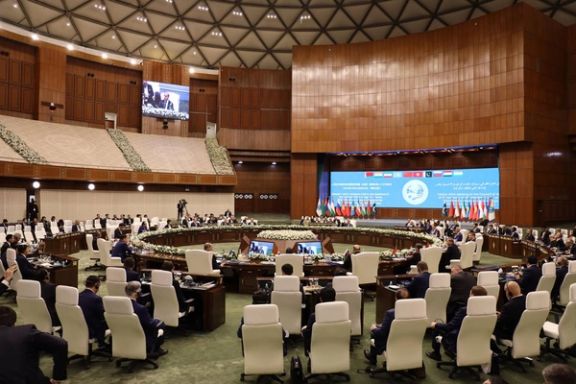
The 23rd meeting of the Council of Heads of State of the Shanghai Cooperation Organisation (SCO) began on Wednesday, October 16, in Islamabad, the capital of Pakistan.

The 23rd meeting of the Council of Heads of State of the Shanghai Cooperation Organisation (SCO) began on Wednesday, October 16, in Islamabad, the capital of Pakistan.
Although Afghanistan is an observer member of the Shanghai Cooperation Organisation, the Taliban has not been invited to the meetings of this regional organisation.
Afghanistan joined the SCO as an observer member on June 7, 2012, but the Taliban has not been invited to its meetings for the past three years.
In his welcome speech to the participants of the Shanghai Cooperation Organisation (SCO) meeting, Pakistani Prime Minister Shehbaz Sharif emphasised on peace and stability in the region.
At the same time, he said, "The participation of representatives of all SCO members in this meeting is a sign of the strength of relations and cooperation between the countries."
Shehbaz Sharif said, "Our joint efforts are vital to overcome today's crises, from environmental challenges to terrorism and extremism.”
The Shanghai Cooperation Organisation (SCO), which was formed in 2001 by Russia and China, consists of nine members, including Belarus, Iran, Pakistan, India, Kazakhstan, Kyrgyzstan, Tajikistan, and Uzbekistan.

The former Afghan attorney general has said that the "deliberate killing" of Afghan migrants by Iranian border guards is a "crime against humanity.
Dozens of Afghan migrants trying to enter Iran have been reportedly shot dead by Islamic Republic border guards.
Mohammad Farid Hamidi has asked the United Nations and international human rights organisations to punish the perpetrators of this crime.
Mohammad Farid Hamidi, the former Attorney General of Afghanistan, wrote on social media platform X, "Intentional attack on people despite knowing that they are refugees and that they are defenceless, is an example of a crime against humanity, a serious and inhumane crime."
Earlier, a news agency reported that the border forces of Iran shot at Afghan migrants who were trying to enter Iran in Kolgan Saravan area. According to this news agency, out of about 300 Afghan refugees and asylum seekers, only 60 or 70 people survived and the rest were killed or injured.
Hamidi said that these refugees had taken this dangerous route in the hope of finding a "safe and secure place and escape from life threats" and they deserved protection according to international laws, human ethics and Islamic teachings.
He has criticised the Taliban and said that this group does not have the ability to defend the rights of citizens abroad and does not feel responsible in this matter.
He added, "The United Nations, the United Nations High Commissioner for Refugees, the United Nations Human Rights Council, the International Criminal Court and other relevant institutions must take serious action and punish the perpetrators of the case.”
According to the reports, this event happened on Sunday evening and there are no accurate figures of casualties yet. Some of the eyewitnesses, whose audio file reached Afghanistan International, said that around 300 Afghan migrants were targeted by Iranian military forces and more than 200 people were killed.
Kolgan Saravan region is in Sistan and Baluchistan province of Iran and borders with Panjgur region of Balochistan province of Pakistan. Apparently, the Afghan refugees intended to enter Iran through Pakistan.
Along with human smugglers, Baloch rebels also use this route to travel, and the Panjgur area is one of the areas where Baloch rebels have a large presence.
This is not the first time that Iranian forces shot at Afghan refugees at the border. Earlier, Amnesty International said in a report that Afghan migrants who wanted to go to safe countries through Iran and Turkey were shot dead by Iranian and Turkish border forces.

In a joint statement, the leaders of Pakistan and China asked the Taliban regime in Afghanistan to adopt a "moderate" policy and form an inclusive government.
The Prime Ministers of Pakistan and China also emphasised on the need for an effective and measurable fight against terrorism in Afghanistan.
The Ministry of Foreign Affairs of Pakistan published the joint statement of Shehbaz Sharif and Li Qiang, Prime Ministers of Pakistan and China, on Tuesday.
The Chinese Prime Minister has gone to Islamabad on a four-day visit to participate in the Shanghai Cooperation Organisation meeting.
On Tuesday, in a joint statement, they emphasised on the necessity of preventing the use of Afghan soil against the neighbours.
Pakistan accuses the Taliban of supporting its opposition groups, including the Tehreek-e-Taliban Pakistan. Pakistani authorities say that Tehreek-e-Taliban Pakistan has carried out attacks in this country using the soil of Afghanistan.
Islamabad considers the attack on Chinese citizens in this country also related to Afghanistan. Taliban, in turn, has accused Pakistan of supporting ISIS.
Sharif and Chiang emphasised on the need to strengthen anti-terrorism cooperation at bilateral and multilateral levels and asked the Taliban government to take concrete and verifiable measures to eliminate terrorist groups active in this country.
The prime ministers of Pakistan and China also emphasised on the importance of strengthening communication and coordination on the situation in Afghanistan and called for "coordinated efforts by the international community to encourage the Taliban to establish an inclusive political framework and implement moderate policies.
The two countries agreed to play a constructive role in supporting the sustainable development of Afghanistan and its integration into the international community.
During his visit to Islamabad, the Chinese Prime Minister called Pakistan "China's iron friend" and signed several memorandums of understanding with this country in the fields of transit, trade and security

The Taliban's Supreme Court said that it publicly flogged two men in Khost province on charges of having same-sex relations.
The court said that it had sentenced the individuals to 30 and 35 lashes and sentenced them to one year and one year and six months in prison each.
The Taliban's Supreme Court wrote in a statement on Tuesday (October 15) that the individuals were punished in the presence of officials of the group's local court in Khost, clients, and the general public.
Earlier this morning, the Taliban's Supreme Court announced the punishment of five people, including a woman, in Maidan Wardak province. The court said it had punished each of the men with 25 lashes on charges of "illicit relations" and robbery.
Despite international demands, the Taliban have continued to inflict corporal punishment and torture on defendants in public.
International human rights organisations have complained about the trial process of individuals by Taliban courts, criticising the defendants' lack of access to a lawyer and a fair trial.

Kyrgyz media reported that a Kyrgyz humanitarian group from Kyrgyzstan travelled to Badakhshan to help and treat Afghan Kyrgyz.
These rescuers have helped the Kyrgyz living in Badakhshan with medicines, hygiene supplies and veterinary facilities.
Kyrgyzstan's AKI Press reported on Tuesday, October 15, that the humanitarian group, led by Kyrgyzstan's Deputy Minister of Labour, Social Security and Migration, Darmankul uulu Bakyt travelled to Badakhshan on the orders of Kyrgyzstan's president.
The Kyrgyz humanitarian group, which includes cardiologists, dentists, and obstetricians and gynaecologists, has so far provided medical services to 755 Kyrgyz people in Badakhshan, including 195 women and 180 children, according to the outlet.
The media outlet stated that the Kyrgyz humanitarian delegation spoke with the Taliban governor in Badakhshan about the "economic and infrastructural" problems and the living conditions of the Kyrgyz people in the province.
This humanitarian delegation has also taught the Kyrgyz living in the Pamir of Badakhshan how to use veterinary medicines and diagnose infectious diseases.
The Kyrgyz of Afghanistan live mainly in the Pamir Mountains of Badakhshan. They face many difficulties and do not have adequate access to health and livelihood facilities. The problems of this deprived minority increase sharply in the winter season due to snowfall and lack of transportation roads.

The Taliban's Supreme Court announced that it had flogged five people, including a woman, in Maidan Wardak province.
The Taliban said that they punished each of these individuals with 25 lashes on charges of "illegitimate relations" and robbery.
On Tuesday, October 15, the Taliban's Supreme Court wrote in a statement that two individuals were also sentenced to one month in prison on charges of robbery. The court said that the verdict of the Maidan Wardak court was implemented in the presence of local officials and the general public.
Despite widespread international condemnation, the Taliban has continued to punish defendants in public.
International organisations emphasise that the Taliban's courts do not respect the principles of fair trial and that the defendants do not have access to a lawyer and the principles of fair trial.
