Iran Human Rights Reports Execution of Two Afghans At Qom Central Prison
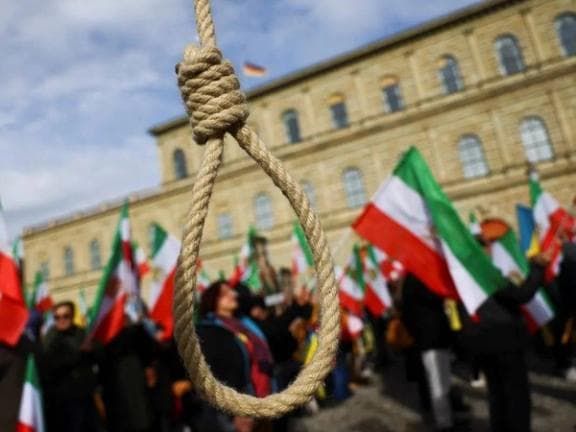
Iran Human Rights announced that five prisoners, including two Afghan nationals, were executed at the Qom Central Prison.
Iran Human Rights announced that five prisoners, including two Afghan nationals, were executed at the Qom Central Prison.
The human rights organisation said on Tuesday that the men had been executed for murder.
The death sentence of an Afghan named Abdul Qadir was carried out on October 10, and another Afghan, whose identity is unknown, was executed by the Islamic Republic on October 16, the Iran Human Rights Organisation wrote in a statement.
The organisation reported that both Afghan citizens were executed on charges of premeditated murder.
The human rights organisation also reported the execution of three other prisoners, Shahin Dehghani, Mohsen Khodabandehlu, and Milad Badinlu, on charges of murder at the Qom Central Prison in October.
The executions of the five men have not been confirmed by Iran's domestic media or official sources in the Islamic Republic.

The Director General of Bureau for the Conservation and Rehabilitation of Wetlands has said that the Taliban government has diverted the main water source of the Hamoun wetland.
Arezou Ashrafizadeh said that this wetland has been drying up due to the diversion of rivers and the construction of dams in Afghanistan.
In an interview with the Iranian Labour News Agency, Ashrafizadeh said that the Taliban government has diverted the course of the Helmand River to the Godzareh depression (a saline wetland) for the past three years and has prevented the water from reaching the Hamoun wetland in their natural course.
The official of Iran's Environment Organisation emphasised that the Taliban is also building the Bakhshabad dam on the Farah River, which will also be bad for the Hamoun wetland.
According to her, the Taliban government has implemented small and large water resources control projects on these rivers.
The official of the Environment Organisation of Iran emphasised that based on international law and customs related to the Hamoun wetland, the water needs of this ecosystem must be met and the natural and historical water supply route should be established.
Ashrafizadeh warned that the consequences of the drying up of the Hamoun wetland will affect countries on both sides of the border, and the dust from the dry bed of the wetland will also disturb the residents and infrastructure of Afghanistan.
Ashrafizadeh said that the organisation has asked the Taliban government and international communities to cooperate in the restoration of the Hamoun wetland.
The United Nations Office for the Coordination of Humanitarian Affairs (OCHA) in Afghanistan said that 83 humanitarian aid projects were temporarily suspended in September this year due to 173 incidents.
The office said that 98 percent of these cases occurred due to the Taliban's interference, and these incidents increased by 66 percent compared to last year.
According to a report released by OCHA on Tuesday, October 22, two facilities in Afghanistan were temporarily closed in September this year, and one project was moved to another location.
Among the incidents, the southern, eastern and western regions of the country suffered the most, respectively, the organisation added.
According to the report, these incidents included interference in humanitarian activities, violence against employees, and restrictions on the movement of institutions, employees, or goods within the country.
The OCHA report shows that during this period, nine humanitarian operations employees were arrested by the Taliban and three establishments were forcibly closed.
"These incidents continuously disrupt the operational environment, where the safety of human workers is at stake," OCHA added.
In September, 73 cases of direct Taliban interference in the implementation of programmes, 35 cases of interference in the recruitment of employees, 19 cases of interference in requesting sensitive information from employees, five cases of influencing the supply of goods, five cases of limiting the participation of female employees, and three cases related to women's clothing were reported.
According to the report, other instances of Taliban interference have also been reported, including illegal tax requests, confiscation of aid, delays in signing documents, and the employment of facilities.
The report shows that after the Taliban's law for the promotion of virtue was signed, the Taliban's Ministry for the Promotion of Virtue has interfered in humanitarian activities in 48 cases.
According to OCHA, these interventions included surveillance visits to offices, staff detentions, segregation of work spaces, requests for sensitive information, and dress requirements for female employees.
Local sources told Afghanistan International that the Taliban members began house-to-house searches in Kabul's Khair Khana on Tuesday.
According to sources, Taliban members have surrounded the area from the 11th district to parts of the 17th district in Sar-e-Kotal Khair Khana and were searching houses.
Local residents said that the Taliban has increased their checkpoints in the 315th Khair Khana crossing, Russ Road and parts of Khair Khana Hill.
Over the past three years, the Taliban has repeatedly searched the homes of Kabul residents, especially in the Khair Khana and northern areas of the city.
Taliban members have not yet officially commented on these searches.
The Taliban has repeatedly searched the homes of Afghan citizens in many provinces. The Taliban had earlier said that they were searching houses to find weapons.
House-to-house searches in Kabul's Khair Khana area comes as the Afghanistan Freedom Front, the group's military and political opposition, recently targeted the Kabul airport in an unprecedented operation.
The Afghanistan Freedom Front said on Sunday evening that it had attacked the military section of the Kabul airport from several directions. The front added that the operation began with the firing of several rockets and caused casualties to the Taliban.
Pakistan's Express Tribune quoted informed sources as saying that Islamabad is avoiding interaction with the Taliban by not nominating a new representative for Afghanistan affairs.
The newspaper wrote that Pakistan is reluctant to expand relations with the TTP due to the Afghan Taliban's support for the TTP.
Pakistan's Express Tribune reported on Tuesday, October 22, that Pakistani authorities have so far shown no interest in nominating a successor after the dismissal of Asif Durrani. The outlet added that Pakistani Foreign Ministry officials believe that they can manage relations with the Afghan Taliban without appointing a diplomat to the post.
The Express Tribune writes that the government's hesitation to appoint new special envoy stems from the ineffectiveness of this role given the minimal diplomatic interaction between Pakistan and the Afghan Taliban.
In early 2023, Pakistan's Foreign Ministry named Asif Durrani as the country's special envoy for Afghanistan. The Pakistani media outlet has clarified that Pakistan's relationship with the Afghan Taliban deteriorated increasingly during Durrani’s tenure.
The Express Tribune quoted analysts of Pakistan-Afghan Taliban relations as saying that Asif Durrani was unable to have any impact on Pakistan-Taliban relations during his tenure. Analysts have said that Asif Durrani had no influence among the Afghan Taliban, as the Taliban's engagement was at its lowest level since he was given the responsibility.
At the height of tensions with the Taliban administration in Kabul, the Pakistani government dismissed Asif Durrani on September 11 this year.
Pakistan has repeatedly accused the Afghan Taliban of harbouring TTP militants and that the militant group is carrying out attacks on Pakistani soil from Afghan soil. This is something that the Taliban has always denied.
Amnesty International said on Monday that the Taliban's crackdown on civil society activists and journalists is a harsh reality in Afghanistan.
The organisation highlighted the recent release of two educational activists, Ahmad Fahim Azimi and Sediqullah Afghan, from Taliban detention, describing it as just one example of the Taliban’s “widespread crackdown” on civil society activists, journalists, and human rights defenders in Afghanistan.
Azimi, a girls' education activist, and Afghan, a rights activist, were released from Taliban custody after months of detention. Azimi and Afghan were transferred to Pul-e-Charkhi prison after being interrogated for 72 days, where, according to their families, they were subjected to torture and ill-treatment.
Amnesty International launched a campaign for the activists' release in February, calling on the Taliban to stop arbitrarily detaining civil society and human rights activists.
In its statement on the plight of Afghan activists, Amnesty International said, "Afghan civil society has been shattered by the Taliban's repression. Journalists, activists and protesters are regularly targeted, and many have been forced to go into hiding or flee abroad."
Amnesty added that activists living in Iran, Pakistan or Turkiye face financial difficulties and risk of deportation to Afghanistan.
"Together, we can protect those who risk everything to defend girls' freedom and the right to education," Amnesty International said, noting the importance of international pressure on the Taliban to support Afghan civil society activists.