Explosion Rocks Cinema Pamir Area In Kabul
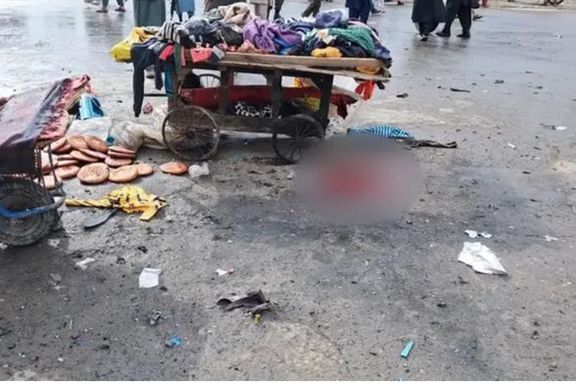
Local sources on Wednesday reported an explosion in the Cinema Pamir area in the centre of Kabul city.
Local sources on Wednesday reported an explosion in the Cinema Pamir area in the centre of Kabul city.
The explosion occurred around 2pm local time. Footage of the incident obtained by Afghanistan International shows that the explosion took place among vendors.
Sources said that the explosion also caused some casualties and that it was caused by a magnetic mine.
Taliban officials have not commented on the incident and no individual or group has claimed responsibility for the blast so far.
Following the explosion, fire-fighting trucks arrived at the scene. Footage shows people fleeing the scene after the explosion.

Nasir Ahmad Faiq, Afghanistan's acting representative to the United Nations, called for decisive and united action by the international community to address the situation in Afghanistan.
Faiq also called on countries to criminalise gender apartheid under international law.
In his speech at the meeting of the Third Committee of the United Nations General Assembly on the Protection and Promotion of Human Rights, Faiq described the situation in Afghanistan as extremely worrying.
The Afghan envoy said that Afghanistan under the control of the Taliban is facing a deep crisis in the fields of human rights, social, economic and politics.
The Afghan diplomat reiterated that the Taliban's institutionalised oppression has led to a catastrophic erosion of the fundamental rights of Afghan citizens, especially women and girls.
Faiq also noted that the Taliban's education system focuses on extremism and the training of new recruits for the Taliban rather than providing real training, which will lead to further instability in Afghanistan and the region.
At the end of his speech, the representative of Afghanistan called for serious action by the international community to protect the rights of women and children and prevent the spread of gender apartheid.
After regaining control of Afghanistan in August 2021, the Taliban imposed a series of sweeping restrictions on Afghan citizens, especially women and girls.
The group currently prohibits girls from going to university and schools above the sixth grade.
The Taliban also recently signed a new law called the Promotion of Virtue and Prevention of Vice, which targets women and girls more than ever.
The international community has condemned the Taliban's strict rules and called for their repeal, but the group has ignored these demands.
During a meeting with Indian Prime Minister Narendra Modi, the Iranian President Masoud Pezeshkian said that the Islamic Republic supports any action that helps to establish peace and bring tranquillity to Afghanistan.
Pezeshkian said, "We should also interact and start a dialogue with Afghanistan. We must help the Afghan people to achieve peace, tranquillity and prosperity by solving their problems."
The leaders of Iran and India discussed the situation in Afghanistan on the sidelines of the BRICS summit in Kazan, Russia, on Tuesday evening (October 22).
In this meeting, the two sides emphasised on the importance of Chabahar port for the development and reconstruction of Afghanistan.
The Indian Prime Minister's Office said that the long-term contract for the Chabahar port is of great importance for the reconstruction and development of Afghanistan and the strengthening of trade and economic ties with Central Asia.
Indian Prime Minister Narendra Modi noted, "The development of Chabahar port is the biggest pillar of our cooperation, and we believe that this development plays an important role in regulating the relations between the two countries as well as the relations between Iran and India with other countries in the region."
In this meeting, the Iranian President said that Afghanistan should be helped to achieve peace and stability.
The Iranian president's office said that Pezeshkian referred to the Indian prime minister's concerns about Afghanistan's issues, saying, "We must build the future of the region with motivation and determination and have dialogue with Afghanistan."
The leaders of the two countries also exchanged views on regional developments, including the situation in West Asia.
Modi expressed deep concern over the escalation of conflicts in the Middle East and once again called for a reduction in tensions. He also stressed on the importance of protecting civilians and the role of diplomacy in resolving conflicts.
As per an examination of Taliban’s institutions on social media by Afghanistan International, it has come to light that the group’s governor in Khost did not publish pictures of his meeting.
However, his deputy has published pictures of his meetings.
Some local journalists in Khost told Afghanistan International that the governor does not allow them to come to his meetings with cameras and videos. However, Mahboob Shah Qanet, the deputy governor, has good relations with journalists and invites them to meetings with cameras.
Neda Mohammad Nadim, the Taliban's Minister of Higher Education banned journalists from taking photos and videos during a meeting at Sheikh Zayed University in Khost province.
The Taliban governor's office in Khost published only pictures of the buildings of Sheikh Zayed University and a jihadi madrassa along with reports of these meetings on social media.
Abdul Qayyum Rouhani, the Taliban's governor in Khost, is a close associate of Taliban leader Mullah Hibatullah. Mehboob Shah Qanet, the deputy governor of Khost, is close to Sirajuddin Haqqani, the Taliban's interior minister.
Earlier, it was reported that the Haqqani network is in favour of publishing photos and images, contrary to Hibatullah's opinion.
According to an investigation by Afghanistan International, pictures of the meetings of Khalid Hanafi, the Taliban's Minister for the Promotion of Virtue, during his last visit to Nangarhar have not been published on the social media pages of the Nangarhar Media Office.
However, on Tuesday, Azizullah Mustafa, the deputy governor of Nangarhar, attended the vaccination campaign meeting and posted pictures of him in several consecutive meetings on social media.
During his visit to Laghman yesterday, Khalid Hanafi did not allow journalists to attend the meeting with cameras, and the pictures of the meeting were not published on the social media pages of Laghman province.
However, images of several visits to Laghman by Taliban governor Sheikh Sher Ahmad Haqqani have been published by the Laghman Provincial Media and Communications Office.
The Taliban's new law banning the use of images of individuals in the media has sparked discontent among sections of the Taliban.
A source close to the Taliban told Afghanistan International that individuals linked to the Haqqani network, which controls many propaganda centres, oppose the new restrictions on the media, seeing the move as an attempt to isolate the group.
Abdullah Khanjani, the head of political affairs of the National Resistance Front (NRF) has claimed that the Taliban's casualties in the first six months of this year have doubled as compared to the same period last year.
In an interview with Afghanistan International, Khanjani said that the operations of this front have increased by 25% during this period.
However, he declined to provide exact figures regarding Taliban’s casualties. So far, no independent source has confirmed this claim of the official of the National Resistance Front.
In recent weeks, two major anti-Taliban groups have said that they have attacked Taliban bases and outposts in the cities of Kabul, Herat, and Ghor. The National Resistance Front and Afghanistan Freedom Front have said in their statements that Taliban forces have been killed and wounded in their attacks.
In the most recent case, the Afghanistan Freedom Front announced this week that it had carried out a rocket attack on the Kabul airport. The unprecedented attack prompted the Taliban to once again launch house-to-house searches in Khair Khana area in Kabul.
Taliban officials have not yet commented on the increase in attacks by opposition groups.
In September, the United Nations announced in a report that in the first three months of this year, anti-Taliban fronts, including the NRF and the Afghanistan Freedom Front, carried out 73 attacks against the Taliban.
The report stated that between May 14 and July 31, 2,127 security incidents were recorded in Afghanistan, an increase of 53 percent as compared to the same period last year.
Also, 80 cases of armed conflict were recorded in Afghanistan during this period, compared to 37 cases at the same time last year.
The full interview with Abdullah Khanjani, the political head of the National Resistance Front, will be broadcast on Afghanistan International TV on Wednesday evening, October 23.
With the Taliban's efforts to prevent the broadcast of images of living creatures in the visual media, the group's Ministry of Defence announced the launch of operations of "Sada-e-Khalid" radio.
The Taliban's Ministry of Defence said that the radio station has started broadcasting from the 201st Corps.
According to a statement from the Taliban's Ministry of Defence, the radio will be broadcast live every day at a specific time.
The Taliban's Ministry of Defence said that this radio station will transmit Islamic and religious rules.
The radio station was launched after reliable sources told Afghanistan International that the Taliban was planning to stop broadcasting on Afghanistan's national television.
According to sources, Yousuf Ahmadi, the head of the Taliban-controlled National Television, said during a meeting with the directors of this channel that the suspension of the broadcast of this channel is the decision of the Taliban leader.
Previously, the Taliban had stopped broadcasting on national television in Kandahar and Takhar.
National television is a state-owned media outlet. Over the past three years, the Taliban has suspended many of the cultural and social programmes of this media outlet and dismissed the female employees of this channel.
The Taliban's controversial Law on the Promotion of Virtue and Prevention of Vice prohibits the publication and distribution of live images by media outlets.
According to information obtained by Afghanistan International, the Taliban is launching several new radio stations that will defend the group's policies and broadcast its religious views.
Sources say that "Radio Batman-e-Shamal" with its equipment will be renamed "Radio Hurriyat" and its broadcasts will be managed by the Taliban's intelligence. The Taliban is also planning to set up a radio station for their Interior Ministry.